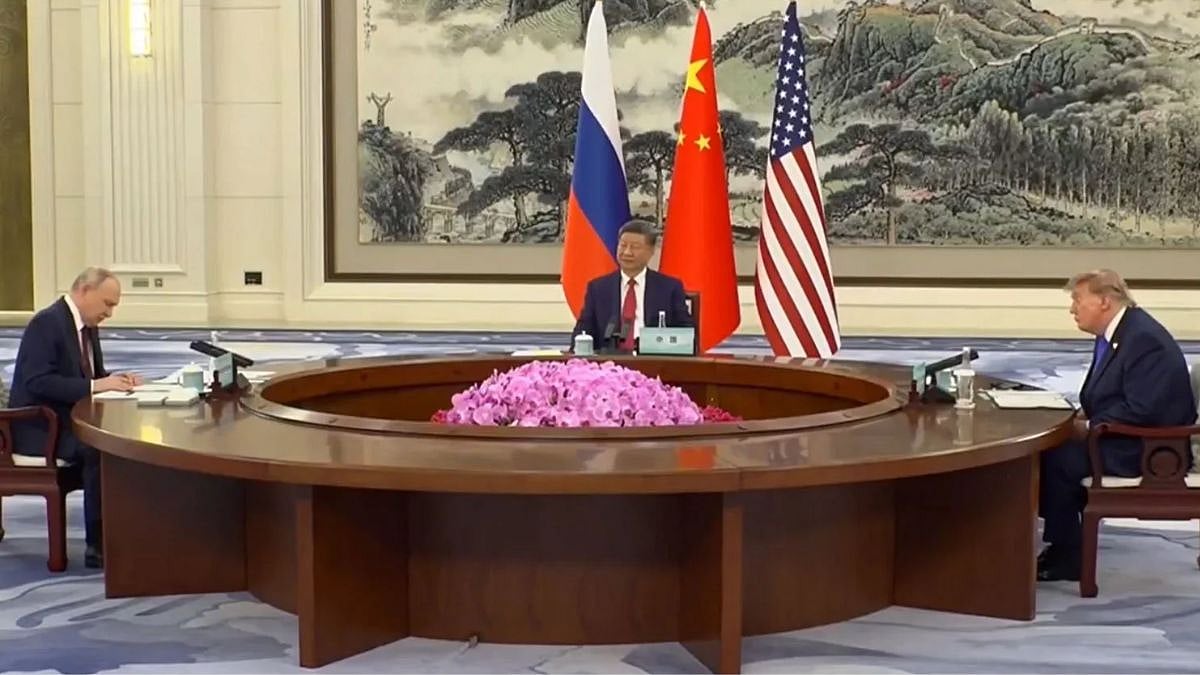
Global attention turned to Shenzhen this week as U.S. President Donald Trump, Russian President Vladimir Putin, and Chinese President Xi Jinping convened in the southern Chinese tech hub for an unprecedented tripartite summit. Held on the sidelines of the APEC summit, the summit meeting prompted much discussion of whether it was a Yalta 2.0 and whether it would lead to a redrawing of the international order, as the famed 1945 summit meeting had done.
Also Watch:
President Trump made it clear in his speech that the Shenzhen summit was “making history.” Having just come from Manila, where he had attended the Quad summit meeting, the US president made it clear that the presidents of the three largest countries had a responsibility to maintain “open, respectful and productive dialogue on issues impacting not just our people but the entire planet.”
Trump’s language was echoed by President Xi, who said that the three countries must set a “worthy example” to uphold “peace and stability throughout the planet” – a sentiment echoed by President Putin – showing that, as far as the leaders were concerned, the rules of global order would be decided by them.
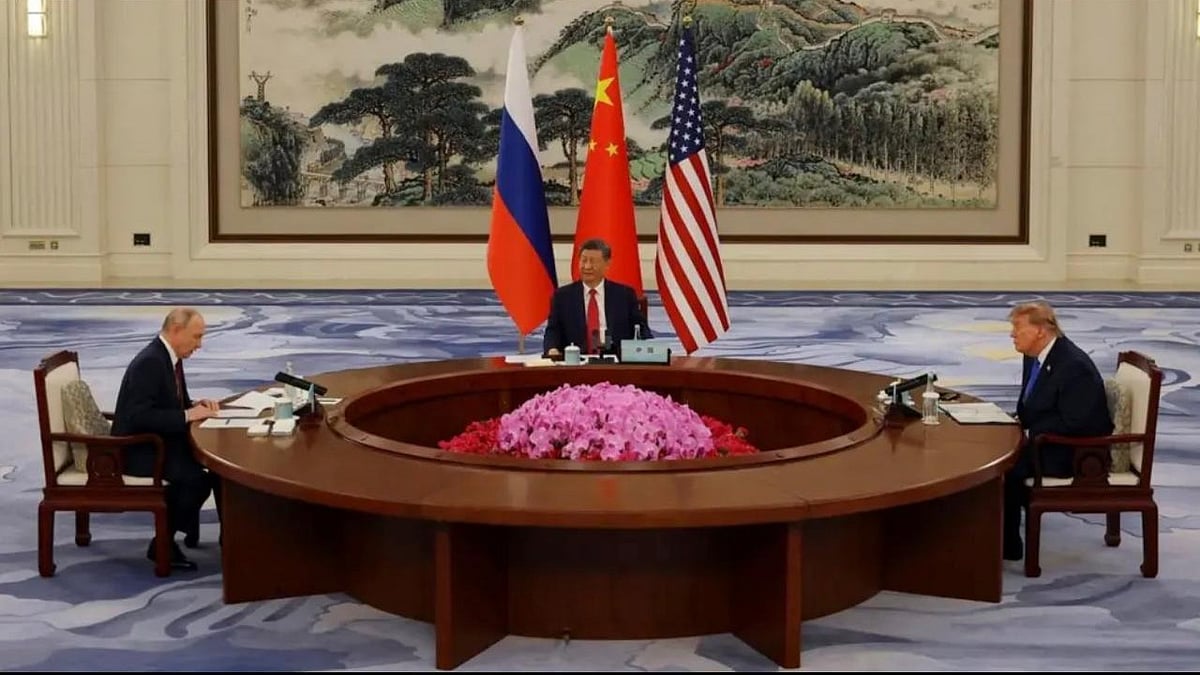
Diplomats pointed out that the four-point declaration, notable for its brevity and lack of specific timelines, suggested that the meeting should be currently viewed as “grand optics.” Comparing the summit to the recent Quad summit meeting where timelines had been agreed to, former Ambassador Talmiz Ahmad believed that the summit was a bid by Trump to reassert himself on the world stage after the drubbing faced by the Republican party in the mid-term elections.
“The meeting should be seen as a Trump-led initiative where he was accommodated by China and Russia, who also saw it to their advantage,” he said. “Putin was happy to meet with Trump because prior to the summit meet (Jared) Kushner and (Steve) Witkoff had floated the idea to (President) Zelensky that he give up the Donbas in exchange for Nato membership. The deadline for Nato membership had not been fixed, nor is Europe part of this deal. So Putin is happy.” Regarding China, diplomats said that President Xi knew he had to exchange with Trumps on tariffs and technology. So a summit meeting full of pomp and pageantry but little in the way of specifics would suit both Moscow and Beijing’s interests.
Coming to the declaration itself, the four points are, at first glance, a puzzle. Senior diplomats say the point that talks about the “reform of the UN” so that it can “respond more effectively to global challenges” makes little sense.” Trump’s efforts to defund the UN ensured that the international body announced last year that it would cut 25% of its peacekeeping forces across the world, with peacekeeping operations affected in key conflict areas such as South Sudan, Lebanon, the Golan Heights and Abyei – an administrative area jointly run by South Sudan and Sudan.
Diplomats say the statement is erroneous because UN reforms regarding extending membership of the P5 and the use of the veto cannot take place without the consent of all P5 nations. “Reforms that require expanding the Security Council or changing the veto do require ratification by all five P5 states, so the US, Russia and China cannot change this on their own,” said a senior diplomat.
“The reason for this declaration was more probably at the behest of China, who wants to assure the Global South that it is voicing their concerns. Such a declaration does not bother either the US or Russia, as they know this reform will not happen.”
Regarding “energy stability” and the emphasis on “refined petroleum products", the second point in the declaration is something that will be of more interest to India. A US Energy Information Administration (EIA) report states that both the US and China can each refine up to 18.5 million barrels per day, which ensures that the US can play a larger role in the global energy market should the energy crisis worsen, and for China, it ensures a stable flow of oil and gas from West Asia as Gulf nations are dependent on refined oil. Overall, the declaration put oil and fossil fuels centre-stage, which is a boon for large oil producers like the US and Russia.
Diplomats say the declaration should be best described as “self-seeking” rather than seen as a view to “reform the global order". The bid to curb the power of the International Criminal Court (ICC) and other international bodies was not only to help Putin, who is facing an ICC warrant for his arrest in 2023, but also to safeguard Trump. “Trump knows that he could be charged for war crimes in Iran, as has already been done with Hegseth, and this is a way of safeguarding himself,” said Ahmad.
The lack of specific language throughout the declaration comes as no surprise, and so diplomats were not surprised to see no mention of a bid to reintroduce talks to replace the New START treaty, which lapsed in February this year. A senior diplomat familiar with nuclear negotiations said he had expected that such a discussion would not take place given the “strategic competition between the three nations, the fact that Russia’s war with Ukraine is increasingly becoming one with Europe, for which Moscow has felt the need to brandish the nuclear threat from time to time, and China’s need to catch up with the US and Russia on nuclear weapons.”
Coming to India, does anything in the Shenzhen declaration really impact New Delhi? The answer is no, not really. “The tripartite meeting confirms to Europe that Trump does not care for their concerns,” said Ahmad. “This is a divide that both China and Russia will seek to exploit. For India, it doesn’t mean much except to reaffirm that we do not fit into Trump’s view of the world.”

