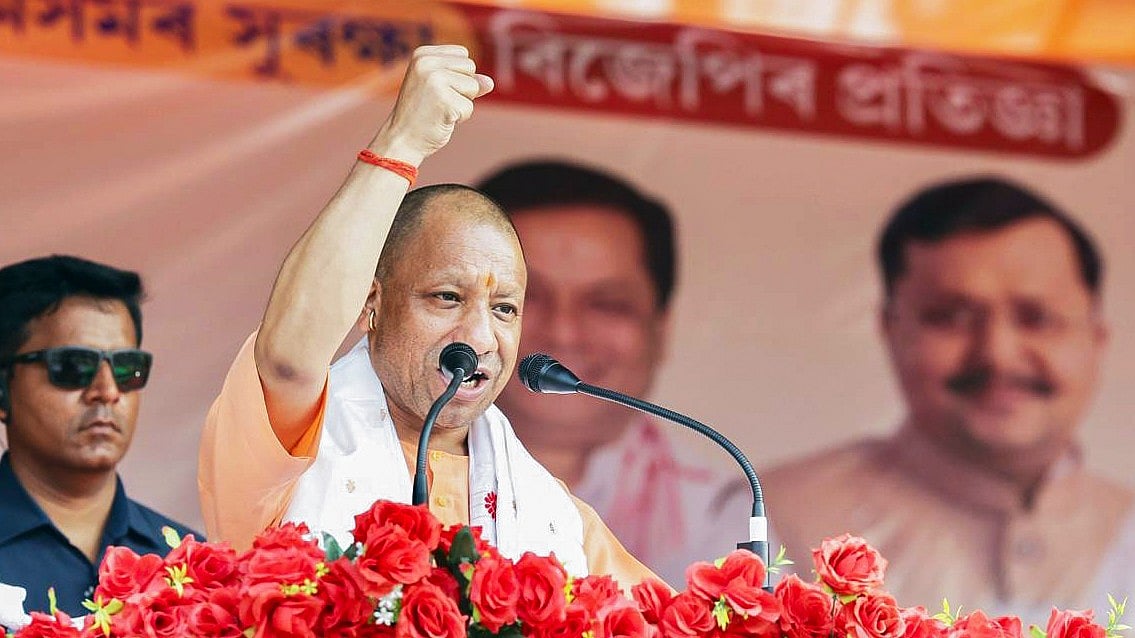
Lucknow: While inaugurating the 6th Uttar Pradesh Agricultural Science Congress 2026 held in Lucknow, Chief Minister Yogi Adityanath presented a comprehensive and forward looking vision for the overall development of the agriculture sector.
He clearly stated, the time has come to take agriculture from production to productivity, from productivity to profitability, and ultimately from profitability to prosperity. The vision of a Atmanirbhar Viksit Bharat will be realized only when the farmer becomes prosperous. Increasing production alone is not sufficient, it is necessary to make it profitable and sustainable.
This journey from production to prosperity will determine the path of the future, and Uttar Pradesh is ready to play a leading role in this direction.
Chief Minister added, "During this 3 day event, serious deliberations will be held on various aspects of agriculture, in which ground level experiences, innovations, and successful experiments will be shared. This platform should not remain limited to discussions, but should become a medium for preparing a concrete action plan so that farmers can receive real benefits."
Referring to the agricultural potential of Uttar Pradesh, he said that the state is home to about 16 to 17% of the country’s population, while it has only about 11% of the cultivable land. Despite this, Uttar Pradesh contributes about 21% to the country’s total food grain production. This is the result of planned efforts, farmers’ hard work, and effective policies. The state has succeeded in increasing the agricultural growth rate from 8% to about 18%, which is a remarkable achievement.
Chief Minister further informed, "Historically, agriculture has been the foundation of India’s economic strength. There was a time when India’s share in the global economy was around 44 to 45 percent, and the primary reason was its strong agricultural system."
He added, during that time, farmers were not only producers but also artisans and entrepreneurs. They participated in processing and manufacturing along with production. However, over time, this system weakened and farmers were reduced to being producers of raw materials only, which led to economic imbalance. The food producing farmer began to fall into debt.
Chief Minister emphasized the use of modern technology, stating that Internet of Things, artificial intelligence, drones, and satellite technology can give a new direction to agriculture. With sensor based technology, farmers can obtain data on soil moisture and nutrients and make precise decisions.
He informed, Through AI, real time analysis of crops, identification of diseases, and production forecasting is possible. Drones enable precise spraying of fertilizers and pesticides, while satellites help monitor weather and land conditions, making agriculture more scientific and effective. To address the challenges of climate change, the use of biotechnology is extremely necessary. Through this, seed varieties can be developed that are suitable for changing weather and can yield higher production.
He described natural farming as a long term solution, stating that it not only reduces costs but also maintains soil quality and environmental balance.
Chief Minister highlighted the important role of digital agriculture platforms, stating that farmers are now directly receiving information related to markets, weather, and prices. With initiatives like One Nation One Mandi and reduction in mandi fees, farmers are getting better prices. Along with this, through digital soil health cards, farmers are receiving accurate information about the quality of their land on their mobile phones.
Chief Minister emphasized shifting from the traditional ‘lab to land’ model to the concept of ‘land is lab’. He said that fields themselves must become laboratories where farmers and scientists work together to establish innovation. In this direction, he described the role of Krishi Vigyan Kendra and agricultural universities as important and called upon all institutions to work together.
Chief Minister mentioned the reforms in the sugarcane sector, stating that earlier farmers had to wait for years for payments, whereas now out of 122 mills, 107 are making payments within 6 to 7 days. The state contributes about 55 percent of the country’s total sugarcane production. Uttar Pradesh ranks first in ethanol production in the country, and more than ₹3.15 lakh crore has been paid to farmers as sugarcane dues through DBT.
He continues by saying, "About 85 to 86 percent of the land in the state is irrigated. Tube wells and solar panel based irrigation are being promoted. By completing long pending projects like the Saryu Canal National Project, irrigation facilities have been extended to 14 lakhs hectares of land, benefiting farmers significantly."
He further informed, to deal with natural disasters, the government has ensured a rapid relief system. Under the Mukhyamantri Krishak Durghatna Bima Yojana, there is a provision to provide assistance within 24 hours. Along with this, efforts are being made to reduce losses caused by incidents like lightning through early warning systems. Real transformation in the agriculture sector is possible only when strong coordination is established among farmers, scientists, government, and the market. There are 89 Krishi Vigyan Kendra functioning in the state, which are being connected with progressive farmers and agricultural universities to develop a strong ecosystem.
Chief Minister also said, "Before 2017, the agriculture sector had become a symbol of disorder, unorganized systems, and deep mistrust among farmers. Effective procurement at Minimum Support Price could not be ensured, procurement centres were weak, and middlemen dominated. Farmers faced difficulty in getting fair prices for their produce. Sugarcane farmers had to wait for years for payments, which pushed them into debt."
He said, after 2017, the government prioritized agriculture and implemented transparent, technology based, and farmer centric policies. Procurement at MSP at one and a half times the cost of production was ensured, and payments were made directly through DBT. This increased farmers’ confidence and gave agriculture a new identity as a profitable and respectable profession.
Chief Minister further added, "Current global conditions have made it clear that self reliance in agriculture and food security is extremely essential. Disruptions in international supply chains, uncertain availability of petroleum products, and fluctuations in fertilizer prices indicate that dependence on external sources can be risky for the country. In such a situation, it has become necessary for an agriculture based country like India to strengthen its traditional agricultural system and integrate it with modern technology."
He emphasized that if a strong system of local level production, processing, and distribution is developed, not only can the impact of global crises be reduced, but farmers’ income and the country’s economic stability can also be ensured.
On this occasion, Agriculture Minister Surya Pratap Shahi, Minister of State Baldev Singh Aulakh, Chairman of Uttar Pradesh Cow Service Commission Shyam Bihari Gupta, Principal Secretary Agriculture Ravindra Kumar, Chairman of Uttar Pradesh Council of Agricultural Research Captain Retired Vikas Gupta, Director General of ICRISAT Hyderabad Professor Himanshu Pathak, Director General of UPCAR Dr Sanjay Singh, Director of Indian Institute of Sugarcane Research Dr Dinesh Singh and others were present.

