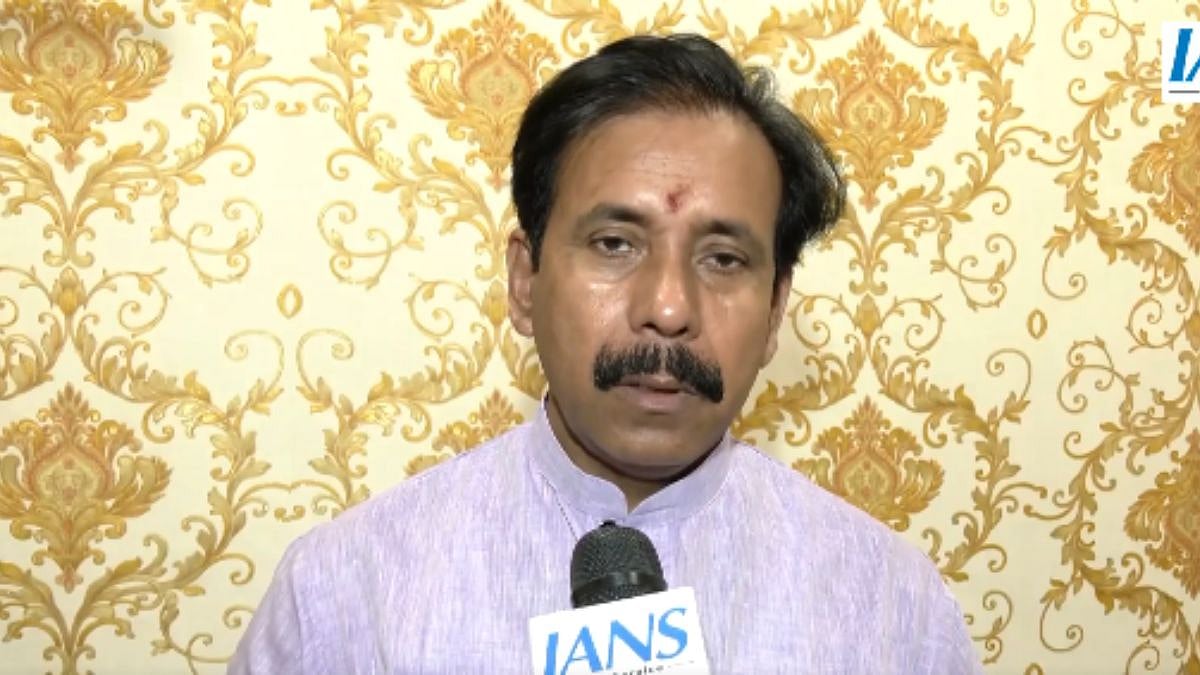
Greater Noida: Uttar Pradesh Minister for Labour and Employment Anil Rajbhar said that the four labour codes being implemented by the Central Government will play a significant role in promoting ease of doing business in the country and the state.
Anil Rajbhar said, “The government’s priority is to safeguard the interests of workers while also creating a conducive environment for industry. Workers and industries are complementary to each other; therefore, policies and decisions are being formulated keeping in mind the interests and future of both.”
Rajbhar made these remarks while addressing the “Special Labour Codes” session on the fourth day of the Uttar Pradesh International Trade Show (UPITS)-2026 on Monday.
The Labour Minister remarked, “Uttar Pradesh has ranked first in the country for the registration of new factories for the past two consecutive years. A large number of new factories have been registered in the state since 2017. This reflects the continuous efforts made by the state government to create a favourable environment for industries.”
He further stated, “Under the leadership of Chief Minister Yogi Adityanath and the guidance of Prime Minister Narendra Modi, law and order has been strengthened, connectivity has improved significantly, adequate power supply has been ensured, and a positive ecosystem for industries has been developed in the state. These efforts are reflected in increasing investment and employment opportunities across Uttar Pradesh.”
The minister noted, “One of the government’s longstanding challenges has been maintaining industry confidence without affecting the interests of workers. To address this, the government is placing special emphasis on establishing better coordination between workers and entrepreneurs.”
He added, “Industries cannot function without workers, and workers cannot thrive without industries. Therefore, decisions must be taken with a clear understanding of the interests, sentiments, and future of both.”
Anil Rajbhar said that the implementation of the four labour codes marks a significant step towards reforming and simplifying labour laws. He informed that the Central Government has engaged with various stakeholders and industry representatives regarding the codes, and the Uttar Pradesh Government is moving forward in the same spirit.”
The Labour Minister asserted that government’s doors are always open to industry. If any industry faces challenges or requires government support, departmental officials and the government are available to provide solutions. He reiterated that the government is committed to working closely with industry stakeholders and addressing their concerns.
Rajbhar said that Uttar Pradesh has undergone substantial transformation across various sectors since 2017. Industry has played a major role in this change. Expressing gratitude to investors and entrepreneurs, he said that the state’s development goals cannot be achieved without the cooperation and participation of industry.
He added that global competition and challenges are likely to intensify in the coming years. In such a scenario, continuous dialogue, cooperation, and coordination between the government and industry will help Uttar Pradesh move towards new opportunities for growth.
The session was attended by Additional Chief Secretary, Labour and Employment, Ashish Kumar Goyal, Labour Commissioner Soumya Agrawal, Junaid, Basant Gangwar, Rakesh Dwivedi, Brijesh, officials of the Labour Department from Ghaziabad, Meerut, Noida and the NCR region, representatives of industry, and social workers.
Labour Codes will simplify compliance for industries and strengthen the single-window system: Goyal
Additional Chief Secretary, Labour and Employment, Ashish Kumar Goyal, said that in line with the Prime Minister’s vision of “Ease of Doing Business,” “Ease of Living,” and “Minimum Government, Maximum Governance,” numerous old labour laws have been consolidated and the system simplified through the four labour codes.
He said that industry had long demanded simplification of labour laws, as the complexity and large number of regulations often created compliance challenges. Through the four labour codes, labour laws have been streamlined and rationalised.”
Goyal informed that most of the related rules have already been notified in Uttar Pradesh. He also said that efforts are being made to further strengthen the single-window system for the convenience of industries. Under this arrangement, industries will be able to apply through a single portal for approvals from multiple departments and local bodies. This, he said, will save time, simplify compliance, and further strengthen the investment climate in the state.
He emphasized that workers and industries are complementary to each other, and maintaining a balance between their interests while ensuring worker safety and a business-friendly environment remains a government priority.
He further informed that workshops will be organised across the state to raise awareness about the labour codes, particularly in industrial areas, where extensive outreach and awareness campaigns will be conducted regarding their provisions.
Effective implementation of Labour Codes is in the interest of both industry and workers: Soumya Agrawal
Labour Commissioner Soumya Agrawal said that the primary objective of the session was to establish better coordination between industry and workers while ensuring worker dignity, safety, and welfare.

She said that four labour codes, namely the Code on Wages, Industrial Relations Code, Code on Social Security, and Occupational Safety, Health and Working Conditions Code, have been introduced by consolidating earlier labour laws, and that the department is fully committed to ensuring their effective implementation.
Through these codes, the government is promoting freedom from multiple registrations and encouraging a single-window system. She highlighted that bringing platform workers under the ambit of social security, creating a digital database of workers, and ensuring effective delivery of welfare schemes are among the key features of the new framework.
Agrawal also stressed the importance of ensuring safe workplaces in line with international standards in the field of occupational safety and health. Equal opportunities and a safe working environment for women workers are also being given special emphasis.
She stated that merely enacting labour codes is not sufficient; ensuring their effective implementation is equally important. The department’s goal is to create a system in which industries can grow while workers’ rights and welfare remain fully protected.

