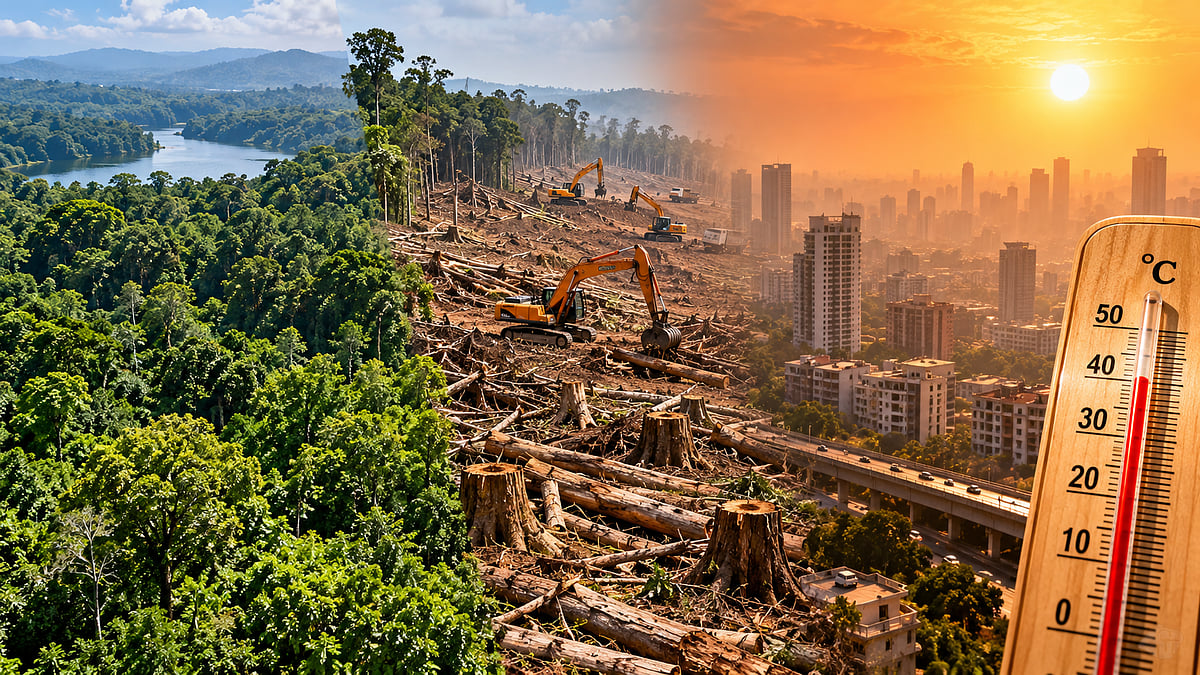
Lucknow: India’s green cover declined by 5.6 percentage points between 2001 and 2025, while areas without green cover consistently recorded higher summer temperatures, according to a new study by Climate Trends. The study highlights the role of vegetation in regulating local temperatures and warns that continued loss of green cover could aggravate heat stress across vulnerable regions.
The study, titled Assessment of Green Cover Dynamics and Their Influence on Summer Temperature across India Using MODIS Land Cover and ERA5 Reanalysis Data, found that green cover fell from 36.95 per cent of the country’s land area in 2001 to 31.35 per cent in 2025. The proportion of non-green land increased from 63.05 per cent to 68.65 per cent during the same period.
Non-green landscapes were consistently warmer than vegetated areas, with the average summer temperature difference ranging from 1°C to 2.5°C. Areas that experienced green-cover loss recorded a mean summer temperature increase of 0.26°C, the study found.
Vegetation Plays Key Role In Cooling
The findings underline the importance of vegetation in reducing local heat through shade, evapotranspiration and moisture retention. The researchers said green cover should be treated as a critical component of climate adaptation rather than merely an environmental asset.
“Vegetation is not merely an ecological asset; it is an important component of India’s climate-adaptation infrastructure,” said Dr Palak Balyan, Research Lead at Climate Trends. She called for the protection of existing natural vegetation, particularly in regions experiencing both green-cover loss and rising summer temperatures.
Regional Variations In Green Cover Loss
The study found considerable regional variation in land-cover changes and temperature trends. Green-cover loss was concentrated in western India, the Indo-Gangetic Plain, parts of central India and several areas of peninsular India. Northwestern and northern India experienced pronounced warming, while localised cooling was observed in parts of central and southern India.
Some areas of the northeastern states, the Himalayan foothills and scattered parts of southern and eastern India recorded gains in green cover.
The findings are relevant to Uttar Pradesh, which lies largely within the Indo-Gangetic Plain, one of the regions identified by the study as experiencing green-cover loss. However, the report does not provide state-specific figures to quantify the extent of vegetation loss or its impact on temperatures in Uttar Pradesh.

Experts Advocate Vegetation Restoration And Protection
Dr S K Dhaka, Professor of Atmospheric Physics at Delhi University, said vegetation restoration could reduce local heat stress but should not be considered a substitute for broader climate action.
“The warming observed even within areas that remained continuously green shows that large-scale climatic forcing continues to influence regional temperatures,” he said, advocating a strategy that combines the protection of existing vegetation with targeted restoration in heat-vulnerable regions.
The study recommends preventing unnecessary loss of green cover, conserving existing vegetation and restoring degraded landscapes as part of climate adaptation and sustainable land management.
Also Watch:
Broader Climate Factors Influence Temperatures
It also stresses that land-cover changes are only one factor influencing temperatures. Regional climate warming and broader climatic processes continue to affect temperature patterns, limiting the extent to which vegetation alone can offset rising heat.
The analysis used MODIS land-cover products and ERA5-Land temperature data to assess changes in vegetation and summer surface temperatures across India between 2001 and 2025.

