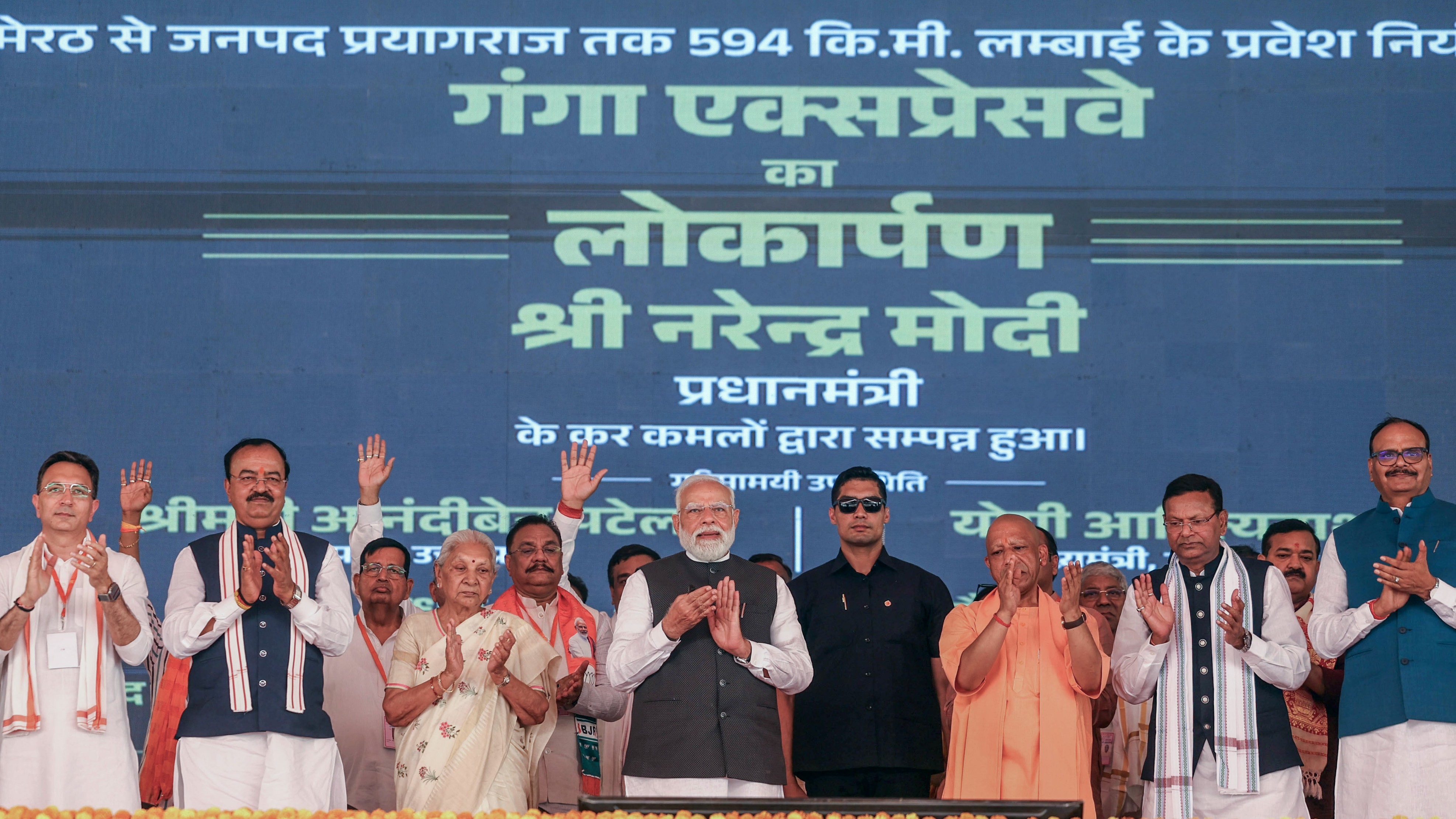
Lucknow: It’s early morning. A car enters the high-speed expressway from Bijoli village in Meerut. Cruising at 120 km/h, it passes through fields, towns, and several cities. Along the way, modern toll plazas, fuel stations, wayside amenities, and industrial nodes come into view. By evening, the same car reaches Prayagraj - what once took 10-12 hours is now completed in just 6-7 hours.
This is not just a road. It is infrastructure racing toward Uttar Pradesh’s one-trillion-dollar economy. On the newly built Ganga Expressway, not only vehicles will speed ahead - industries, investments, dreams, and opportunities will too.
Stretching from Meerut to Prayagraj, this road is truly a new economic stream, set to take Uttar Pradesh to a level of growth where the goal of a “one trillion dollar economy” begins to look achievable.
The Ganga Expressway is a 594-km-long greenfield, access-controlled highway that links 12 districts from Meerut to Prayagraj into a strong economic axis. This six-lane (expandable to eight lanes in the future) mega project has been developed on a PPP model at an estimated cost of around ₹36,000-37,000 crore.
It directly connects the developed industrial belt of western Uttar Pradesh with the agriculture- and labor-driven regions of eastern UP, reducing the distance between production, supply, and markets.
As a result, it is not just a transport route but a connectivity engine that can drive investment, industry, and employment, elevating the state’s economic strength.
With the expressway operational, travel from Meerut to Prayagraj will take just 6-7 hours, compared to the earlier 10-12 hours. This time saving directly translates into reduced logistics costs. Faster and smoother movement will make supply chains more efficient, enabling agricultural produce to reach markets more quickly while preserving quality and value.
E-commerce, warehousing, and distribution networks will also gain momentum. In essence, time saved becomes economic efficiency - and that efficiency can multiply a state’s growth pace.
The Ganga Expressway connects 12 districts - Meerut, Hapur, Bulandshahr, Amroha, Sambhal, Badaun, Shahjahanpur, Hardoi, Unnao, Rae Bareli, Pratapgarh, and Prayagraj - laying the foundation for broad-based economic transformation.
Each district is poised for development aligned with its strengths: manufacturing and sports goods in Meerut-Hapur; food processing and dairy in Bulandshahr-Amroha; agri-based industries in Shahjahanpur-Hardoi; textiles and MSMEs in Unnao-Rae Bareli; and Prayagraj as a logistics and tourism hub.
In this way, the expressway integrates diverse economic capacities into a single, interconnected network where production, processing, and distribution flow seamlessly.
The Ganga Expressway is designed as an integrated development corridor, laying a strong foundation for industrial growth alongside transportation. It includes 2 main toll plazas and 19 ramp tolls for smooth entry and exit, along with 9 modern public amenity complexes featuring food courts, fuel stations, and rest areas.
Engineering highlights include a 960-meter Ganga bridge and a 720-meter Ramganga bridge, further strengthening its capacity. A 120-meter right-of-way ensures space for future expansion and additional infrastructure.
Overall, the expressway is a well-planned system designed to support long-term industrial growth, rapid transport, and sustainable economic development.
Industrial and logistics hubs developing along both sides of the expressway are turning it into a powerful investment destination. Warehousing and cold storage, MSME clusters, food processing units, and defense manufacturing industries are rapidly taking shape.
This ecosystem will not only strengthen supply chains but also generate lakhs of direct and indirect jobs, increasing employment opportunities for local youth within their own districts. With this mega project becoming operational, Uttar Pradesh is set to take a leading position in India’s expressway network, with a share that could reach around 60%.
This signals the state’s rapid shift toward an infrastructure-driven growth model, where roads are not just routes but instruments of economic leadership.
Uttar Pradesh’s target of becoming a one-trillion-dollar economy will find a strong pillar in the Ganga Expressway. Better connectivity attracts investment; investment leads to industries; industries generate employment; employment raises incomes; and higher incomes drive broader economic expansion.
In this chain, the Ganga Expressway will act as an “economic multiplier,” accelerating the entire cycle of development and propelling the state’s economy to new heights.
