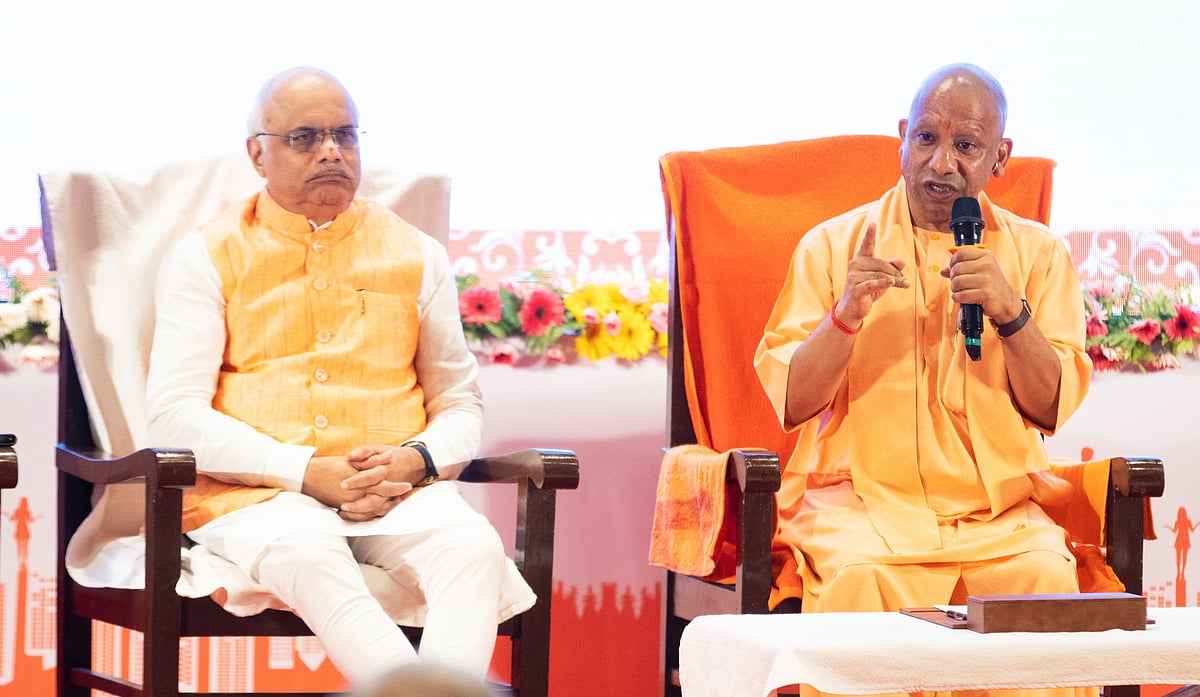
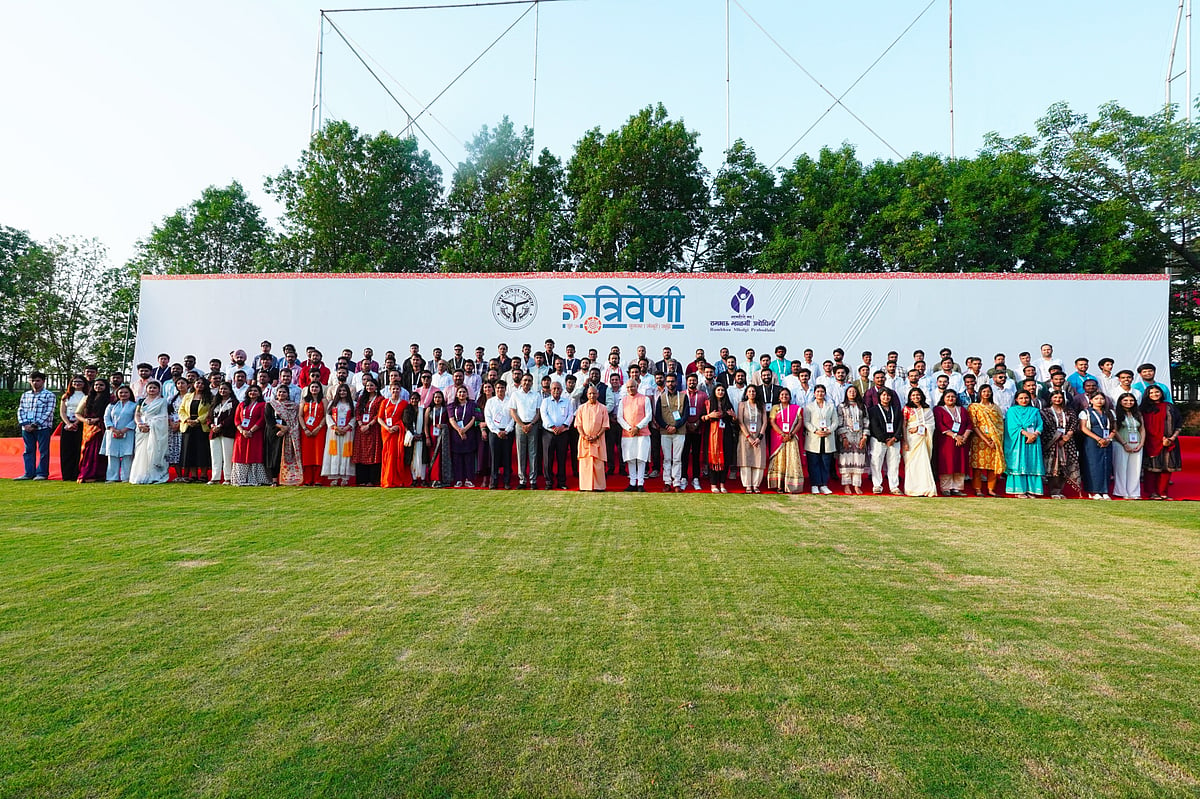
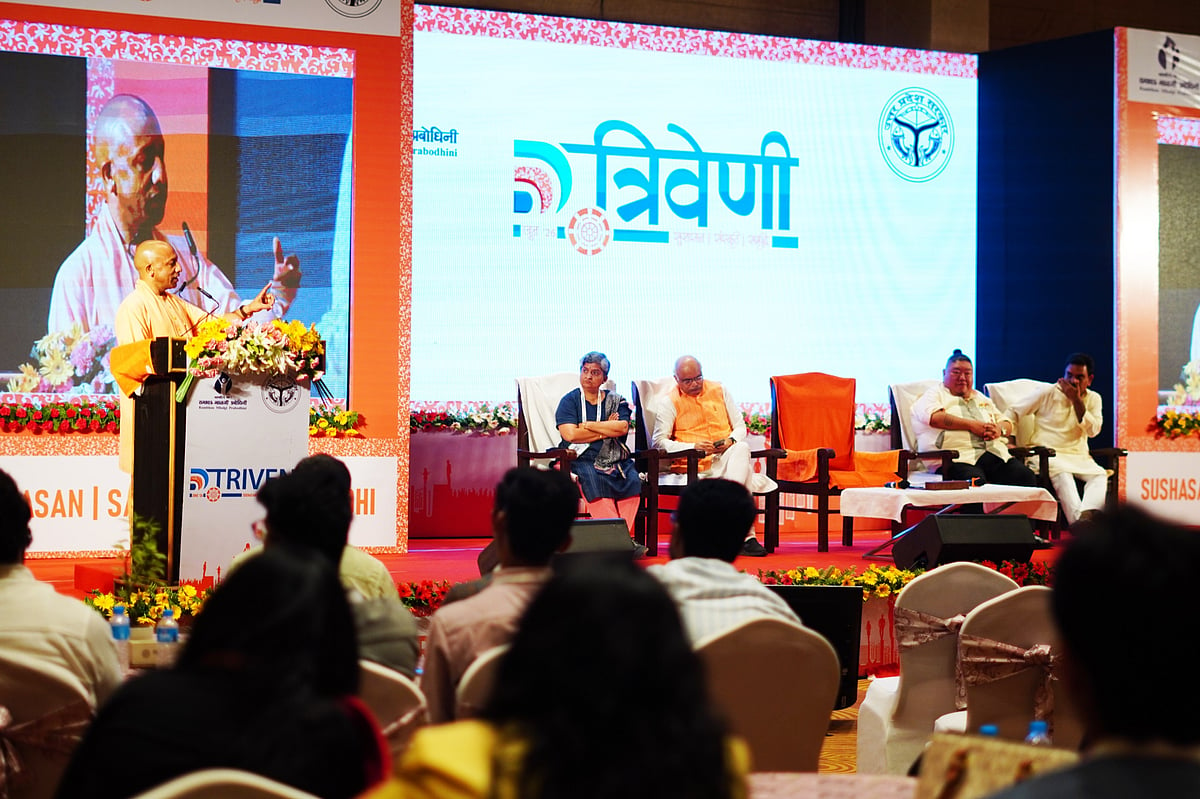
Lucknow: Discussions were held on the good governance, culture and prosperity of the Yogi Government during the closing ceremony of the three-day Digital Democracy Dialogue 'Triveni' held at a hotel in Lucknow on Monday. The main focus of the discussions was on two sessions - Prosperity (Women and Youth) and Cultural Renaissance. Speakers said that Uttar Pradesh's future prosperity will largely depend on its ability to fully utilize the potential of its women and youth.
In the first session, Uttar Pradesh Minister of State (Independent Charge) for Social Welfare and Scheduled Caste and Scheduled Tribe Welfare, Asim Arun, said, “In a democracy, people can choose their leaders and public representatives. Along with this, law and equality are essential in society. The coming era will be driven by a digital revolution, for which people must keep learning.”
He added that content creators have opened new avenues. Chief Minister Yogi Adityanath repeatedly reminds officials to seek public feedback on every new policy, and therefore social media is also used as a tool for feedback.
During the discussion, senior journalist Mrinalini Nanivadekar said, “Women and youth play a vital role in the development of any country or state.” She pointed out that many women are now working in newsrooms, which was not the case 25 years ago.
She said, “The female workforce and birth rate are rising in Uttar Pradesh. Encouraging women's participation in the workforce is essential for bringing about significant change. A major shift has occurred across the country, including in UP, where the government and administration have become sensitive to issues concerning women. Women are now able to voice their views more effectively than before, and female creators are also playing a significant role in this process.”
Referring to women's reservation, she said that discussions have been going on for a long time and it may be implemented soon. Responding to a question from creators, she explained feminism as the coexistence of Shiva and Shakti.
Nagaland Higher Education Minister Temjen Imna Along said, “The digital revolution is bringing new energy. All digital revolutionaries of the country must take responsibility. With the support of digital creators, a narrative of a capable and united India must be built.”
He said digital media has broken the barriers between states. During the discussion, he advised social media influencers to create positive content because the entire country is watching Uttar Pradesh. He said creators can help unite the country through their platforms.
He said, “Even people in the last village on the Nagaland-Myanmar border know and recognize Prime Minister Narendra Modi and Chief Minister Yogi Adityanath. All this has been possible because of digital creators and digital revolution. The people of Nagaland also believe that leaders like PM Narendra Modi and CM Yogi Adityanath will take the country forward. Our Naga tribe is also ready to support them.”
He said that after the Modi Government came to power at the Centre in 2014, the highest number of roads were constructed in Nagaland. He added that Rs 16,000 crore is being spent on 18 national highways in the state.
Meanwhile, Patna University professor Guru Prakash Paswan said, “Women are getting opportunities across the state and the country. For the first time in 75 years, a woman from a tribal family reached the country's highest constitutional office.”
He also said that digital creators have the power to reach millions and crores of people instantly. In today's era, entrepreneurship and innovation are crucial for development.
The second session focused on cultural renaissance. During the discussion, ISKCON Governing Body Commissioner Gauranga Das said, “The Bhagavad Gita is a scripture that helps people understand the root of their pain. India's one billion Hindus should take some time to try and understand the scriptures. The first step towards a cultural renaissance is to incorporate the Gita into one's life.”
He said, “Temples serve as centers of inspiration. After the construction of the Shri Ram Temple in Ayodhya, the number of devotees visiting temples across the country increased by up to five times.”
Addressing social media influencers present at the session, he urged them to spread Lord Ram's message through their content. He said people should be guided on how to strengthen family values and make their homes resemble temples.

Author and social activist Shefali Vaidya said that she had witnessed the period before 2014, when even thinking about the construction of the Ram Temple seemed impossible. She said, “We had not imagined the growth seen in areas such as digital payments. However, significant changes have taken place over the past few years.”
She encouraged content creators to make content about temples located near their homes and educate people about their history. She said this would also help promote Indian culture.
Senior Advocate Vishnu Shankar Jain said that he had witnessed the Ram Temple movement since childhood and that his father had also faced many difficulties during that period. He said, “The legal battle continued for nearly 69 years, and it was a period of oppression. Truth often remained suppressed in those days, but that is no longer possible in the age of social media.”
He said that today, correct information about the Gyanvapi and Mathura Krishna Janmabhoomi cases is reaching people quickly. He added that content creators are also conveying our side of the matter correctly to the people, which is a significant change. According to him, this is also helping strengthen people's faith.
He urged creators not to engage in hate speech and instead focus on conveying accurate information. He said the courts are the biggest mirror of society. As court proceedings are now being broadcast live, factual information can be presented correctly before the public. He also called upon creators to work responsibly in this direction.
