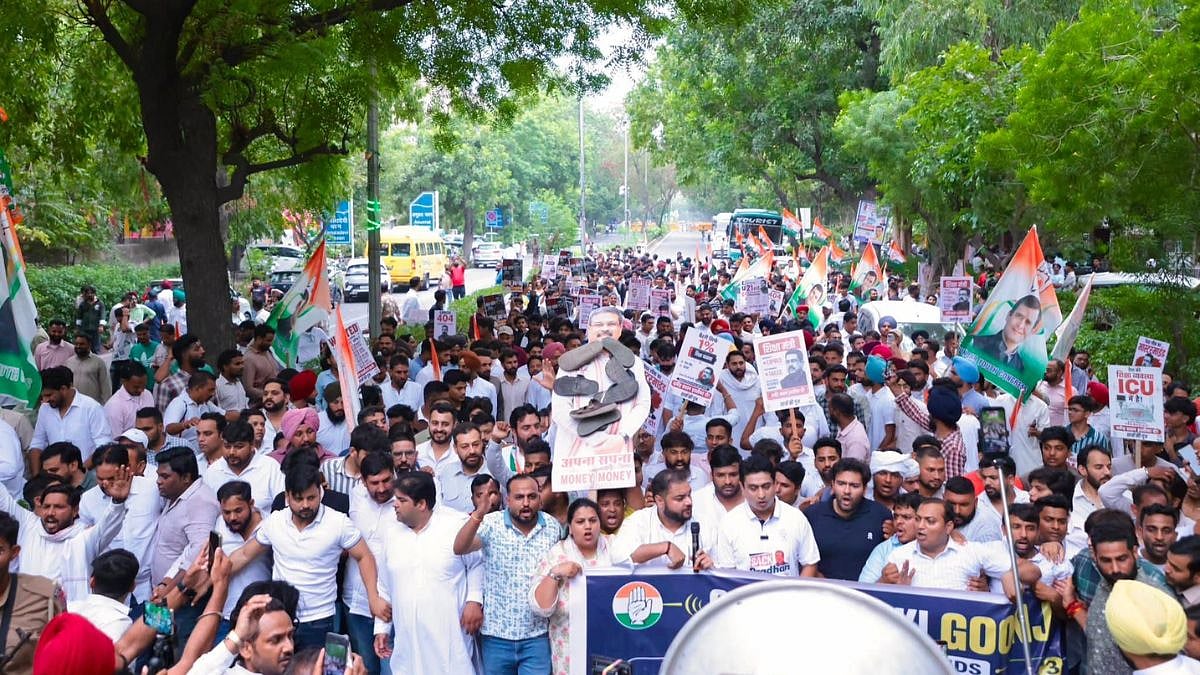
Prayagraj has always held a historic place in Uttar Pradesh politics as a centre of ideological and political movements. Lakhs of students from across the country come to this city to prepare for civil services and other competitive examinations, making it their workplace and centre of aspirations. This is why when the Leader of Opposition in the Lok Sabha, Rahul Gandhi, decided to hold the Chhatron Ki Goonj (Students' Voice) interaction programme in Prayagraj, political circles began viewing it as a major show of strength by the opposition against the Yogi Adityanath government in Uttar Pradesh. The objective of the programme was also clear: to unite student dissatisfaction over issues such as paper leaks, unemployment and delays in recruitment processes and use it to corner the state government. However, that did not happen.
Despite political claims, large posters and the extensive use of promotional tools, the event failed to create the political impact that had been anticipated. Owing to the absence of a solid grassroots strategy, clear direction and effective leadership, the programme remained an ordinary formal interaction rather than a challenge to the political stronghold of the Yogi government. Barely five thousand students could be gathered for the event. The Congress may attribute the programme's failure to inadequate preparations and organizational shortcomings, but it cannot deny the reality that a large section of Uttar Pradesh's youth is satisfied with the functioning of the Yogi government. In particular, the atmosphere of security provided to girls has increased their opportunities for education and employment. In such a situation, Rahul Gandhi did not have any strong basis for projecting a genuine Chhatron Ki Goonj.
If Rahul Gandhi could not mobilize students against the Yogi government in a city like Prayagraj, which has a vast student base, it is a matter for introspection for him. Perhaps that is why his speech relied heavily on terms such as data, artificial intelligence, corporate companies and the global economy. The level of interaction between Rahul Gandhi and the students whom Congress workers managed to bring to the venue after considerable effort remained extremely ordinary. Rahul Gandhi could neither present any concrete figures against the Yogi government nor offer any well-planned blueprint from the Congress. The students had not come merely to listen to a speech. They expected Rahul Gandhi to present a concrete policy roadmap of the Congress Party for the youth. As a result, even the students who attended the programme were left disappointed.
In Uttar Pradesh, the governance model of the Yogi Adityanath government is known for its administrative firmness and ability to take swift decisions. The strict laws introduced by the Uttar Pradesh government and its prompt actions to prevent irregularities in competitive examinations have significantly blunted the sharpness of the opposition's narrative. At the same time, the Bharatiya Janata Party and its affiliated organizations possess a strong organizational network extending to the booth and youth levels in Prayagraj and surrounding areas. Congress lacks in Uttar Pradesh the kind of student political cadre structure through the NSUI that can maintain continuous engagement with students in universities and coaching institutions. Without a cadre base, the presence of leaders alone cannot lay the foundation for any major mass movement.
Politics in Uttar Pradesh does not change merely through a high-profile event or social media campaigns conducted on a single day. To challenge the Yogi government directly in the political arena, the opposition will have to compel the youth to look either into history or into the future. The problem for Congress is that its history is filled with issues affecting youth, and it still does not have a blueprint for the future. Rahul Gandhi's visit to Prayagraj resembled a worn-out "single-day event." Once the programme ended, neither was any framework for a permanent student struggle committee presented, nor was any strategy announced to take the movement forward. This is why, forget the state level, the impact of the programme faded very quickly even at the local level and failed to create any political pressure on the government.

The ‘Chhatron Ki Goonj’ programme in Prayagraj is direct evidence that in a complex political laboratory like Uttar Pradesh, a government cannot be cornered merely through visits by national leaders or media coverage. To challenge the Yogi government politically and administratively, the opposition will have to draw a bigger line and demonstrate that it possesses a better vision for the youth than the Yogi government.
Instead of expending its energy in Uttar Pradesh, it would have been better for the Congress to undertake something in the interest of youth in the states where it is in power that could become a topic of discussion across the country. However, no such message is emerging for the youth from Karnataka, Telangana, Himachal Pradesh, Kerala, Jharkhand or Tamil Nadu. The Congress, which speaks aggressively in Parliament on Gen-Z demonstrations in New Delhi, remains silent on the student movement in Jharkhand.

