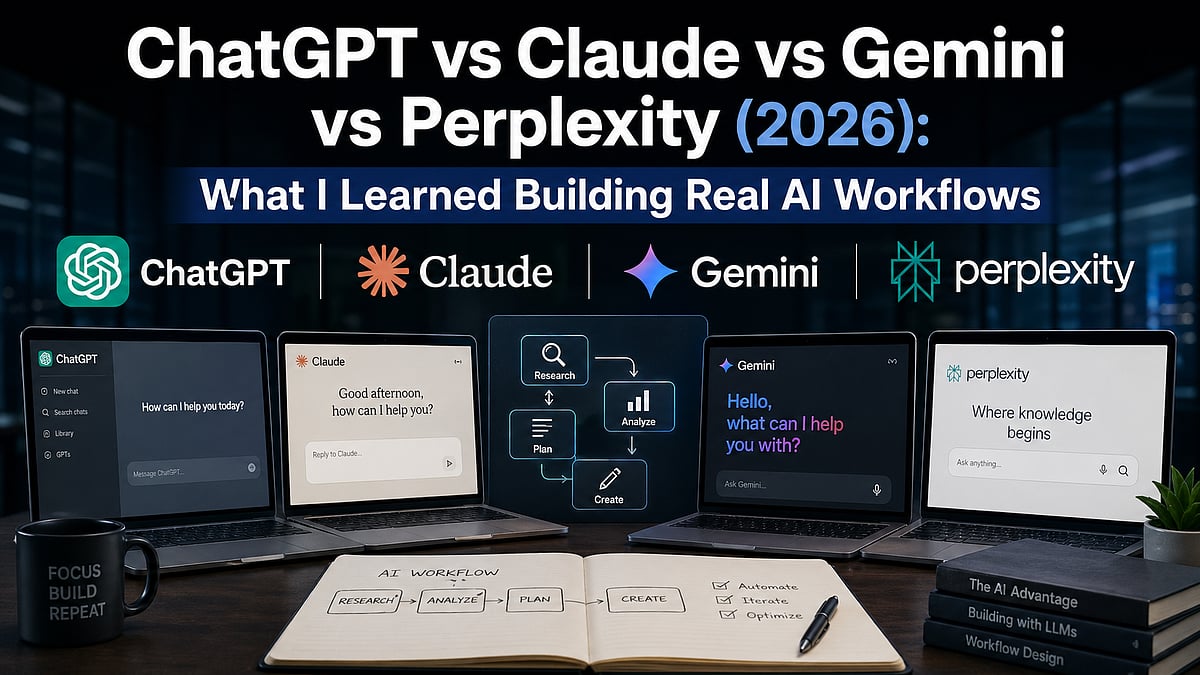
I run a Search Everywhere Optimization agency called CrazyDi. I am also an AI consultant. Over the past year, I have built AI-powered editorial tools for one of India's leading English-language dailies, using different tool stacks across ChatGPT, Claude, and Gemini.
That experience, combined with running my agency's daily SEO and content workflows on these platforms, shaped a very clear opinion.
My ranking for real business use: Claude first. Gemini second. ChatGPT as a general fallback. Perplexity when deep, sourced research is required.
Market share does not equal output quality. ChatGPT still commands roughly 65% of global AI traffic. But traffic numbers do not tell you which tool will actually produce the work your business needs.
Here is what does.
Claude: First Choice for Business
Claude has done phenomenally well in 2026. The new features coming into the picture, like Cowork and the ability to build Skills, have levelled up its game completely.
What changed my mind was context engineering combined with Skills. You can build a mini replica of your own brain inside Claude. Feed it your SOPs, brand guidelines, decision frameworks, and preferred formats. The result is not a generic AI. It is an AI that thinks the way you think and outputs the way you need it to.
For my agency, I have built a complete skill ecosystem: content writing frameworks, SEO audit templates, brand voice guidelines with banned word checks, and client intake systems. When a team member triggers a skill, Claude pulls in the right context, references existing data from Google Drive through connectors, and delivers structured output that is on-brand from the first pass.
The connectors are worth mentioning specifically. Google Drive, Notion, Gmail, SEMrush, and others work inside the conversation. You can pull client documents, reference live data, and work across tools without switching tabs. This is a genuine workflow accelerator, not a demo feature.
For anyone building content strategies, running audits, or doing deep analytical work, Claude's 200K context window, extended thinking with visible reasoning traces, and the Projects system for persistent instructions make it the most capable business tool available right now.
Recommended reading: I wrote a detailed comparison of AI subscription plans and pricing for Free Press Journal. If you want the full pricing breakdown across all platforms, that piece covers it in depth.
Gemini: Second Choice, and Gaining Ground Fast
Gemini has improved significantly. As compared to ChatGPT, it is performing much, much better on practical daily tasks.
Where Gemini earns its place in my stack:
- OCR. I have used Gemini for OCR processing and it works remarkably well. Extracting text from scanned documents, screenshots, and image-based content is fast and accurate.
- Team tooling. I built tools for my editorial team at Free Press Journal using Gemini that they use in their daily workflow for basic content fixes, formatting, and processing. These are not complex systems, but Gemini handles them consistently.
- Latest data. Gemini's access to current information through Google's search infrastructure gives it a real edge. When I need something from the last 48 hours, Gemini is where I go first.
- Image generation. Nano Banana creates genuinely impressive images within Gemini's ecosystem. For quick social visuals and concept graphics, it has become a regular go-to.
If your work already lives inside Google Workspace (Gmail, Docs, Sheets, Drive), Gemini is the most friction-free AI upgrade. The $20/month plan also bundles 2TB of Google One storage, which makes the effective AI cost much lower.
Where Gemini falls behind Claude is in depth. For strategy documents, long-form analysis, or work that requires maintaining a complex set of instructions across conversations, Claude's Project and Skills system is still ahead.
ChatGPT: The Fallback, Not the First Choice
I need to be honest here. ChatGPT's output quality has degraded.
The responses I get now are short, heavily bullet-based, and lack the deeper context that business work requires. Unless I invest significant effort in very detailed prompting, specifying tone, structure, depth, and format in granular detail, the default output is surface-level. This was not the case a year ago.
ChatGPT still has the broadest feature set of any AI tool: voice, vision, image generation, Canvas, web browsing, code interpreter, and the largest plugin ecosystem. The free tier is also the most generous available. For someone trying AI for the first time, ChatGPT Free remains the best starting point.
But for real business work where output quality matters more than feature breadth, Claude and Gemini have both pulled ahead.
Recommended reading: For a broader view on how AI tools are reshaping professional workflows, including practical productivity stacks and how tools like ChatGPT, Perplexity, and others fit into daily routines, I covered this in detail.

Perplexity: For Research, Not for Everything
Perplexity is a different kind of tool. It is not a general-purpose assistant. It is a research engine that pairs AI reasoning with live web search and source citations.
When I need super in-depth research with verifiable sources, Perplexity is where I go. The Deep Research feature synthesises dozens of sources into structured outputs with citations, which is excellent for competitive analysis and market research.
Two concerns worth noting: Perplexity was caught silently downgrading paid subscribers' queries to cheaper models without disclosure. And Deep Research daily limits were slashed from 600/day to 20/month with no warning. For a platform built on trust and transparency, these are not small issues.
Use it as a specialist research layer. Do not rely on it as your primary tool.
| My Ranking | #1 |
| Strongest At | Strategy, writing, deep work, coding |
| Paid Plan | $20/mo (Pro) |
| Weakest At | No image gen, tight free tier |
The Takeaway
The real advantage in 2026 is not which AI tool you pick. It is how you build systems around it.
Context engineering, Skills, structured workflows, connectors: these are the things that turn a general-purpose chatbot into a business operating system. That is where Claude is ahead of the field right now. Gemini earns its place through strong practical capabilities and Google ecosystem integration. ChatGPT remains a solid general tool, but the gap between its default output and what business work demands has widened.
My advice: start with one, invest time in building your context, and add others where they fill a genuine gap.
Recommended reading: The AI landscape is shifting faster than most people realise. I wrote about the 10 trends that will define AI for the next decade, including the move from chatbots to agentic workflows, in this piece.

Shikha Kumari is an SEO, AEO, LEO — Organic Growth Expert with 7+ years of experience helping brands stay discoverable across platforms.

