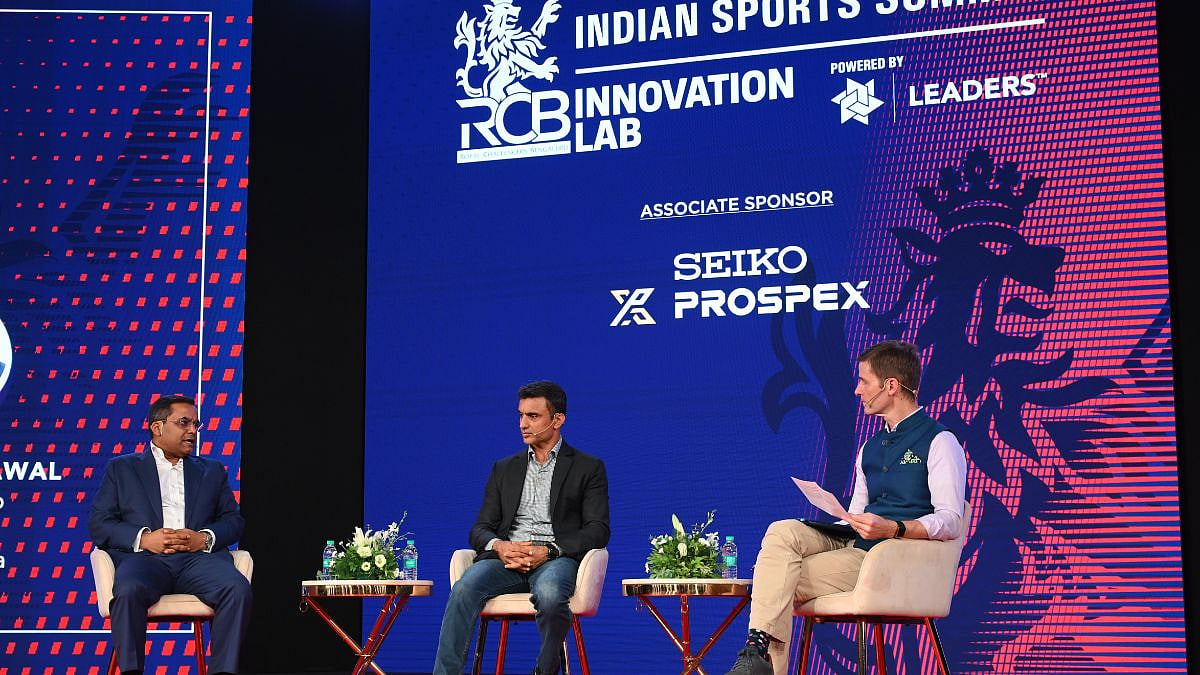
Bengaluru: The rapidly rising valuation of IPL franchises and the recent sale of Royal Challengers Bengaluru were at the centre of discussions yesterday during the “Inside the Room: How sport’s biggest deals get done” session at the RCB Innovation Lab Indian Sports Summit powered by Leaders in Bengaluru featuring Rahul Saraf, Head of Investment Banking at Citi Bank and Sandeep Agrawal, Head, Group Corporate Finance at Aditya Birla Group.
The discussion offered insights into the recent acquisition of RCB by a consortium comprising Aditya Birla Group, Blitzer-led global investors, Blackstone and Times Group, while exploring why IPL franchises continue to attract growing global interest and what that means for the future of Indian sport.
Explaining the rationale behind IPL valuations, Sandeep Agrawal highlighted the importance of media rights in driving franchise revenues.
“The biggest driver, at least in the Indian context, for IPL has been media revenues. About 70-75 percent of revenues for most franchises come from media and broadcasting revenues, and those have seen growth rates of about 18-20 percent over the last 10 years,” Agrawal said.
Addressing questions around the long-term sustainability of growth, he added, “We came to the conclusion that there might be one odd weak cycle, but over 10 to 15 years we would continue to see strong secular growth.”
Agrawal also compared IPL’s scale to global sporting leagues saying, “NFL has an average viewership of 18 million across 270 matches annually. IPL averages over 150 million viewers, yet IPL franchise valuations are still significantly lower. We believe this is a long-term premiumisation story for Indian sports and media consumption.”
Rahul Saraf spoke about the unprecedented level of investor interest surrounding the RCB transaction.
“We reached out to more than 100 potential investors and signed over 50 NDAs, the highest number I’ve seen in any auction process. People weren’t just looking at numbers, they wanted to own a part of the IPL ecosystem,” Saraf said.
Highlighting the scarcity value attached to IPL franchises, Saraf added, “It’s like selling Buckingham Palace. There are only a limited number of IPL franchises with unmatched market share in Indian sport. If India continues becoming a larger consumption economy, there’s only one direction these valuations can go.”
The panel also discussed how the growth of IPL is creating momentum across the wider Indian sports ecosystem, with increased corporate investment and fan engagement expected to benefit emerging sports in the country.
Speaking on the future of sports in India, Rahul Saraf said, “My pecking order is men’s cricket, women’s cricket, football, because the next generation is very focused on football and follows the English leagues closely. And then I genuinely hope Kabaddi comes alive. It’s grassroots, it’s unique and people can relate to it in different ways.”
Sandeep Agrawal added that India’s improving performances and growing sports culture are creating the foundation for long-term growth across multiple disciplines.
“For a league to be successful in India, people want to see India doing well in that sport. Football has massive interest already, women’s cricket has taken off, and Kabaddi also has the opportunity to become a truly pan-India sport,” he concluded.

