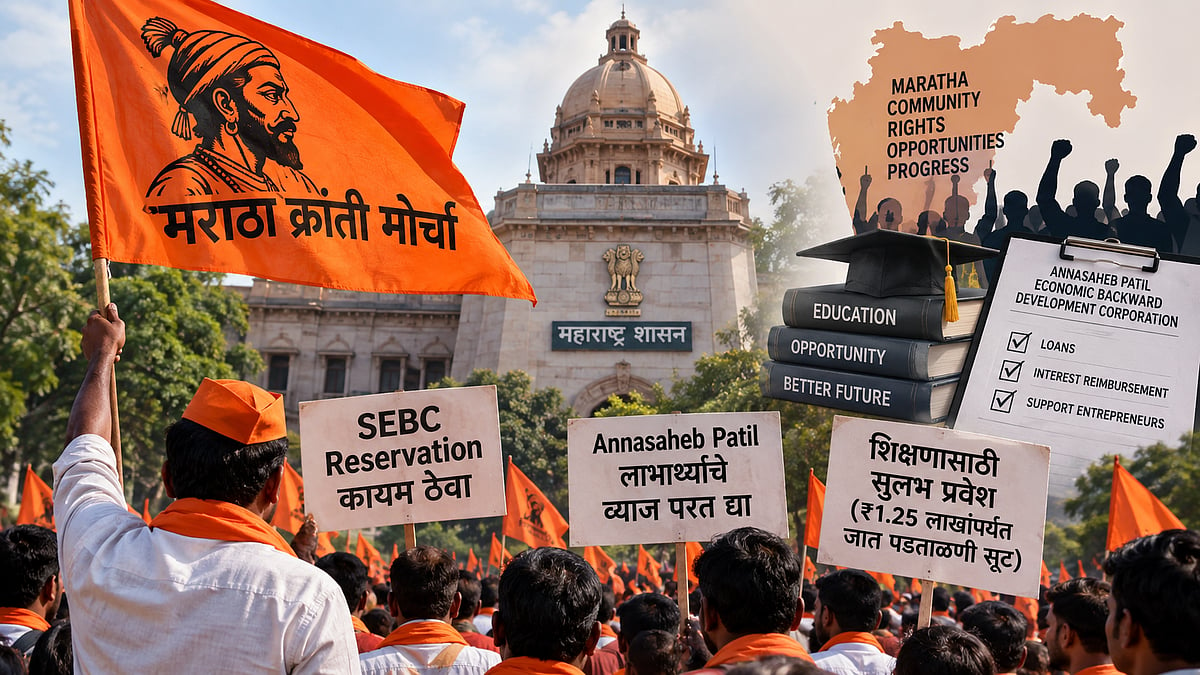
Pune: Maratha Kranti Morcha has demanded that the Maharashtra government take immediate steps to protect the reservation granted to the Maratha community under the Socially and Educationally Backward Classes (SEBC) category and clear pending interest reimbursement dues of beneficiaries of the Annasaheb Patil Economic Backward Development Corporation.
The demands were raised during an important meeting between representatives of the Maratha Kranti Morcha and legal experts on Maratha reservation at the SARTHI office in Pune on Monday. Several issues concerning reservation, education, employment and financial assistance for the community were discussed at the meeting.
The organisation alleged that although the SEBC reservation granted to the Maratha community is currently sub judice, the government and the Maratha Reservation Cabinet Sub-Committee have not taken adequate steps to defend and safeguard it.
Members expressed displeasure over what they termed the lack of visible and concrete action by the Cabinet Sub-Committee over the past one-and-a-half to two years. They also questioned the alleged absence of regular consultations between the government, the sub-committee, and members and experts of the Backward Class Commission whose report formed the basis for the reservation.
Sachin Adekar, a member of the Maratha Kranti Morcha, alleged that government officials were present during the initial period but have not been regularly attending subsequent hearings.

"We demand seriousness and preparedness from the government," Adekar said.
While Maratha community members who possess Kunbi records can seek Kunbi certificates and avail themselves of benefits under the Other Backward Classes (OBC) category, a large section of people across Konkan, Mumbai, western Maharashtra and other parts of the state have records identifying them only as Maratha.
The meeting focused on financial difficulties faced by young entrepreneurs who have benefited from the Annasaheb Patil Economic Backward Development Corporation's loan schemes. According to the organisation, nearly 1.75 lakh young people have received encouragement and assistance for entrepreneurship through the corporation, with many going on to establish successful businesses.
However, delayed reimbursement of interest by the government has allegedly resulted in some beneficiaries' loan accounts becoming overdue, adversely affecting their CIBIL scores. The organisation said the issue was causing financial and mental stress among several young beneficiaries.
Rekha Konde Deshmukh, a member of the Maratha Kranti Morcha, demanded that the Maharashtra government immediately provide the corporation with the required funds in a lump sum and ensure that pending interest reimbursement amounts are directly credited to beneficiaries' accounts.
The organisation demanded a concrete decision on the issue within the next eight days and warned that failure to address the pending dues could lead to an agitation by members of the Maratha community.
Additionally, caste validity certificates are mandatory for the centralised admission process conducted through the CET Cell. The organisation demanded that professional courses with approved fees of up to ₹1.25 lakh, particularly those where a large number of sanctioned seats remain vacant, be exempted from mandatory caste certificate verification. It said such an exemption would reduce the workload on caste verification committees while making the admission process easier for students.

