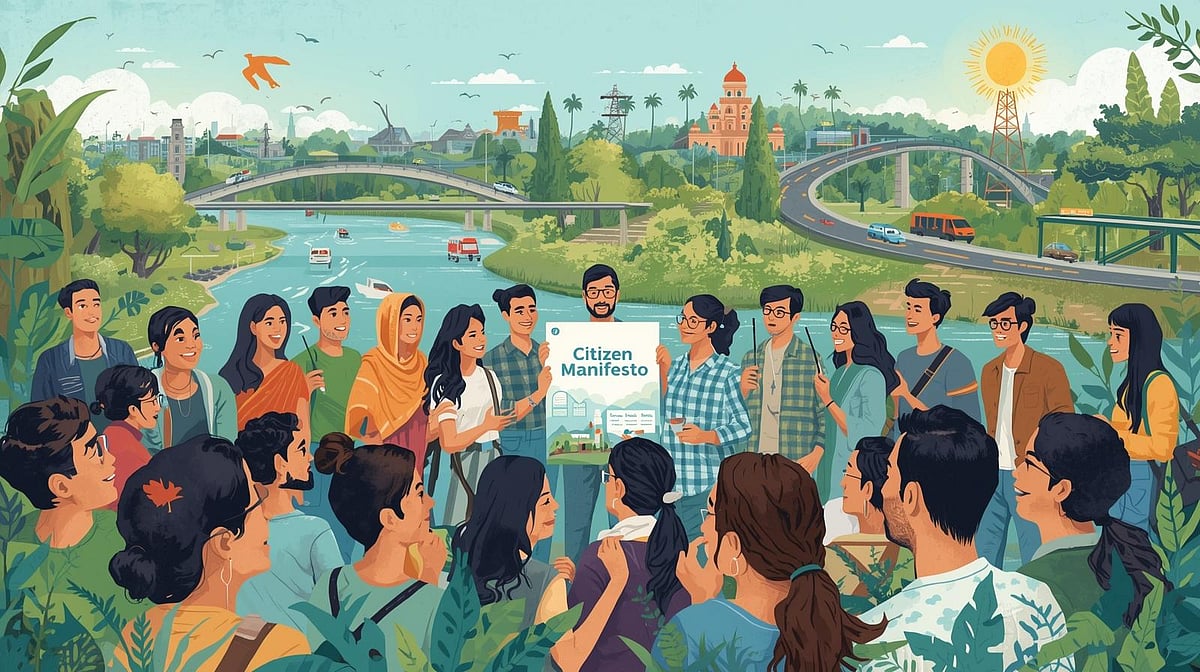
Ahead of the Pune Municipal Corporation (PMC) elections, citizens and environmental groups have released a 'Citizen Manifesto' urging political representatives to prioritise environmental protection, water security and pollution reduction to improve the city’s quality of life.
The manifesto stresses that adequate water supply, efficient public transport, clean rivers and reduced AQI levels are the most critical needs for Punekars.
'Need proper water management'
Sushma Date from Vetal Tekdi Bachav Kruti Samiti, who is working to save eco-sensitive forest areas, highlighted that protecting the city’s green cover and groundwater systems are the two key issues that must be addressed urgently. She warned that unchecked urbanisation and concretisation are pushing Pune towards a serious water crisis, with nearly one-third of the city’s water demand already being met through groundwater and several areas dependent on tanker water.
"We need to have proper water management through managed aquifer recharge, protection of open spaces and public gardens, and declaring major hill ranges, including Vetal, Chatushringi, Pashan and Katraj, as groundwater recharge sanctuaries. We have also demanded revival of Pune’s stream network and opposed infrastructure projects cutting through hills, as they would damage biodiversity, increase pollution and worsen water stress, added Date.
She also recalled the massive public protest on April 15, 2023, when thousands of citizens took to the streets to save Pune’s hills. She said, "Our manifesto makes it clear that environmental protection and sustainable development will be key issues that will influence voters' choice in the upcoming PMC elections."
'Rivers and trees are Pune’s life-support systems'
Prajakta Mahajan, a volunteer at Pune River Revival, noted. "A city that destroys its rivers and trees cannot sustain, let alone prosper." She added, "Rivers and trees are Pune’s life-support systems. In this municipal election, we expect candidates to go beyond token promises and take firm, transparent action to protect the Mula-Mutha, conserve riparian forests and urban tree cover, and safeguard green spaces. Our demands are: stop sewage from entering rivers; stop constricting rivers, no dumping in it; protect trees, wetlands, and groundwater; and revise the RFD to make it eco-friendly."
'Vehicular emissions are a big contributor to harmful pollutants'
Sharmila Deo, Senior Program Associate, Parisar, said, "While it is intuitive that the congestion and pollution in the city are because of the rapidly growing number of vehicles, what steps is the city taking to curb those? Vehicular emissions are a big contributor to harmful pollutants like Particulate Matter, and are impacting citizen health on a large scale. De-incentivising private vehicles and actively strengthening public transport, including last-mile connectivity, providing good footpaths and cycle tracks, is what will help citizens shift from private to public transport. Increasing the bus fleet, adding to the routes and frequency, is necessary to meet the citizens' demand, and it is a key issue influencing voter choice in the upcoming PMC elections."
'Pollution-free rivers is necessary'
"Economic growth without due regard for the environment is a recipe for disaster. Our rivers and green cover need to be preserved to counter climate change & global warming. Compliance with the letter and spirit of the Maharashtra Urban Areas Trees Protection & Preservation Act of 1975, Rules of 2009 and the landmark verdict/order of the Mumbai High Court in the matter of Deepak Vahikar vs. State of Maharashtra & Others (Pune Municipal Corporation included) is expected of our corporators. Conscious effort, in line with the Universal Declaration of Rivers' Rights, rejuvenation of our rivers (Mula-Mutha) in its true sense is imperative instead of mere beautification and impeding the natural flow of rivers, disruption of the riverine ecosystem. Pollution-free rivers through effective sewage treatment is necessary to ensure ecological integrity," said Rohan Aaron, an environmental activist.
'Air pollution is a rising threat'
Ranjit Gadgil, programme director at Parisar, said, "Air pollution is a rising threat to citizens, which is worsened due to climate change and urban heat island effects. Conservation of our natural heritage - hills, rivers and tree cover is critical for the future of the city and the health of residents. The BDP reservation of the hills needs to be made final, the rivers need to be rejuvenated in an eco-friendly manner - not concretised, and we need to stop cutting thousands of trees for mindless projects. Trees are being cut on a massive scale for projects like the RFD. Tunnels are proposed without considering the impact on groundwater, which is a critical element of the water supply in the city."

'We need 100 trees per person'
Ameet Singh, an economist, added, "Working for the environment is counterintuitive, because whatever you want to do, which is pro-environment, will be counter to increasing mindless consumption. For instance, you cannot build an unlimited road, and 1 km of road can only support 200 vehicles. Pune has only 2100 km of road. They built over 7X the road Pune had 20 years ago. Pune had only 400 km of road in the early 90s. Today, four lakh vehicles take to the streets, and Pune traffic hits a gridlock. Pune has over 7 million vehicles. The way out of this is safe, clean, comfortable, battery-operated, AC, app-based public transportation. How many people would like to give up their cars and opt for public transportation instead? Similarly, Pune generates 2.5 crore tonnes of emissions. We need 100 trees per person to obviate this pollution burden, but what we have is one tree per two people. That’s the reason why we need to put the environment first before any planning decision is made. Trees are our primary stakeholders as clean air, pure water and zero garbage are a reality that’s our birthright."

