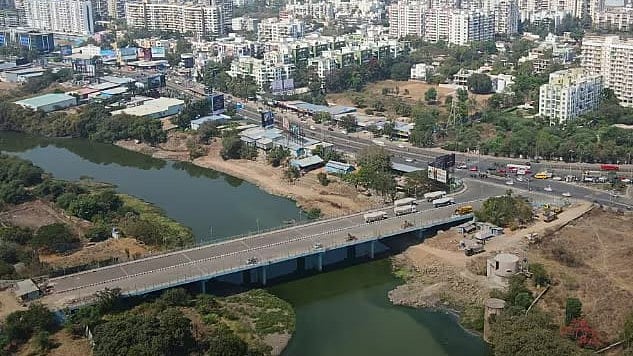
Pune’s efforts to control pollution in the Mula-Mutha river have reached an important stage, with three major sewage treatment plants (STPs) under the Pollution Abatement of River Mula Mutha at Pune (PARMM) project nearing completion.
The project is being implemented under the National River Conservation Programme, which involves the construction of 11 STPs across the city, along with missing sewer links to ensure untreated sewage does not flow into the river. It is jointly executed by the central government, Japan International Cooperation Agency (JICA) and the Pune Municipal Corporation (PMC).
Work at the Mundhwa (20 MLD), Warje (28 MLD) and Wadgaon (26 MLD) STPs, with a combined capacity of 74 million litres per day (MLD), is almost complete. Dry run testing of electro-mechanical systems has been successfully carried out, and wet testing using actual sewage will begin shortly. Once cleared, the plants will be fully operational.
The Mundhwa STP will treat sewage from areas including Handewadi, Mohammadwadi, Kalepadal, Sasane Nagar, Malwadi, Magarpatta and parts of Hadapsar. Warje and Ramnagar areas will benefit from the Warje facility, while the Wadgaon plant will serve Dhayari, Ambegaon, Jambhulwadi and surrounding localities.
Two more STPs, 7 MLD at Matsyabeej Kendra, Hadapsar, and 30 MLD at Kharadi, are scheduled to begin trial operations within the next two months. The remaining five plants are expected to be completed by the end of 2026.
Approved in 2016 at a cost of ₹990.26 crore, the project is largely funded by the central government, with PMC contributing 15 per cent. The overall cost has since increased to around ₹1,173 crore, with ₹844.45 crore already spent.
Once fully commissioned, Pune’s total sewage treatment capacity will rise to 895 MLD, significantly strengthening efforts to prevent untreated wastewater from entering the Mula-Mutha river. Officials said the project will be formally inaugurated after all facilities become operational.
The PARMM (Old Limit) project, aimed at river pollution abatement in Pune, was sanctioned under the National River Conservation Plan by the Ministry of Environment, Forest and Climate Change, Government of India, on January 14, 2016, with financial support from the JICA through a central government loan. The Government of India approved a total grant of ₹841.72 crore, covering 85 per cent of the project cost, while the Pune Municipal Corporation (PMC) is contributing ₹148.54 crore, accounting for the remaining 15 per cent. After completing procedural requirements, JICA granted final approval to the tender process on February 21, 2022, following which PMC conducted the tender for Package ‘A’ and awarded the work to Enviro Control and Toshiba Water Solutions JV on March 3, 2022. The project was formally inaugurated by Prime Minister Narendra Modi on March 6, 2022, marking a significant milestone in Pune’s river conservation and wastewater management efforts.

