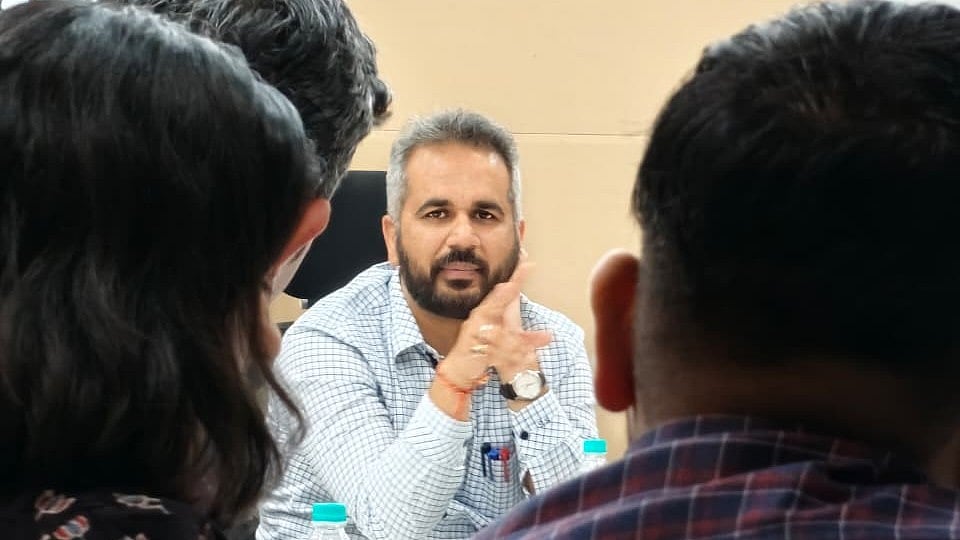
Nashik: The Nashik–Trimbakeshwar Kumbh Mela Authority (NTKMA) on Friday convened the inaugural meeting of the Technical Advisory Committee (TAC) on City Beautification to accelerate preparations for the Simhastha Kumbh Mela 2027. The meeting was held at the Smart City Office, Panchavati, under the chairmanship of Dr Prajakta Baste, in the presence of NTKMA Commissioner Shekhar Singh, NTKMA Chief Officer Amol Chaudhary and other committee members Dinesh Vaidya, Samruddha Mogal, Praful Sawant, Shreya Krishnan, and Arch. Pramod Kamble.
The TAC has been constituted to provide strategic and multi-disciplinary guidance aimed at enhancing the visual, cultural and experiential landscape of Nashik and Trimbakeshwar in the run-up to the Kumbh Mela.
The committee deliberated on seven key intervention themes under the city beautification initiative: Urban Repairs and Restoration, Paint My City, Signage (permanent and temporary), Illumination (temporary and permanent), Intangible Heritage, Urban Art Installations, and Digital Interventions.

Discussions under the Urban Repairs and Restoration theme focused on heritage-sensitive improvements and upgradation of select urban spaces in Nashik and Trimbakeshwar. The ‘Paint My City’ initiative will involve empanelment of agencies and artists to undertake curated aesthetic enhancements at identified locations, including Nashik, Trimbakeshwar, Kavnai, Taked and Chakrateerth.
The committee also reviewed proposals to strengthen signage and wayfinding systems across key pilgrimage routes, forts, hills and temples, with scope for CSR participation. Plans for illumination, including façade lighting and decorative installations, were discussed to enhance the visual character of important sites. In addition, strategies for promoting intangible heritage through knowledge partnerships and curated urban art installations at prominent locations were examined.
Speaking on the occasion, NTKMA Commissioner Shekhar Singh said that Simhastha 2027 presents a significant opportunity to showcase Nashik and Trimbakeshwar as culturally vibrant, aesthetically refined and pilgrim-centric cities.

“The beautification efforts must respect the timeless identity of the region while integrating contemporary design approaches and sustainable practices,” he said.
Dr Prajakta Baste emphasised the need for a cohesive visual language and coordinated implementation to ensure that interventions create a lasting impact beyond the event period.
The meeting concluded with a clear direction to move towards detailed planning and phased execution, with the TAC set to undertake periodic reviews to ensure that the approved interventions are implemented in a timely, integrated and heritage-sensitive manner.