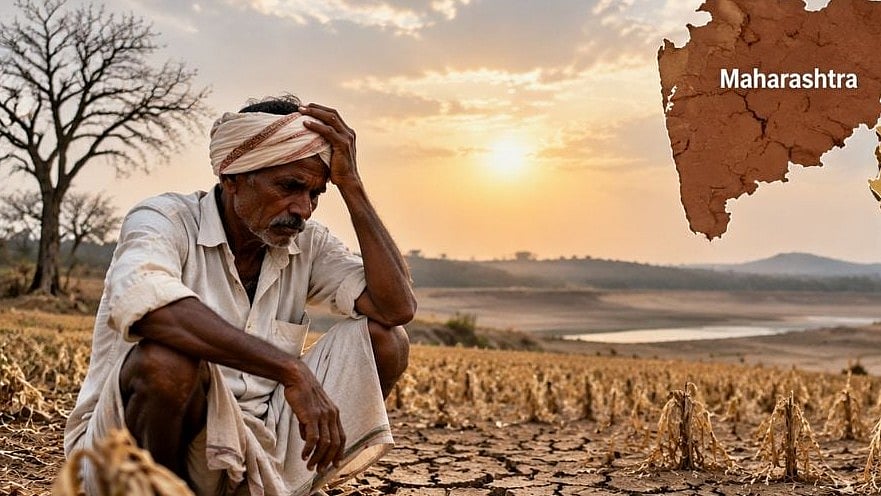
Nashik: The kharif season in Nashik district has suffered a severe blow due to a prolonged dry spell following a strong onset of the monsoon. The extended lack of rainfall has raised drought concerns across all 13 talukas of the district, with crops on 6,44,289 hectares suffering damage.
The dry spell has affected 6,87,065 farmers across 3,306 villages in the district. The process of conducting crop damage assessments (panchnamas) has been completed, and the district administration has submitted a proposal to the state government seeking financial assistance of ₹658.60 crore to compensate farmers for crop losses.
For the current kharif season, the Agriculture Department had projected a cultivation area of 6,40,550 hectares. Encouraged by favourable early monsoon forecasts, farmers completed sowing across a record 6,51,287 hectares, achieving 101.68% of the target.
Farmers invested thousands of rupees in seeds, fertilisers and land preparation and struggled to keep their crops alive. However, rainfall stopped when the crops were at critical growth and flowering stages, severely affecting agricultural production.
With their fields drying up, farmers have suffered substantial losses on their investments. A joint survey conducted by the Revenue and Agriculture departments revealed extensive damage to rain-fed crops.
Rain-fed crops were the hardest hit, with 5,43,549 hectares belonging to 5,57,701 farmers affected. The estimated loss in this category stands at ₹462.01 crore.
Water scarcity and declining groundwater levels affected 54,687 hectares of irrigated land belonging to 71,944 farmers, with losses estimated at ₹92.96 crore.
Another 46,053 hectares of perennial fruit crops, including grapes, pomegranates and other fruits, belonging to 57,420 farmers suffered significant damage. The estimated loss in this category stands at ₹103.61 crore, raising concerns about the upcoming season.
Drought-Mitigation Measures in Two Phases
Recognising the gravity of the situation, the government, through the Department of Relief and Rehabilitation, initiated drought-mitigation measures in the district in two phases.
In the first phase, Trigger-1 was implemented in 10 talukas facing acute water scarcity. In the second phase, Trigger-2 was declared for Niphad, Trimbakeshwar and Chandwad talukas.
The administration submitted the final damage report to the state government on Oct 26. Farmers are now urging the government to deposit relief funds directly into their bank accounts without bureaucratic delays.

