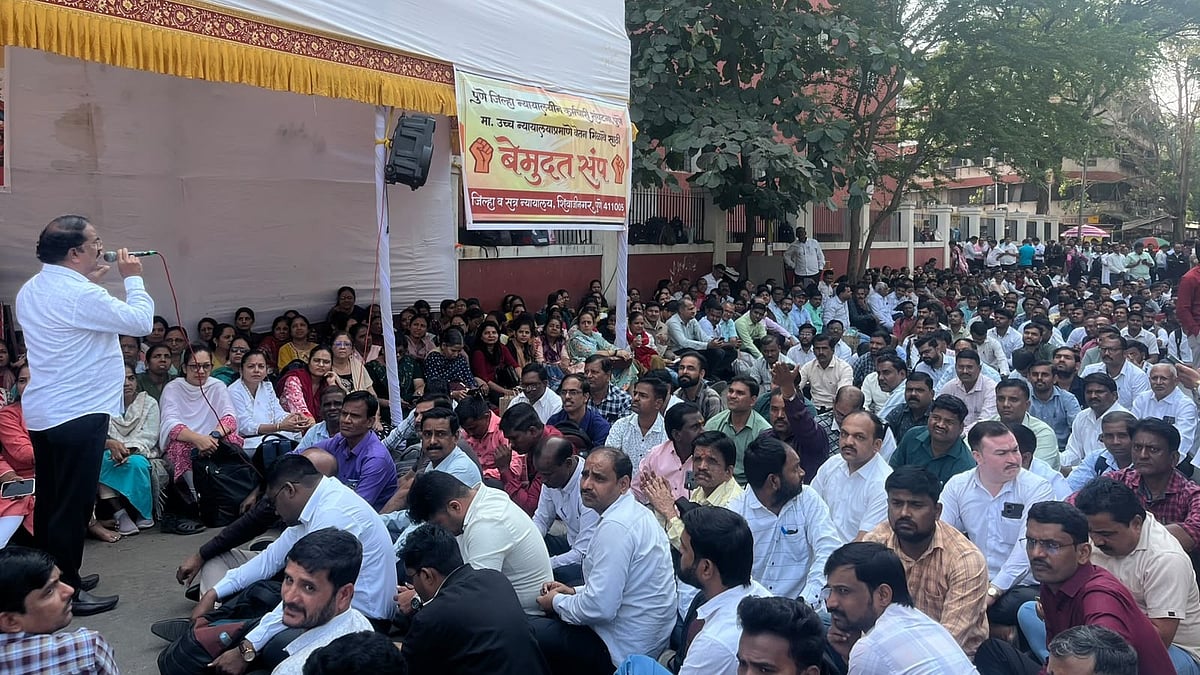
Pune: Judicial employees across Maharashtra began an indefinite strike on Tuesday, November 17th bringing court-related work to a standstill as more than 2,000 employees of district and subordinate courts, including Pune District Court at Shivajinagar, stayed away from work to demand equal pay for equal work.
The employees are demanding that the Maharashtra Government approve a revised pay-scale proposal granting them salary benefits on a par with employees of the Bombay High Court. They have warned that the strike will continue until the government issues a Government Resolution (GR) approving their demand.
Speaking to The Free Press Journal, Mahesh Almalik, president of the Pune District Court Employees' Association, said, "Our only primary demand is equal pay for equal work. The work performed by employees in district courts is the same as that performed by employees in the High Court. In fact, the workload in district courts is greater because trials and the actual proceedings of cases take place here, while the High Court primarily deals with appeals."

He alleged that while the pay scales of High Court employees were revised from 2006 onwards, those of subordinate court employees remained unchanged.
Explaining the disparity, he said, "If a peon in the High Court earns around Rs 25,000, a peon working in a district court receives only Rs 17,000 to Rs 18,000. There is a difference of at least Rs 8,000 for the same work."
Almalik said employees had been pursuing the demand for several years. A committee comprising two High Court judges had examined the matter and reportedly submitted a report recognising the similarity like work performed by both categories of employees.
Subsequently, the Bombay High Court forwarded the revised pay-scale proposal to the State Government on Jan 31, 2025. However, it remains pending.
"We have approached MLAs, MPs and Cabinet ministers, and several representatives have given written support to our demand. Despite repeated follow-ups, the proposal has not been approved. We did not want to go on strike, but when injustice is being done to us, we have no other option. We will continue the indefinite strike until we get justice," he said.
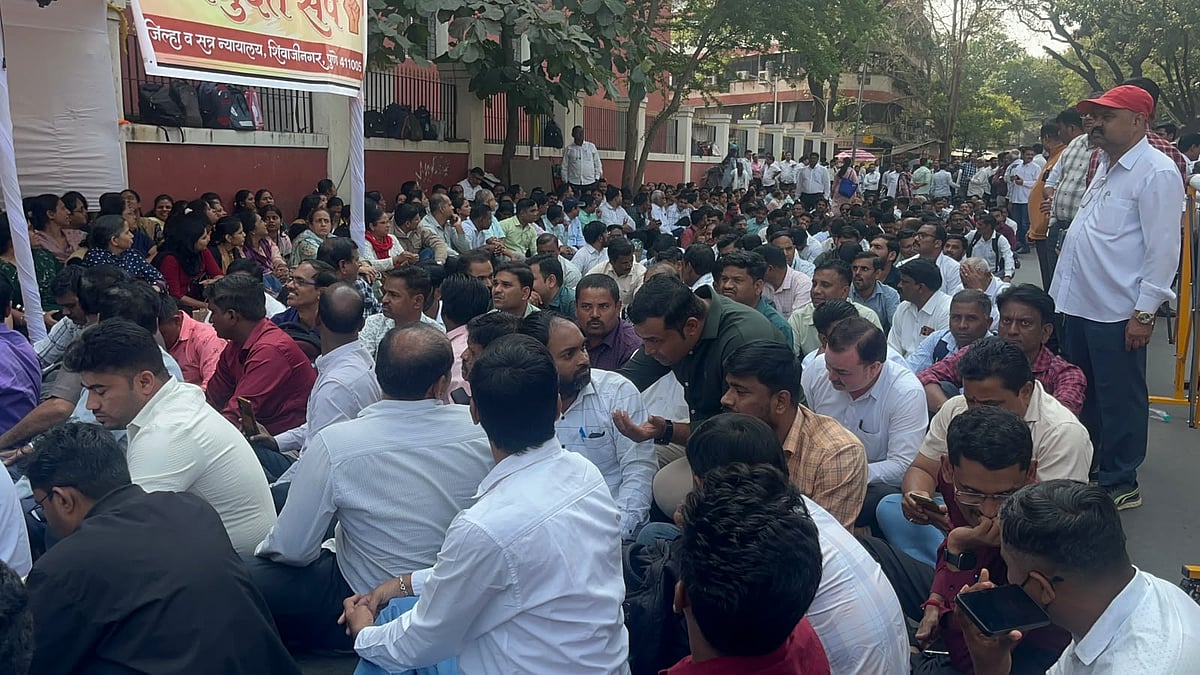
Supporting the agitation, advocate Rupali Thombare said judicial employees were indispensable to the functioning of courts.
"The courts cannot function without these employees. The work of the High Court itself depends on the work carried out by district court employees, as files and cases move from the district courts to the High Court. If the work is the same, why should the salaries be different? Their demand is completely justified," she said.
Appealing to Chief Minister Devendra Fadnavis and Deputy Chief Ministers Eknath Shinde and Sunetra Pawar, Thombare said the government should approve the proposal immediately.
"People who maintain law and order should not be forced to take to the streets for their rights. If the Chief Minister approves equal pay today, these employees will leave the protest within two hours. If the agitation intensifies, the government will be responsible," she added.
An employee participating in the protest said employees were unwilling to sit outside courts instead of working.
"We want to work, but we must get the salary we deserve. We handle files, court dates, litigants and lawyers, and often do more work than our counterparts. We will not withdraw until the GR is issued and the pay-scale proposal is approved," she said.
Meanwhile, a memorandum dated Aug 16, 2026, submitted by four recognised judicial employees' organisations, lists several long-pending demands, including implementation of the Old Pension Scheme, recommendations of various commissions, removal of restrictive promotion conditions, regular recruitment in place of contractual appointments and the establishment of a separate tribunal to address employees' grievances.
The organisations had earlier announced phased protests, including wearing black ribbons, collective leave and hunger strikes during Diwali, before launching the indefinite strike on Nov 17. They have appealed to the government and the High Court administration to intervene and resolve the issue.

