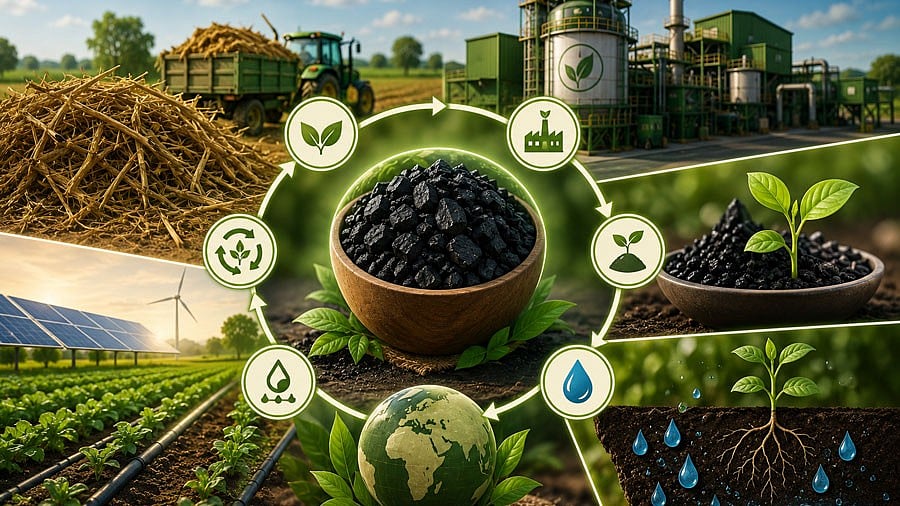
Jalgaon: Jain Irrigation, a global leader in sustainable agriculture and the world's largest provider of micro-irrigation systems, has commissioned one of the world's largest industrial-scale biochar facilities in Jalgaon. Developed in collaboration with international partners and experts, the project marks a major step towards climate-smart agriculture, circular manufacturing and large-scale carbon removal.
The facility has an annual processing capacity of approximately 20,000 tonnes and can process more than 50 metric tonnes of agricultural and fruit-processing residues every day. Considered one of the world's largest single biochar reactors, the project significantly strengthens India's position in the rapidly growing global biochar and carbon removal sector.
Biochar is a stable, carbon-rich material produced through the controlled heating of agricultural residues in a low-oxygen environment, a process known as pyrolysis. Instead of being burnt in fields, crop residues are converted into biochar, allowing carbon to be safely stored for hundreds of years while simultaneously improving soil quality. Owing to its ability to remove and store atmospheric carbon, biochar is increasingly being recognised as one of the most effective and sustainable carbon dioxide removal (CDR) solutions.
The Jalgaon project is based on a circular economy model that converts agricultural waste into a valuable soil-enhancing product and returns it directly to farmers. By improving soil fertility, increasing water-retention capacity and reducing dependence on chemical fertilisers, biochar can help strengthen climate-resilient agriculture while creating additional income opportunities for farmers.
A key advantage of the initiative is Jain Irrigation's extensive agricultural network, which spans micro-irrigation, nurseries, agro-processing and renewable energy sectors. This enables the company to deliver biochar directly to farming communities, providing an efficient last-mile distribution system that is unmatched in the Indian biochar industry.
India generates more than 500 million tonnes of agricultural residue every year, much of which is burnt in open fields, contributing to air pollution and carbon emissions. Jain Irrigation's biochar initiative seeks to convert this environmental challenge into an economic and agricultural opportunity by creating value from agricultural waste while reducing harmful emissions.
Beyond environmental benefits, the project is expected to generate rural employment opportunities in the collection, processing and distribution of agricultural residues and biochar products. It also supports India's National Action Plan on Climate Change and has the potential to integrate farmers into emerging global carbon markets through the generation of carbon credits.
The project's carbon removal capability is particularly significant. By converting biomass into biochar and storing it in soil, carbon can remain locked away for centuries, making the process an effective long-term climate mitigation strategy. At the same time, the application of biochar helps increase soil organic carbon levels, improve water-use efficiency and enhance agricultural productivity.
Alvin Lee, Head of Supply at Puro.earth, a global carbon removal registry, described the project as an important example of leadership in the carbon removal sector.
"The large-scale biochar project established by Jain Irrigation demonstrates the kind of innovation and commitment needed to advance carbon dioxide removal. Biochar offers substantial benefits for Asia's agricultural economies by improving soil health and water retention while reducing dependence on chemical fertilisers," he said.
Speaking on the occasion, Jain Irrigation Managing Director Anil Jain said the project reflects the company's commitment to creating long-term value for farmers, communities and the environment.
"This is a moment of immense pride and an important milestone for us. The principle of creating value for all lies at the heart of our work. This project goes beyond technology and reimagines the agricultural value chain. By transforming agricultural residues into valuable resources, we are building a circular ecosystem that generates benefits for farmers and all stakeholders," he said.
The Jalgaon facility is the first in a planned series of industrial-scale biochar reactors, with additional projects already under development. Through these initiatives, Jain Irrigation aims to expand sustainable agricultural practices, accelerate carbon removal efforts and create new economic opportunities for rural communities across India.

