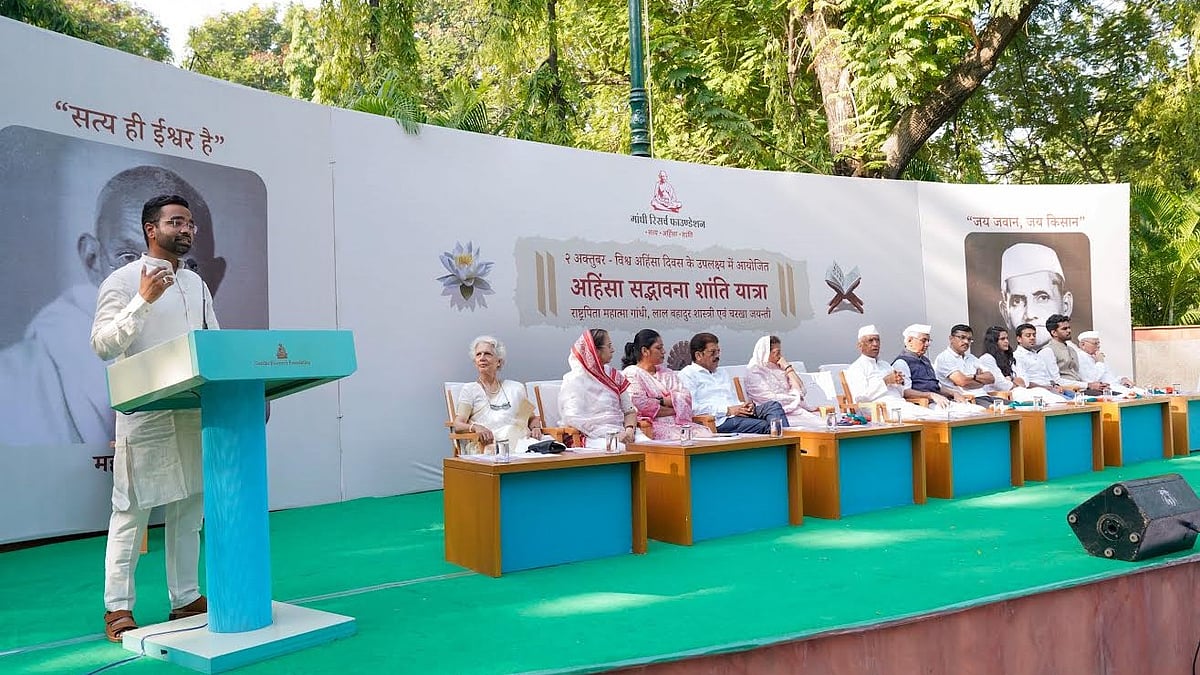
Jalgaon: Conflict, instability and interdependence are currently on the rise globally. Against this backdrop, Gandhiji’s ideals of non-violence, peace and goodwill are essential today, District Collector Rohan Ghuge said.
He said a capable generation of enlightened citizens can be shaped by embracing values such as Swadeshi (self-reliance), cleanliness, rural development, preservation of traditional occupations, voluntary labour (shramdan) and social commitment.
The Ahimsa-Sadbhavana-Shanti Yatra was organised by the Gandhi Research Foundation to mark Gandhi Jayanti, Lal Bahadur Shastri Jayanti and the International Day of Non-Violence. Ghuge was speaking as the chief guest at the concluding ceremony of the march.

Dignitaries present on the dais included MP Smita Wagh, MLA Suresh Bhole, Mayor Deepmala Kale, Superintendent of Police Shrikant Dhivare, Zilla Parishad CEO Karishma Nair, Deputy Conservator of Forests Sauresh Sahay, Municipal Commissioner Aditya Jeevane, Sub-Divisional Officer Yogesh Kumar Meena, former Vice-Chancellor Dr K B Patil, Jain Irrigation Chairman Ashok Jain, Jyoti Jain, Rajendra Mayur and Gandhi Research Foundation Dean Gita Dharampal. On the occasion, MP Smita Wagh administered the pledge of non-violence to the attendees.
Ghuge remarked that a close look at Gandhiji’s life reveals that the reason for his greatness was not that he never made mistakes, but that he honestly acknowledged his errors and ensured they were not repeated. He openly shared many incidents from his life in his book, The Story of My Experiments with Truth.
He said Gandhiji conveyed the values of truth, non-violence, Swadeshi (self-reliance), goodwill, voluntary labour (shramdan) and cleanliness not merely through words, but through his own conduct. Living by what one preaches was the true strength of his personality.
A message was conveyed urging today’s generation to look to the ideals and thoughts of Mahatma Gandhi and Lal Bahadur Shastri for inspiration. During Shastriji’s era, the country faced food shortages and numerous challenges; yet, it was from this context that the nation moved towards the Green Revolution, dairy cooperatives and food security. The Gandhi Research Foundation in Jalgaon is doing significant work to preserve the legacy of Gandhiji’s philosophy.
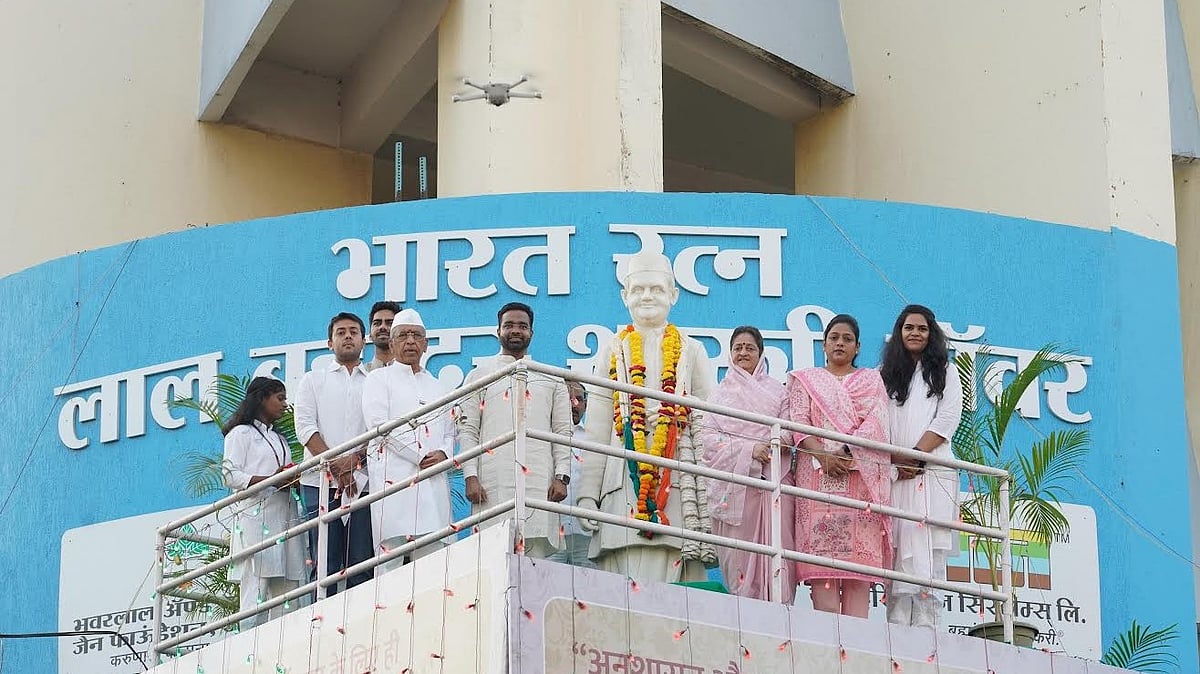
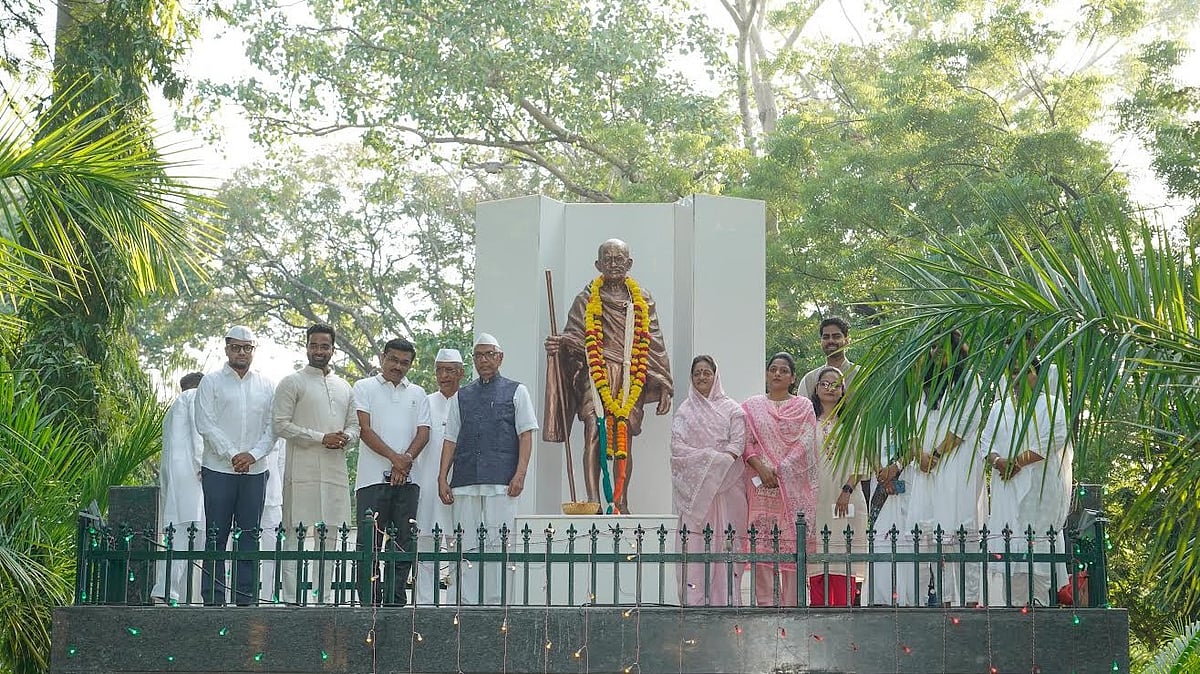
The Ahimsa-Sadbhavana-Shanti Yatra was flagged off by the dignitaries present after they garlanded Lal Bahadur Shastri’s portrait. The procession concluded at Mahatma Gandhi Udyan with the offering of a Suti-haar (cotton yarn garland) to the statue of Mahatma Gandhi.
Students participated in the procession dressed as national icons, including Bharat Mata, Kasturba Gandhi and Subhash Chandra Bose. A live tableau featuring continuous cotton spinning on a Charkha (spinning wheel) mounted on a bullock cart was a major attraction. Hundreds of residents from Jalgaon, representing various schools and organisations, participated in the event.
Students from Anubhuti Balniketan presented the song Gandhiji Ke Bandar Hum (We are Gandhiji’s Monkeys) accompanied by a performance. The group included Artham Athang Jain, Litsa Manish Jain, Aarav Harshad Jain, Anaysha Ashish Bansal and Rachit Kunal Rajput, performing under the guidance of Shubhada Neve.
Celebrating Culture And 18 Languages Through ‘Bharat Ki Santan’
A unique programme titled Bharat Ki Santan (Children of India), conveying the message of unity in diversity, was presented on the occasion. The central message of the programme was, “We are all one.”
Students participating in the National Gandhian Leadership Camp showcased the diversity of the 18 languages recognised by the Indian Constitution, as well as the attire and culture of the respective linguistic regions.

