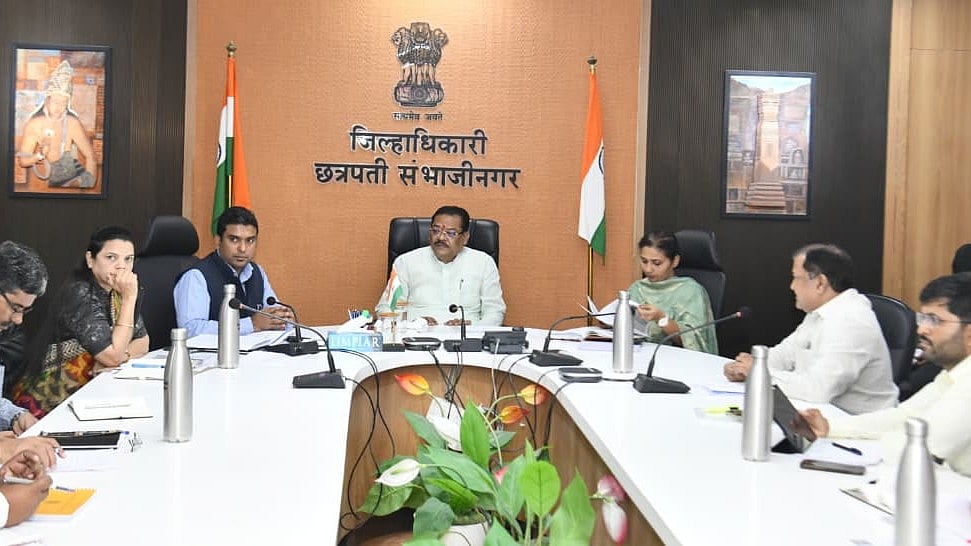
Chhatrapati Sambhajinagar: Against the backdrop of the drought situation in the district, State Minister for Social Justice and the district’s Guardian Minister Sanjay Shirsat issued directives on Thursday to prioritise scarcity mitigation works in the district. He emphasised the need to prioritise activities such as fodder crop cultivation, desilting and depositing the silt in farmers’ fields, water supply, providing assistance to farmers and farm labourers, and ensuring the availability of employment.
Guardian Minister Shirsat reviewed drought relief measures during a meeting of the district-level monitoring committee on Thursday.
District Collector Vinay Gowda GC, Zilla Parishad Chief Executive Officer Minnu PM, Additional Commissioner Kalpita Pimple, Superintending Engineer and Administrator of the Command Area Development Authority Rajendra Dhodapkar, Executive Engineer (Irrigation) SG Shahpure, Executive Engineer (Jayakwadi Irrigation Division) Ganesh Hase, Executive Engineer (Nandur-Madhmeshwar Irrigation Division) Pravin Pable, Deputy Executive Engineer (Minor Irrigation Division) Rupesh Hire, City Engineer Sanjay Kombde, among others, were present.
Shirsat began by reviewing the district’s available water reserves and fodder supply. He emphasised the need to boost fodder production to ensure that fodder does not have to be sourced from outside the district. To this end, subsidies could be provided to farmers cultivating fodder under the Fodder Development Programme. He also directed that farmers with land along canals be encouraged to cultivate fodder crops.
District Collector Vinay Gowda GC stated that fodder cultivation can be undertaken along the banks of the Godavari River and in the dam backwater areas of Gangapur taluka. By supplying fodder to the district’s silage producers, livestock feed security can be ensured through the production of silage.
Shirsat stated that, if the need arises, fodder should be made available to neighbouring districts. Priority must be given to scarcity relief measures while utilising funds. Field visits to ongoing works should be conducted, and reviews should be carried out based on daily and weekly reports.

Voluntary organisations should be involved in drought relief operations and assistance, and Corporate Social Responsibility (CSR) funds from industries should be utilised. These organisations and industries should be invited to provide assistance. A control room should be established to manage the relief funds and materials being received and distributed.
He directed that a system be established to monitor tanker transport via GPS and control operations from the district headquarters. He instructed that a proper schedule be prepared for water supply rotations and distribution. Priority should be given to desilting work, and the removed silt should be transported to farmers’ fields free of cost. Additionally, he directed that employment opportunities be made available to farm labourers at the local level.
He instructed the administration to plan in such a way that farmers receive assistance before Diwali. He also directed that the district should implement scarcity relief measures that serve as a model for the rest of the State.

