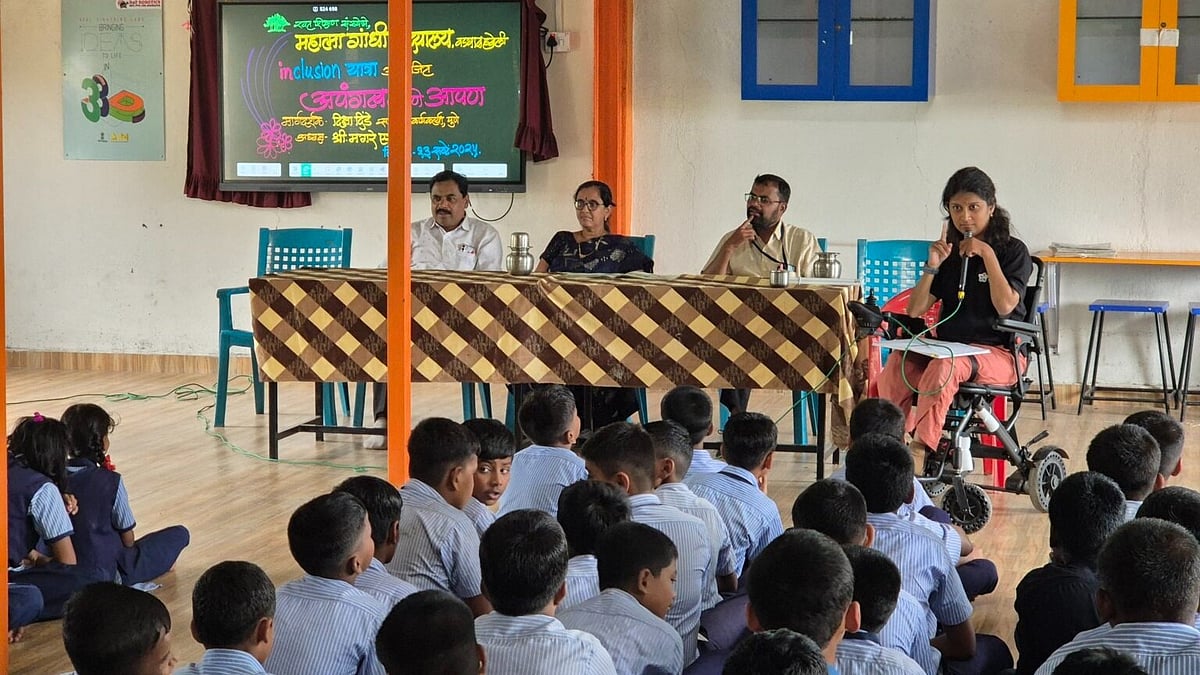
In a country where accessibility for the disabled is often treated as an afterthought, EquiBridge Foundation in Pune is working to make inclusion the starting point.
Founded in November 2024 by Diksha Dinde and her partner Amol Sutar, EquiBridge is a rights-based organisation committed to advancing accessibility, inclusion and social justice -- not as acts of charity, but as matters of dignity and justice. The idea behind the foundation is both simple and urgent: every individual, whether disabled or non-disabled, should be able to live, learn and work without barriers.
The name itself reflects the work it does. “Equi” stands for equity and equal opportunity, while “Bridge” represents the organisation’s role in connecting communities, institutions and systems. EquiBridge works to bridge the persistent gap between policy and practice, ensuring that the rights promised on paper are actually experienced in everyday life.
Dinde's inspiration came from lived experiences and years of grassroots work across India. “I have worked closely with rural and marginalised disabled communities and have seen how structural barriers, not impairments, limit opportunities. We construct buildings, design classrooms, draft policies, and launch schemes, and only later ask whether disabled people can access them. Accessibility is often treated as an afterthought rather than a foundation. That deeply troubled me,” said Dinde.
The foundation’s approach addresses a systemic challenge in India: while laws mandating accessibility exist, their implementation often does not. From education systems and workplaces to public infrastructure and digital platforms, accessibility continues to remain a missing piece. EquiBridge actively works to change this through a combination of advocacy, accessibility audits, sensitisation training and capacity building. So far, the organisation has conducted more than 30 accessibility audits across institutions, assessing compliance with the Rights of Persons with Disabilities Act and other accessibility standards. But their work does not end with evaluation. Their work is primarily on disability rights and the intersection of disability with other social identities. The core gap that they are addressing is between rights and reality. India has multiple laws and constitutional guarantees that clearly mandate accessibility and equality. On paper, these protections are strong. But in everyday life, accessibility is still a missing piece in many spaces. They are trying to address the systemic gap where rights exist in legislation but are not reflected in lived experience.
Their sensitisation and training programmes engage directly with students, teachers, professionals, government officials and community members. These sessions are designed as interactive dialogue spaces that encourage participants to reflect on inclusive practices, rethink language and understand disability through a human rights lens.

One of EquiBridge’s most impactful initiatives has been the Inclusion Yatra, a statewide journey across Maharashtra aimed at understanding and improving accessibility at the grassroots level. Instead of hosting isolated conferences, the team travelled across districts for over 100 days, engaging with diverse stakeholders, including parents, architects, educators and policymakers.
Through this initiative alone, the organisation has directly reached more than 35,000 individuals. In total, within just one and a half years of its inception, EquiBridge has engaged with over 40,000 people through its trainings, audits and public dialogues. The impact of this work is already visible. Schools that participated in EquiBridge’s programmes have begun rethinking infrastructure and inclusive practices. Two private institutions have committed to becoming fully accessible in the near future, working towards creating systems that will allow students with disabilities to learn there.
Mindset shifts are also emerging. Many individuals who engaged with the organisation have expressed a commitment to becoming more empathetic in their communication and conscious in their everyday actions. “When people begin to say, ‘This is not just your issue, this concerns all of us,’ that shift is powerful,” the founder noted.
Kshitija Deshmukh, Aspirational Block Fellow, NITI Aayog, Collector Office, Nandurbar, shared, “I first got to know about Diksha Dinde during my graduation, and the way she was so inspiring and clear with her goals truly stayed with me. I wanted to know her personally because she genuinely wanted to make a change and was rigorously working toward it. Later, when I started working as an Aspirational Block Fellow with NITI Aayog at the Collector’s Office in Nandurbar, she came to deliver a speech. I assumed she would address only persons with disabilities, but she made sure everyone, disabled or not, was present to understand that accessibility is a human right. We always thought adjustment was the key, but her words changed that perspective. Today, her efforts are visible; you can see changes in the office that have been made in favour of persons with disabilities.”

