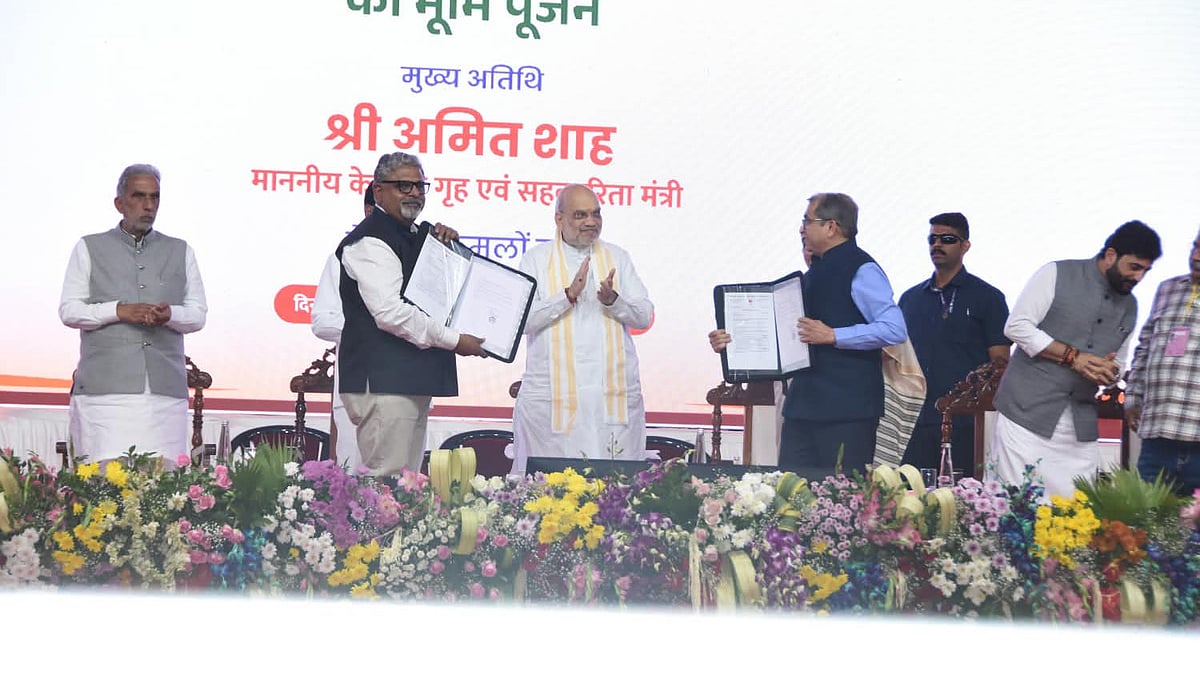
Pune: Union Home and Cooperation Minister Amit Shah on Sunday announced that production at the National Heavy Engineering Cooperative (NHEC) plant in Talegaon Dabhade would begin before December 2027. Shah performed the bhoomipujan (groundbreaking ceremony) for the plant's revival project, which aims to restore operations at the cooperative engineering institution after years of closure. The 110-acre facility in Pune district will initially manufacture machinery for sugar factories, dairy processing equipment, ethanol plants and compressed biogas (CBG) facilities.
It will also manufacture equipment for the agriculture and food processing industries. Maharashtra Deputy Chief Ministers Sunetra Pawar and Eknath Shinde said the revival project involves financial assistance of ₹1,500 crore from the Centre. They said the initiative would give a fresh lease of life to the institution and create employment opportunities in the region. Addressing the gathering, Shah said the revival process had involved financial restructuring, audits and the participation of major cooperative institutions. “Before December 2027, production will commence here, and sugar mills will start being built from here,” he said.
NHEC To Expand Beyond Sugar Industry
Established in 1974, NHEC played an important role in manufacturing heavy machinery for sugar factories in India and abroad. It also manufactured centrifugals, high-pressure boilers and other industrial equipment. Shah said the institution had supplied more than 5,000 centrifugal machines across India and overseas. Its machinery was also exported to 11 countries, including Zambia, Ethiopia and Vietnam.
However, the institution gradually shut down after facing several challenges. Shah said the factory had once received so many orders that customers had to wait up to four years for the supply of sugar plant machinery. He said the factory had also faced the threat of encroachment on its 110-acre land after its closure.
The revival plan has been prepared by the National Dairy Development Board (NDDB). Major cooperative institutions, including Amul, National Agricultural Cooperative Marketing Federation of India (NAFED), Indian Farmers Fertiliser Cooperative (IFFCO), National Cooperative Development Corporation (NCDC), Indian Potash Limited (IPL) and NDDB have come together to support the project.
NDDB has taken over as the administrator of the institution. Shah said the pending audits had been completed, its board of directors had been reconstituted and a plan had been prepared to restructure its liabilities and settle outstanding debts. The board decided to rebuild the facility at its first meeting on Oct 9, 2026.
With technical support from NDDB's subsidiary IDMC Limited, the revived facility will also move into sectors beyond its traditional sugar industry operations. The proposed manufacturing activities include dairy farm machinery, dairy processing equipment, ethanol plants, compressed biogas facilities and equipment for food processing.

Second Phase To Focus On Railway, Defence Equipment
Shah said the project would be expanded in its second phase to include the manufacturing of railway, defence and export containers. He said the facility would also focus on developing a circular economy by using by-products from sugar factories and dairy operations.
“Every byproduct from sugar mills will be utilised to reduce the country's imports,” Shah said. He added that the project would also help farmers earn from cow dung through its use in the production process.
Shah said the initiative would strengthen domestic manufacturing and reduce dependence on imported equipment. He expressed confidence that NHEC would emerge as a successful cooperative institution like Amul, IFFCO and Krishak Bharati Cooperative (KRIBHCO).

Leaders Highlight Employment Opportunities
Shinde said the revival of NHEC would strengthen the rural economy and benefit farmers across Maharashtra. He said the facility would manufacture machinery required by sugar factories, dairy businesses, ethanol plants and biogas industries. He also said the project would generate employment on a large scale and provide opportunities for skilled workers in the region.
Shinde credited Shah with taking the initiative to revive the institution and said the cooperative sector had undergone major changes since the establishment of the Union Ministry of Cooperation.
Sunetra Pawar also highlighted the institution's contribution to Maharashtra's industrial and cooperative sectors. She said NHEC had supplied machinery to sugar factories in Kolhapur, Sangli and Satara, besides serving major steel projects such as Bhilai and Visakhapatnam. She said hundreds of workers had been employed at the institution over the years and that its revival would bring new hope to families associated with it.
However, Sunetra Pawar said some issues concerning the workers were still pending. She expressed confidence that they would be resolved with the support of Shah and the Maharashtra government. The revival project is expected to restore NHEC's manufacturing capabilities and strengthen cooperative-led industrial development in Maharashtra.

