
Navi Mumbai: Residents stepping out for their morning walks may be exposing themselves to dangerously high levels of air pollution, with Navi Mumbai recording an Air Quality Index (AQI) of 216 on Monday morning. The reported PM2.5 concentration translates to an estimated pollution exposure equivalent to smoking 6.4 cigarettes a day, according to an illustrative methodology developed by US-based environmental research organisation Berkeley Earth.
Also Watch:
More than a week after Diwali, firecrackers continue to burst late at night and during the early morning hours, adding to the pollution caused by construction activities, road dust and vehicular emissions. The deteriorating air quality has raised concerns among environmental activists, who warn that the city's pollution problem is no longer restricted to the festive season but has become a persistent public health concern.

According to the AQI.in monitoring platform, Navi Mumbai recorded an AQI of 216 at 6.51 am on November 16, with PM2.5 levels at 140 micrograms per cubic metre (µg/m³) and PM10 at 167 µg/m³. The PM2.5 concentration was more than twice the permissible 24-hour limit of 60 µg/m³ prescribed under Indian standards, while PM10 exceeded its corresponding limit of 100 µg/m³.
The cigarette-equivalence estimate is based on continuous exposure to the reported PM2.5 concentration over 24 hours. It is an illustrative comparison to communicate the potential health risks of air pollution and does not mean that a single morning walk is equivalent to smoking 6.4 cigarettes.
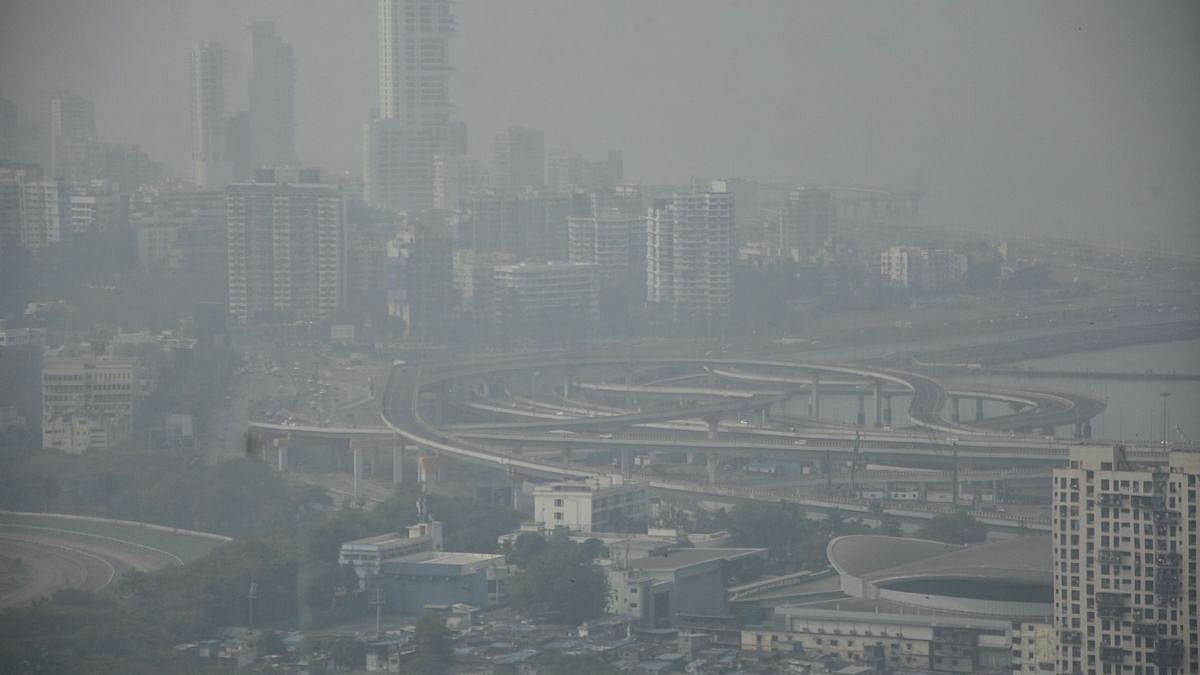
The pollution burden is being felt across Navi Mumbai and neighbouring Thane, with areas such as Vashi, Kopar Khairane, Nerul, Kharghar, Ghodbunder Road, Majiwada and Kalwa witnessing the combined impact of rapid construction and increasing traffic.
Uncovered trucks transporting construction material, indiscriminate dumping of debris, dust generated by infrastructure projects and heavy vehicular movement along the Sion-Panvel Highway, Palm Beach Road and Eastern Express Highway are among the major contributors, said NatConnect Foundation director B N Kumar.
"I opened my window at 7 am on Monday and immediately began coughing severely. I had to abandon my morning walk," Kumar said.

He pointed out that firecrackers were continuing to burst late at night and early in the morning, adding fresh smoke to an atmosphere already laden with construction dust and automobile emissions.
Kumar questioned the lack of enforcement against unauthorised fireworks, uncovered transportation of construction material and visibly polluting vehicles. "What is the point of celebrating development when citizens cannot even breathe clean air? We are building roads, bridges and skyscrapers, but are we building healthy cities?" he asked.
He said air pollution must be treated as a serious public health issue rather than merely an environmental concern, as prolonged exposure could particularly affect children, senior citizens and people suffering from respiratory and cardiovascular ailments.
Echoing these concerns, Shrikant Patki of the Palm Beach Greens platform said rapid redevelopment, unregulated transportation of construction material and continuous vehicular emissions were contributing to the deteriorating air quality.

"Construction activity, movement of uncovered trucks and traffic emissions continue throughout the day. Firecrackers only add to the pollution burden," Patki said.
Weather conditions are also aggravating the situation. Low wind speeds, cool morning temperatures and temperature inversions can restrict the dispersal of pollutants, allowing smoke and fine particulate matter to remain trapped closer to the ground. The AQI.in platform recorded wind speeds of just 4.3 kmph along with smoky haze during Monday's morning reading.
Environmental activists have called for stricter enforcement against unauthorised fireworks, uncovered construction transport, road dust and polluting vehicles, along with continuous air quality monitoring in residential areas and zones witnessing large-scale infrastructure development.
Kumar said authorities must move beyond issuing routine advisories and ensure that pollution-control measures are implemented effectively on the ground.
"Clean air is not a luxury. It is a basic necessity. Development that compromises public health cannot be called sustainable development," he said.
To get details on exclusive and budget-friendly property deals in Mumbai & surrounding regions, do visit: https://budgetproperties.in/

