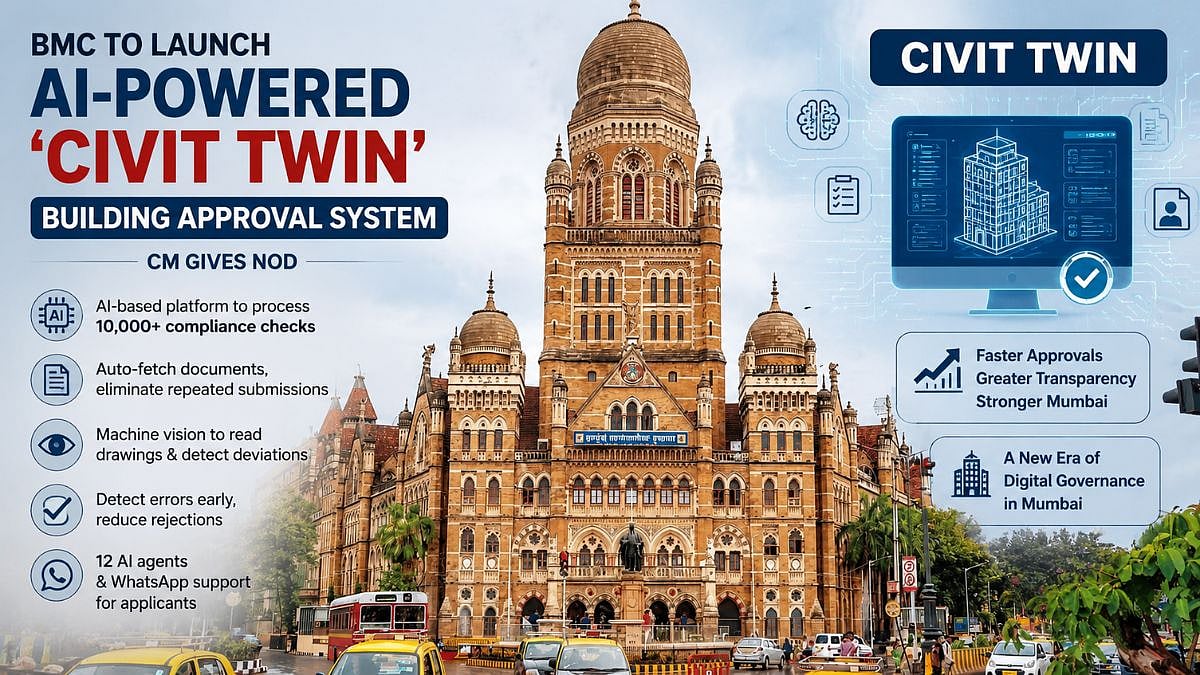
Mumbai, May 26: In a major technological reform aimed at transforming Mumbai’s real estate approval process, the Brihanmumbai Municipal Corporation (BMC) is set to launch an artificial intelligence-powered building approval system named “CIVIT TWIN”.
The rollout of the system received the green signal following a review by the Chief Minister, marking a significant shift towards automation and digital governance in Mumbai’s construction and real estate sector.
According to information shared about the platform by Keval Valambhia, Chief Operating Officer, CREDAI MCHI, a real estate developers’ association, the new system will integrate artificial intelligence into the building permissions and approval process.
The AI-based platform is expected to process more than 10,000 compliance checkpoints during the scrutiny of proposals.
AI to automate scrutiny and approvals
Officials associated with the initiative stated that the system would automatically fetch required documents, eliminating the need for applicants to repeatedly submit records or coordinate with multiple departments.
The platform will also use machine vision and AI-based analysis to read architectural drawings, site plans and technical submissions, reducing the time required for assessment and scrutiny, which has historically faced criticism for delays, repetitive documentation requirements and manual scrutiny.
One of the key features of the system is its ability to detect errors and by-law deviations before formal scrutiny, enabling applicants to rectify issues in advance and potentially reducing rejection rates.
The process is also expected to streamline the approval pipeline from document submission to final permissions.
The system will reportedly include 12 AI agents designed to assist applicants through various stages of the application process. These AI tools will help identify missing documents, incorrect entries, drawing-related errors and deviations from development control regulations and by-laws.
In addition, the system is expected to provide WhatsApp-based support services for applicants.
Expected benefits for developers and homebuyers
Mumbai’s building approval mechanism has long been viewed as one of the most time-consuming aspects of the city’s real estate ecosystem, often involving prolonged approval timelines and multiple rounds of manual corrections.
Industry stakeholders believe the new AI-driven framework could significantly improve project execution timelines and reduce procedural uncertainties.
According to details shared about the initiative, developers and investors are expected to benefit through faster approvals, lower land-holding costs, reduced dependency on intermediaries and more predictable timelines for project execution.
For homebuyers, the system is expected to improve transparency and increase the availability of compliant and verified housing inventory while potentially accelerating possession timelines.
The introduction of CIVIT TWIN is being viewed as one of the most significant technology-driven governance reforms in Mumbai’s urban planning and construction sector in recent decades.
Part of wider governance reforms
The move also follows reforms outlined earlier in April by BMC Commissioner Ashwini Bhide shortly after taking charge. Speaking at a National Real Estate Development Council (NAREDCO) event in Mumbai in April, Bhide had said the civic body planned to streamline building approvals and improve ease of doing business through technology-driven reforms.
At the event, Bhide had stated that upgrading the existing AutoDCR system using artificial intelligence would help reduce human interface, speed up approvals and improve transparency. She had also indicated that the civic body planned to rationalise procedures by removing redundant requirements and leveraging digitisation to address bottlenecks faced by developers.
Also Watch:

Highlighting the broader urban planning vision, Bhide had then stressed the need for infrastructure-led growth alongside real estate development. “A city is not just about buildings but about the quality of life it offers,” she had said.
Officials and industry observers believe the initiative could also influence how other Indian cities modernise civic approval systems through artificial intelligence and digital governance tools.
To get details on exclusive and budget-friendly property deals in Mumbai & surrounding regions, do visit: https://budgetproperties.in/

