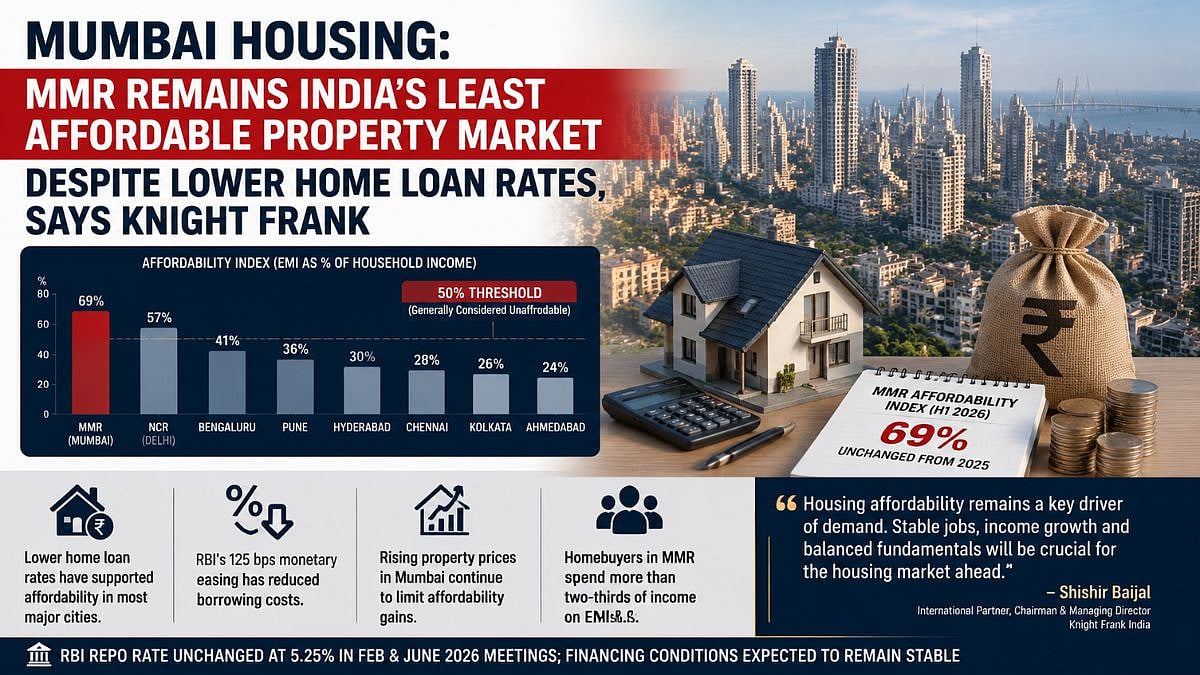
Mumbai, July 3, 2026: The Mumbai Metropolitan Region (MMR) continues to be the country's least affordable residential market, with homebuyers requiring nearly 69% of their household income to service monthly home loan instalments, according to Knight Frank India's latest Affordability Index.
The report, released on Friday, found that while lower home loan interest rates have supported housing affordability across most major cities during the first half of 2026, MMR and the National Capital Region (NCR) remain the only two markets where affordability exceeds the benchmark threshold of 50%.
MMR Remains Least Affordable
The Knight Frank Affordability Index measures the proportion of household income required to pay monthly equated monthly instalments (EMIs) for a standard housing unit. An EMI-to-income ratio above 50% is generally considered unaffordable, as banks are typically reluctant to underwrite home loans beyond that level.
According to the report, MMR's affordability index remained unchanged at 69% in H1 2026, the same level recorded in 2025. Although significantly better than the 77% recorded in 2016 and 2019, the region continues to be India's costliest housing market by a considerable margin.
Knight Frank attributed the broadly stable affordability levels across the country to the cumulative impact of the Reserve Bank of India's 125 basis points of monetary easing, which has reduced borrowing costs over the past year. Lower interest rates have helped offset rising residential property prices, enabling housing demand to remain close to post-pandemic highs.
However, in Mumbai, persistently high residential prices continue to limit the benefits of cheaper home loans. Despite the easing in borrowing costs, the report indicates that homebuyers in MMR still need to allocate more than two-thirds of their monthly household income towards EMIs, making it the most financially stretched housing market among India's eight largest cities.
Interest Rates Offer Limited Relief
Knight Frank noted that affordability across Indian cities had steadily improved between 2016 and 2021, aided by lower interest rates during the pandemic. Conditions deteriorated in 2022 after the Reserve Bank of India raised the repo rate by 250 basis points to combat inflation. Since early 2023, rate stability followed by cumulative monetary easing has helped stabilise affordability levels, although rising property prices have moderated the overall gains.
The report said the Monetary Policy Committee's decision to keep the repo rate unchanged at 5.25% during its February and June 2026 meetings, amid concerns over geopolitical tensions, energy prices and monsoon-related risks, is expected to keep financing conditions stable in the near term.
Commenting on the findings, Shishir Baijal, International Partner, Chairman and Managing Director of Knight Frank India, said housing affordability continues to be one of the most important drivers of residential demand.
He said lower interest rates have supported homebuyers across most markets, although rising property prices have reduced some of the gains achieved over the past year. Stable employment, healthy income growth and balanced market fundamentals, he added, will remain crucial to sustaining housing demand in the coming years.
Also Watch:

High Prices Remain Challenge
For Mumbai, however, the report underlines a continuing structural challenge. While demand has remained resilient and residential sales continue to perform strongly, the city's high property values ensure that home ownership remains significantly more expensive than in any other major housing market in the country.
To get details on exclusive and budget-friendly property deals in Mumbai & surrounding regions, do visit: https://budgetproperties.in/

