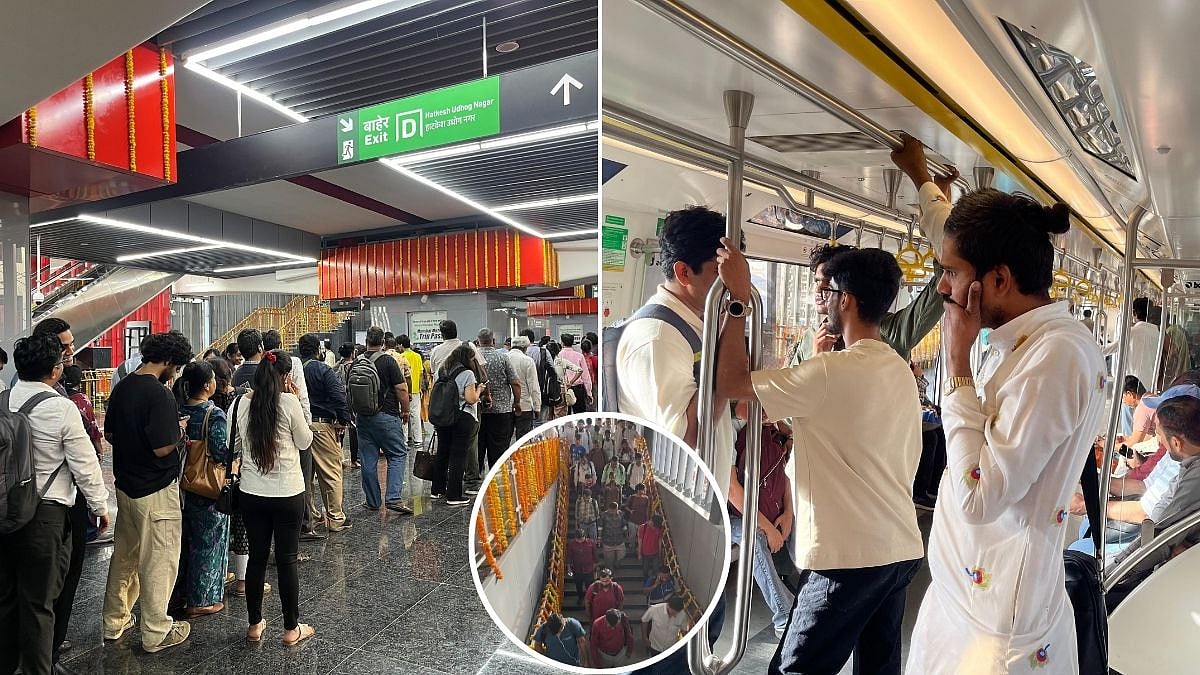
Mumbai, April 8: As services began on two metro corridors developed by the Mumbai Metropolitan Region Development Authority (MMRDA) on Wednesday, I set out to experience the new metro line, and what I saw was strikingly uneven.
A quiet, deserted ride on Metro-2B
I began my journey on Metro-2B, getting down at Chembur railway station. From there, the nearest stop — Diamond Garden metro station — is about 1.5 km away. There were only two ways to reach it: take an autorickshaw or walk. I chose to walk.
The distance, combined with the afternoon heat, made the journey tiring. By the time I reached the station, I expected to see a steady stream of commuters, especially since this is the first metro link to the Harbour Line. Instead, I was greeted by silence.
Inside the station, only a handful of people were visible. I waited for nearly 20 minutes, during which just six to eight passengers showed up. Most of them, like me, seemed to be there out of curiosity — taking a joyride rather than relying on the service for daily commuting.
Despite an investment of Rs 10,986 crore, only 5.6 km of the total 23.456 km Metro-2B corridor has been opened. The biggest drawback was evident — poor connectivity. The distance from the railway station and the lack of integration with other metro lines made access inconvenient.
Approved in October 2016 and expected to be completed by October 2022, the project has seen significant delays. As of now, only four stations out of the planned 20 are operational — and on day one, they appeared largely underutilised.
A completely different picture on Metro-9
Later, I made my way to experience Metro-9 — and the difference was immediate.
At stations between Dahisar and Kashigaon, I saw long, decent crowds of commuters; ticket counters were crowded.
Speaking to fellow passengers, it became clear why. Residents of Mira-Bhayandar have been waiting for this connectivity for years. With Metro-9 now operational, travelling from Mira Road to Andheri via Dahisar, Borivali, Malad, and Goregaon has become far more convenient.
Many commuters told me they prefer the metro over two-wheelers and buses, citing comfort and time savings. There was also optimism that road congestion would ease. One stretch in particular — from Kashimira to Dahisar Check Naka — is notorious for traffic jams. With the metro now running, people expect congestion here to reduce by 15–20%.
Also Watch:

Contrasting realities of new metro lines
My first-day experience of Mumbai’s new metro lines revealed two very different realities — one struggling due to last-mile connectivity issues, and the other thriving on pent-up demand. The contrast underscores a simple lesson: infrastructure alone isn’t enough — seamless connectivity is key to making public transport truly work.
To get details on exclusive and budget-friendly property deals in Mumbai & surrounding regions, do visit: https://budgetproperties.in/

