
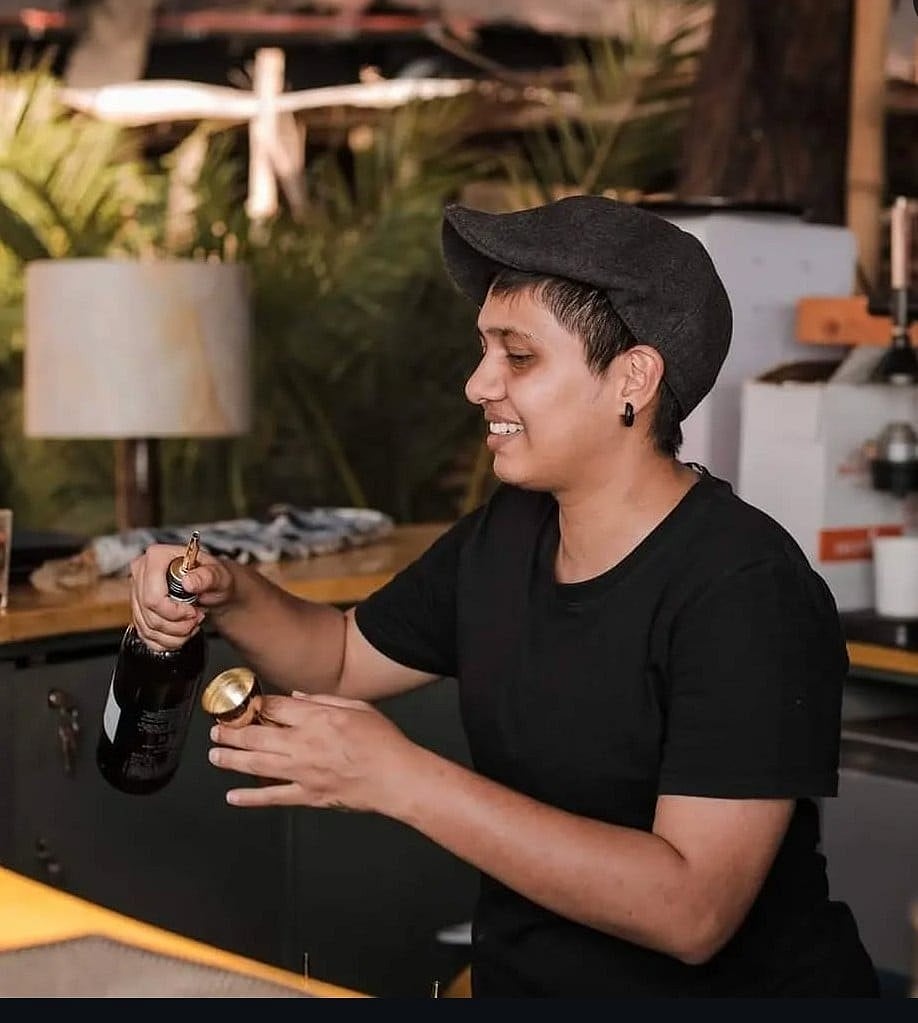
When Fay Antoin Barretto steps behind the bar, it’s never just about the drink. It’s about purpose and pushing back against a system that, for decades, made it difficult for people like him to exist openly. With over ten years of experience in the bartending industry, Fay is widely recognised as India’s first trans bartender and mixologist.
Today, Fay is a mentor, curator, competition organiser and community-builder who has helped shape the modern Indian bar landscape. But the path here was anything but smooth.
Breaking barriers behind bars
“I think the industry has made space for people like me now,” Fay says, candidly. “But back in the day, we did not have space. And it wasn’t just challenging for me. It was challenging for everybody.”
Fay believes that many of the struggles faced by bartenders in India stem less from gender identity and more from deep-rooted classism. “We live in a classist country,” he explains. “People think that if someone is serving them, they are subordinate, that they are beneath.”
This mindset, he says, extends across the service industry, making it even harder for anyone who already exists outside social norms. “So when you have a person who’s different in the mix, it's already like that,” he adds.
He recalls how, in earlier years, safety concerns and outdated laws made things even worse. “After cases like Jessica Lal, it became a big problem, not just for trans people, but also for women. There are still places in India, like Hyderabad and Ladakh, where women aren’t allowed behind the bar at all.”
Refusing to conform
For Fay, these barriers weren’t theoretical, they were personal. “I remember back in the day when I got hired, they told me, ‘You’ll be in the bar, but now go to the hostess desk,’” he recalls. “I was like, no. I don’t want to wear a saree or be pushed into something that’s not me.”
That frustration pushed him to travel extensively. Working across Turkey, Europe and Canada exposed him to environments where self-expression felt easier and respect was non-negotiable. Training under global mentors didn’t just refine his technique, it reshaped his philosophy. “When I came back, I knew I had to start something,” Fay says.

An initiative to better future
In 2021, Fay founded Mr Bartender & The Crew, a bartending collective that focuses on training and employing women and LGBTQIA+ individuals. “It’s a free course for women and members of the community,” Fay explains. “But at the same time, we have to sensitise people, especially men, on how to work with women.”
That process, he admits, isn’t always easy. “I still face issues where people mansplain or don’t respect women supervisors. Just last month, I had bartenders who were disrespecting my female supervisor, and I let them go. I was done.”
For Fay, accountability is non-negotiable. “Under my watch, none of these things happen. You have to learn how to respect people.”

Calling out tokenism
Fay is vocal about performative inclusion, especially when brands or venues demand diversity without understanding responsibility. “People say they want women bartenders,” he says, “but do you know how to take care of them? Do you know how to work with them?”
He’s equally critical of colourism in the industry. “There was a time when everyone wanted white bartenders, like brown bartenders weren’t good enough,” he says bluntly. “Brown people matter. Brown people are more hardworking. We’re just better.”
Despite the frustrations, Fay does see progress. “It’s changing, slowly,” he admits. “But there is change happening.”
He points to a growing sense of unity within the hospitality space. “Bar owners hanging out with bartenders, people actually getting to know each other, it’s a nice way the industry is flourishing.”

Service versus Hospitality
Another issue Fay feels strongly about is tipping culture in India or the lack of it. “Again, it comes back to classism,” he says. “People do tip, but you really have to go the extra mile.”
He distinguishes sharply between service and hospitality. “When you understand hospitality and go beyond what’s expected, people want to tip you.”
A vision beyond bars
Looking ahead, Fay wants structural change, not just conversations. One idea close to his heart is creating better living solutions for bartenders in Mumbai.
“Most bartenders live far away, like in Kalyan, Vasai, Virar,” he says. “By the time they reach home, they’re exhausted. Creativity gets affected.”
His long-term vision includes affordable hostels or bed-and-breakfast-style spaces near work hubs. “If brands invested in taking care of people instead of heavy marketing, it would make a real difference,” he says.
Is it all still a dream? “It’s all in my head right now,” Fay admits with a smile. “But I hope one day I’m able to execute it.”
For someone who has already reshaped so much of the industry, it doesn’t feel like a matter of if, but when.

