Last October, I found myself in Fleurier, Switzerland, a sacred ground for anyone remotely fascinated by the universe of horology. You don’t just land there by accident; it is a town you arrive at after years of pilgrimage across the Swiss watchmaking heavyweights like Geneva, Neuchâtel, La Chaux-de-Fonds, and Le Locle. Unlike these cities, Fleurier is quieter and more intimate. It is the home turf for serious names: Chopard, Bovet, Parmigiani Fleurier (which literally carries the town’s name), and the ultra-exclusive Ferdinand Berthoud.
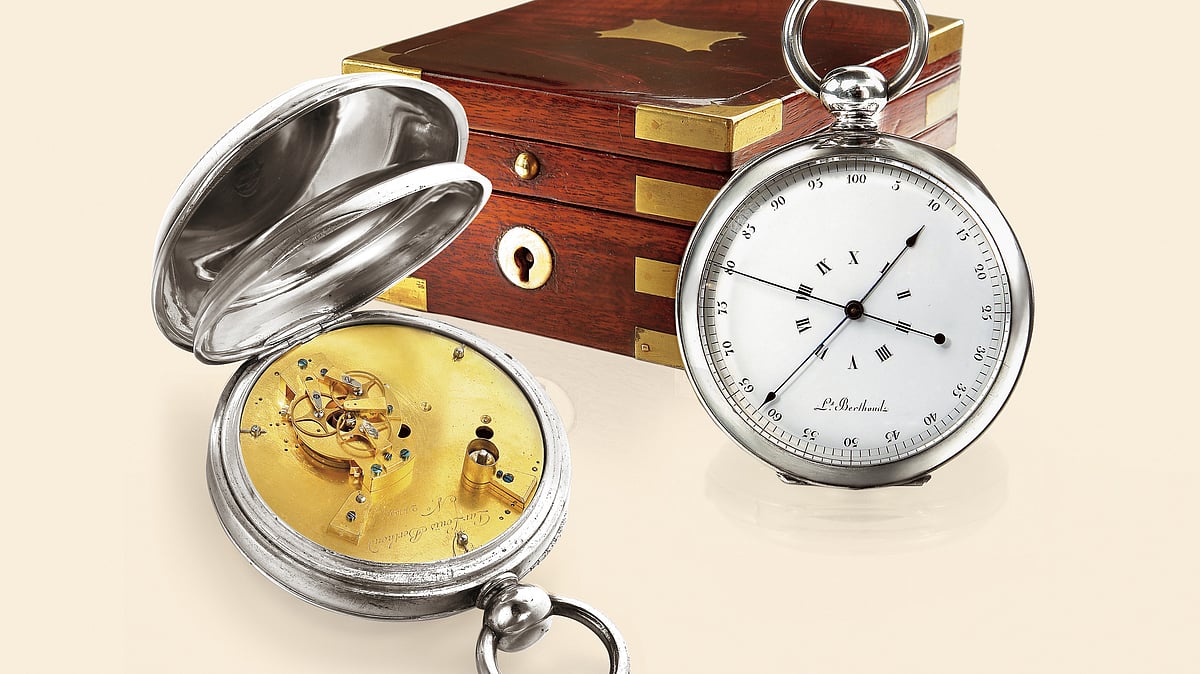
Ferdinand Berthoud is the kind of brand you don’t just walk into and browse; it is an intentional brand that gives you the sense of stepping into something reserved for a select few. What makes it even cooler is that the Ferdinand Berthoud manufacture and the Chopard L.U.CEUM, their in-house museum, Traces of Time, are all housed together within the Chopard L.U.C facility. So, you’re experiencing a living, breathing history of watches. And that’s where I stumbled upon something incredible: A fully functioning watch from the late 1700s, which is believed to be the last surviving one of its kind: the No. 26 decimal pocket watch by Louis Berthoud.
Prodigious family
Louis Berthoud was born in 1754 in the Neuchâtel region. Watchmaking was in his DNA—his father was a watchmaker, and his uncle was the legendary Ferdinand Berthoud, the master watchmaker for King Louis XV in Paris. Louis started young, learning the craft of timekeeping at 12, and eventually moved to Paris to work under his uncle. He even helped build marine chronometers—the super-precise clocks used for navigation at sea, which are still considered the forefathers of precision timekeeping.
After a family tragedy and shifting responsibilities, Louis took over the Paris workshop and continued his uncle’s legacy. Among everything he crafted, one piece stood out, the No. 26 decimal watch. Commissioned in 1792 by Chevalier de Borda, a French mathematician, physicist, and naval officer, the pocket watch was designed to track a completely different system of time. Unheard of in the late 18th century!
A revolutionary idea
During the French Revolution, there was a big push to decimalise quantification—money, measurements, and even time. The idea was simple in theory: instead of 24 hours in a day, you’d have 10. Each hour would have 100 minutes, and each minute 100 seconds. Clean, logical and alien to how we experience time today.
Louis spent over a year just figuring out how to make this work mechanically. The gear ratios had to be completely rethought, and he went through multiple trials before finally completing the watch in 1793.
A limited life
But decimal time barely lasted. It was officially used for a brief window, between late 1794 and early 1795, before being scrapped. As a result, the meticulously crafted and calibrated Louis Berthoud’s No 26 decimal pocket watch became redundant. The incredibly complex, beautifully engineered watch was built for a system that came and went in a blink.
Its rarity and historical relevance are immeasurable. It is a piece of human living heritage from a time when people thought they could reinvent time itself. Today, the watch lives on in Fleurier, part of the Ferdinand Berthoud heritage collection. Still ticking. Still defying time, in more ways than one.

