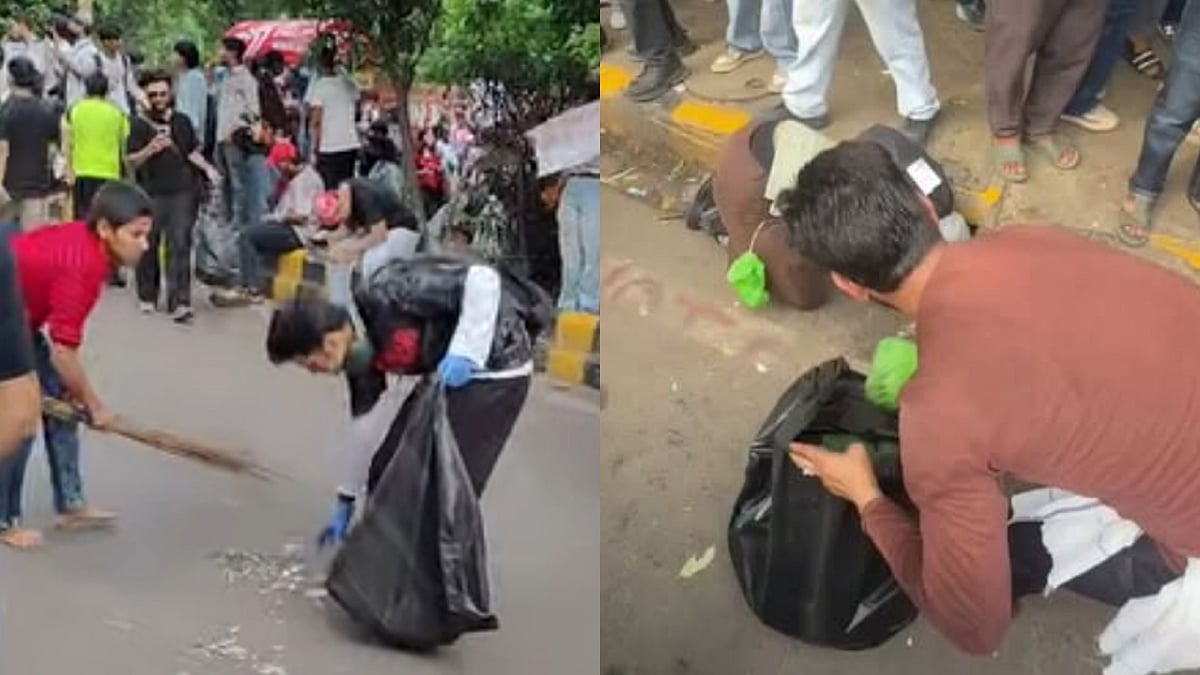
Victory celebrations often end with slogans, selfies and crowds heading home. But at Delhi's Jantar Mantar, the final chapter of the student-led protests unfolded a little differently. Hours after Union Education Minister Dharmendra Pradhan resigned, many young demonstrators picked up brooms and garbage bags instead of simply walking away, leaving behind a message that extended beyond the protest itself.
Gen-Z protesters stayed back to clean Jantar Mantar
Although the Cockroach Janta Party (CJP) leadership wrapped up the gathering around 6.30 pm and urged supporters to disperse, crowds continued to remain at the protest site.
Among the many videos that surfaced online, one stood out for a different reason. Rather than capturing chants or celebrations, it showed groups of young protesters sweeping roads, collecting litter and filling trash bags after the demonstration had officially concluded.

In the viral clip, a man behind the camera says that after the protest ended and everyone was asked to return home, many of the young participants – who had often been labelled "scumbags" by society – chose to stay back and clean the area instead.
Pointing towards the volunteers sweeping the streets, he says, "Yeh hai Gen-Z. Yeh hai humara yuva." According to the video, the clean-up continued until around 8 pm, with volunteers clearing litter across the roads surrounding Jantar Mantar.
The scenes quickly gained traction online, with social media users praising the demonstrators for taking responsibility for the public space before leaving.
According to Hindustan Times, volunteers also formed a human chain on Tolstoy Road around 7.30 pm to create a safe space for those sweeping the roads and collecting waste, while simultaneously guiding people towards the exits.

Additionally, several other videos also showed volunteers continuing the clean-up operation until morning, sweeping roads, collecting waste and restoring the protest site before leaving.
A lesson beyond the protest
The clean-up became one of the most talked-about moments following the demonstrations, shifting attention from the day's political developments to a simple act of civic responsibility.
Whether one agreed with the protest or not, the images of young people choosing to clean the venue before heading home resonated widely online. It served as a reminder that public movements are not only measured by the demands they raise but also by how participants treat the spaces they occupy.
For many viewers, the brooms and trash bags carried just as much symbolism as the protest banners, showing that civic responsibility doesn't end when the slogans do.

