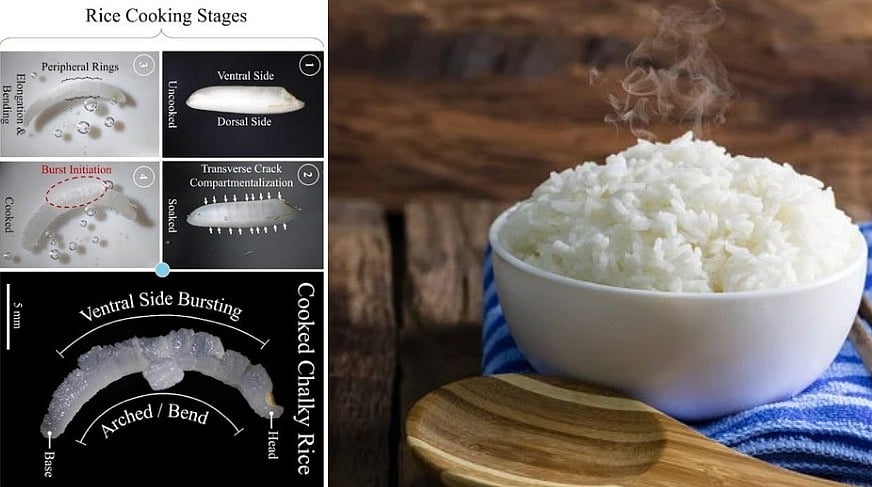
Indore (Madhya Pradesh): Ever wondered why some rice grains turn long, soft and fluffy after cooking while others bend, crack or even burst open? Researchers at Indian Institute of Technology Indore have now uncovered the science behind this everyday kitchen mystery.
The findings, published in the Journal of Food Science, revealed that the answer lies in microscopic defects hidden inside the rice grain long before it reaches the cooking pot.
The study was conducted by Dr Ankur Miglani, Prof Pavan Kumar Kankar and Dr Aman Khurana, along with PhD scholars Niteen Sapkal, Anoop KR and Sourav Kumar.
Using high-resolution imaging and microscopic analysis, the researchers discovered that opaque white rice grains, commonly known as “chalky grains”, contain tiny internal cracks and air pockets. These microscopic defects act as fast channels for water movement, allowing chalky grains to absorb water nearly 2.7 times faster than healthy translucent grains during soaking.
According to the researchers, this rapid water uptake helps explain why prolonged soaking can sometimes weaken rice even before cooking begins, offering scientific insight into the frequently debated question of optimal soaking time.
Experiments conducted on the widely cultivated Pusa 1121 Basmati Rice showed a striking difference in cooking behaviour. Nearly 67 per cent of fully chalky grains burst during cooking, compared to only 13 per cent of healthy grains.
The team also explained why some rice grains bend while cooking. Different regions within a grain absorb water and expand at varying rates, generating internal mechanical stresses that gradually cause the grain to curve. Similarly, the small white rings or bumps often visible on cooked long-grain rice were traced to tiny transverse cracks formed during soaking, which create localised swelling and compartment-like expansion during cooking.

IIT Indore director Prof Suhas S Joshi said, “This research is an excellent example of how scientific investigation at IIT Indore is helping explain everyday phenomena while generating knowledge that can benefit agriculture, food quality assessment and the rice-processing industry.”
Dr Ankur Miglani, principal investigator of the study, said, “The study explains how tiny hidden cracks and internal structures inside rice grains control the way water enters during soaking and cooking, ultimately determining why some grains become long and fluffy while others bend, crack, or burst open.”
The researchers also identified a critical microscopic crack-width threshold that can predict whether a grain is likely to burst during cooking. This finding could help rice breeders, food scientists and the rice-processing industry develop better methods for evaluating cooking quality and consistency in the future.
The study suggests that a rice grain carries a kind of “mechanical memory” of how it developed inside the plant. In other words, whether rice elongates beautifully on the plate or breaks apart during cooking may be determined long before it reaches the kitchen.