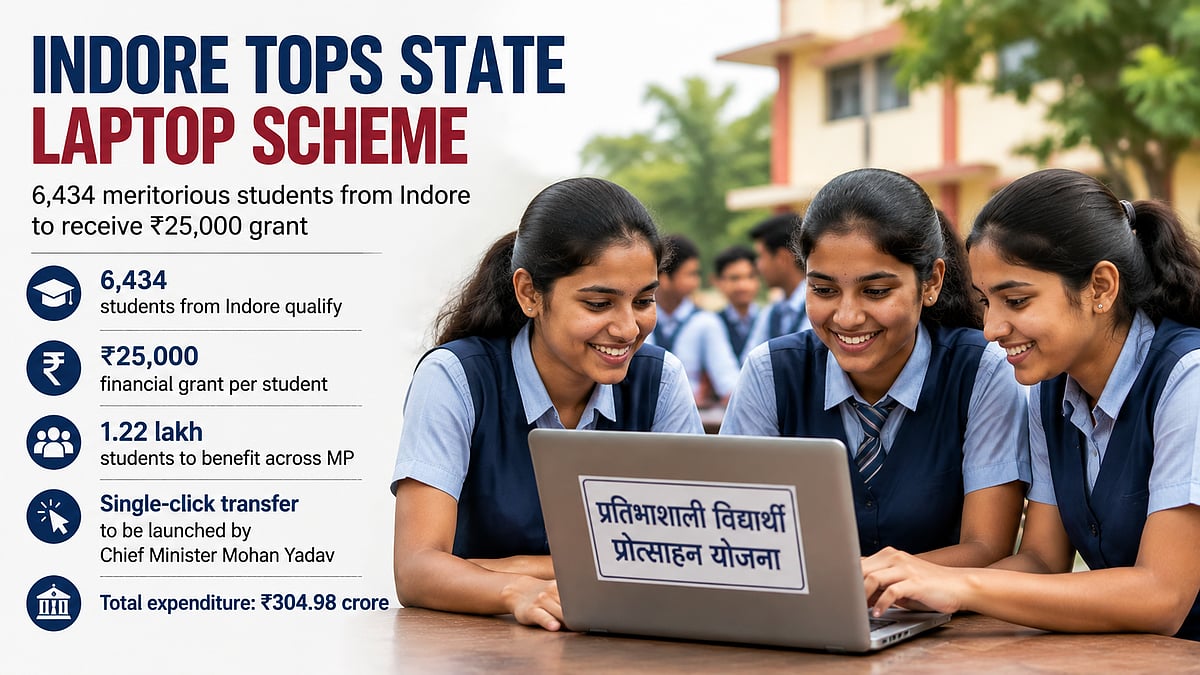
Indore (Madhya Pradesh): Indore recorded the highest number of meritorious students in Madhya Pradesh for the government laptop incentive distribution scheduled for Tuesday.
The School Education Department confirmed that 6,434 students from Indore district qualified for the Pratibhashali Vidyarthi Protsahan Yojana. Bhopal secured the second position with 4,613 verified beneficiaries.
Under the scheme, the state government transfers a financial grant of ₹25,000 directly into the bank accounts of students who secured 75% or higher marks in their first attempt at the Class 12 board examinations.
Chief Minister Mohan Yadav will initiate the single-click transaction from the Kushabhau Thakre Convention Centre in Bhopal.
The rollout involves a total expenditure of ₹304.98 crore, benefiting 1.22 lakh students across the state.
Data released by the district education office, Indore, indicated that government-run institutions produced the largest number of eligible candidates.
Government Excellence Higher Secondary School at Bal Vinay Mandir registered over 250 qualifying students.
Government Ahilya Ashram Girls Higher Secondary School recorded the maximum number of female beneficiaries within the urban limits, while government model schools in Mhow, Sanwer and Depalpur blocks led the rural sectors.
The district education officer stated that verification of bank accounts, IFSC codes and identification links for all 6,434 local students was completed to prevent transaction failures.
The officer added that school clusters received instructions to live-stream the central broadcast.
Statistical records showed that urban blocks within the city limits accounted for approximately 58% of the regional total, with 3,730 students.
The remaining 42% comprised 2,704 students from the rural sectors of Mhow, Sanwer and Depalpur.