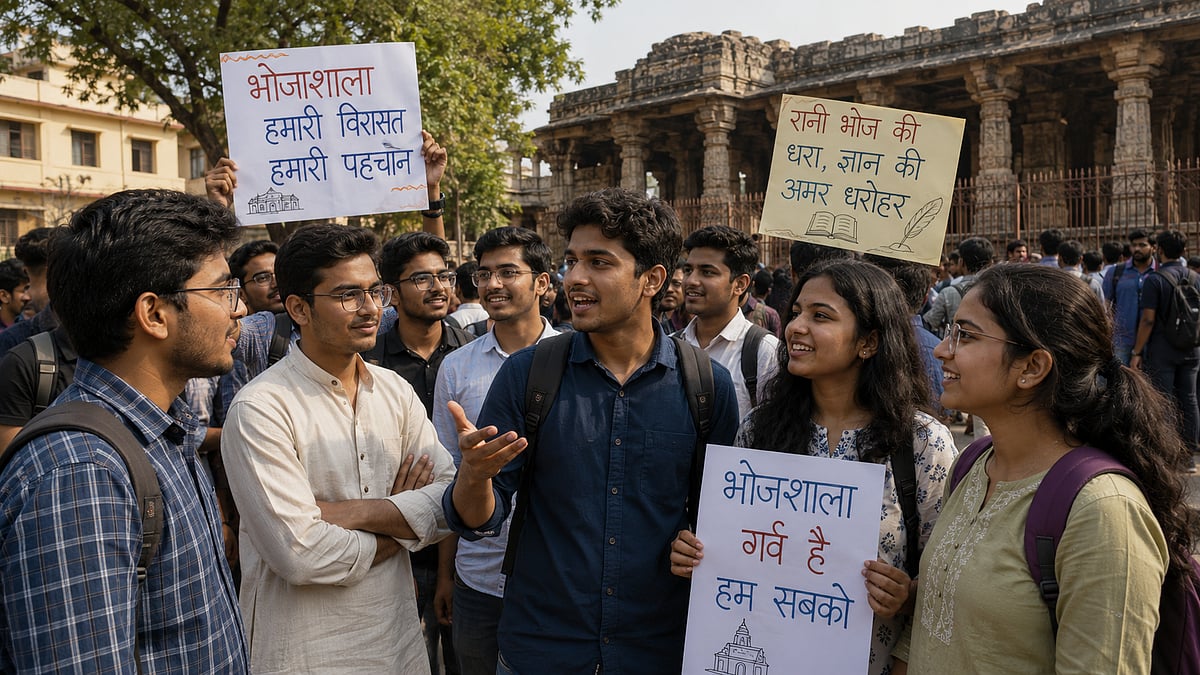
Indore (Madhya Pradesh): The Madhya Pradesh High Court’s verdict declaring the Bhojshala complex in Dhar a temple dedicated to Goddess Vagdevi has found strong support among many students in Indore, with several calling the decision a “victory for history, culture and faith.”
Madhya Pradesh's history and heritage define its culture even today. Temples and places of worship have been in deep conflict ever since invaders captured them. However, in today's world, Gen Z are more open to thinking broadly about their rights as well as those of nations. Many discussions across social media platforms truly show how much impact this decision has on people.
A symbol of knowledge and our heritage
“For us, Bhojshala is not just a disputed structure; it is a symbol of knowledge and how our heritage is linked to Raja Bhoj,” said a commerce student, Aryan Mehna, a resident of Vijay Nagar. “The court’s decision feels like justice to a once forgotten history.” He added.
Students from several colleges said they had closely followed the ASI survey and court proceedings over the past few months through Instagram and X. Many claimed the verdict strengthened their belief that historical sites connected with ancient Indian education and culture should be preserved and recognised.
At some campuses in Indore, small groups of students distributed sweets and raised slogans celebrating the verdict. Similar celebrations were also reported in Dhar after the court ruling was announced.
“This is a proud moment for students who care about history,” said another student, Rakhi Sharma, pursuing law at Government Law College in Indore. “The judgment has encouraged many young people to read more about Raja Bhoj and his stories, archaeology and the cultural significance of Bhojshala.
Since I am a law student, I deeply connected with these results and tried to follow how the decision was made.”
Several students also described the verdict as emotionally significant because Bhojshala has long been associated with Goddess Saraswati, worshipped as the deity of learning and wisdom. Students preparing for competitive exams said the site holds symbolic importance for young people pursuing education.
Social media platforms were flooded with posts from students sharing images, historical references and messages praising the decision. Some student organisations also welcomed the ruling, calling it a landmark judgment for cultural preservation.
The High Court’s order recognised Bhojshala as a temple and ended the earlier arrangement under which Friday namaz was permitted at the complex. The verdict came after years of legal proceedings and debates over the historical character of the site.
While authorities continue to appeal for peace and harmony, many students in Indore say the verdict has become a moment of pride and renewed interest in the state’s cultural legacy.