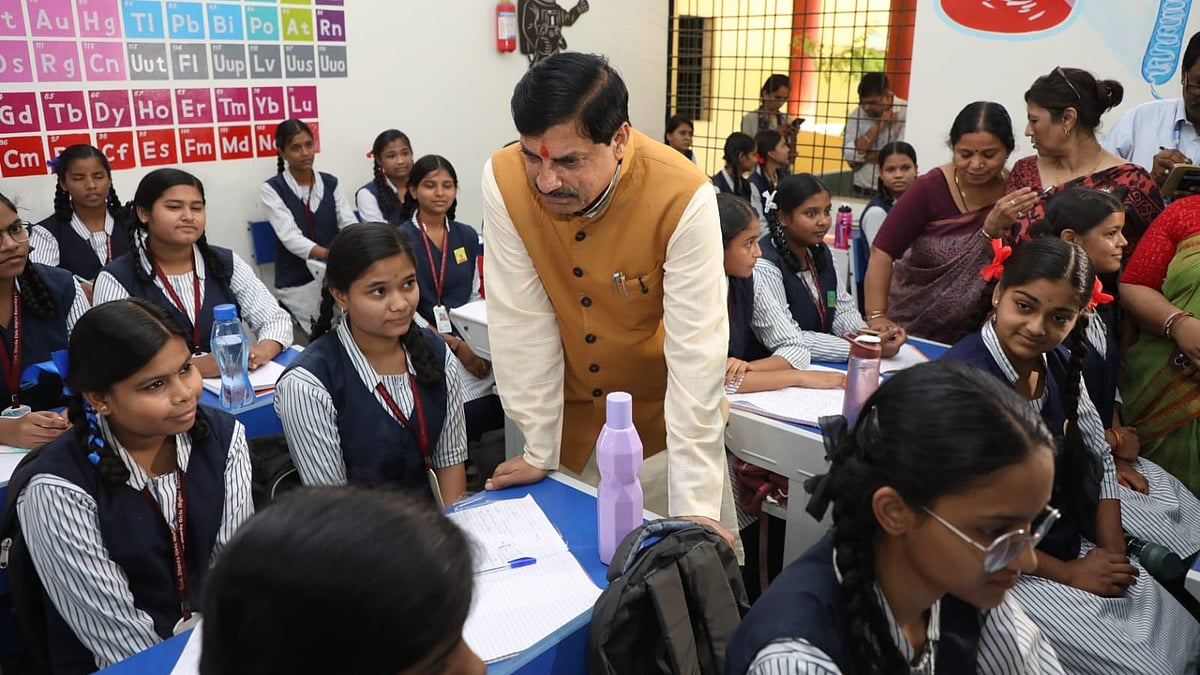
Indore (Madhya Pradesh): Government Sharda Girls Higher Secondary School, a 104-year-old institution in Bada Ganpati, is emerging as an example of how investments in government education reshaping classroom experiences for students are, particularly girls.
The transformation comes amid a broader shift in Madhya Pradesh's education landscape. During the recent School Chale Hum campaign, government schools recorded a 32.4 per cent increase in enrolment, while overall admissions rose by 19.6 per cent. State officials have attributed part of this growth to improved infrastructure and learning facilities, with some students returning from private institutions to government schools.
At Sharda Girls School, the change is visible inside classrooms equipped with telescopes, space-science models and interactive learning tools. Students who once relied largely on textbooks now have opportunities to engage with scientific concepts through observation and practical activities.
"For years, science meant memorising diagrams and definitions," said 16-year-old Vanshika Prajapat. "Now we can understand concepts by seeing them in action. It has made learning much more interesting."
The school's experience reflects a larger effort to strengthen science education in government institutions and make advanced learning resources more accessible to students.
For 15-year-old Tanu Yadav, who recently shifted from a private school, the change has been both academic and financial.
"My parents were spending a lot on school fees," she said. "After coming here, I realised that we had access to facilities that helped us understand subjects in a much better way. It also reduced the burden on my family."
Teachers said hands-on learning has encouraged greater participation in classrooms and increased interest in science-related subjects.
Seventeen-year-old Priyanshi Solanki said access to specialised equipment had changed the way students viewed careers in engineering and space science.
"When you use real equipment, these careers don't feel so distant," she said. "You begin to believe that you can pursue them yourself."
Students also said attitudes towards government schools were changing.

"There is more confidence among parents now," said student mentor Radhika Mandloi. "When they see better facilities and opportunities, they start viewing government schools differently."
Principal Sunayana Sharma said exposure to modern learning tools had helped students become more engaged and confident.
"When students are able to explore concepts through practical learning, their curiosity grows," she said. "They participate more actively and begin to think seriously about their future studies and careers."
The developments at Sharda Girls School coincide with the expansion of initiatives such as the Sandipani and PM SHRI school programmes, which aim to strengthen infrastructure and improve learning outcomes in government institutions.
As classes ended on a recent afternoon, groups of students remained gathered around telescopes and science models, discussing projects and sharing observations.
From the outside, the school still carries the character of a century-old institution. Inside, however, its classrooms offer a glimpse of how changing educational resources can influence aspirations, opening new possibilities for students who may once have seen science as something beyond their reach.