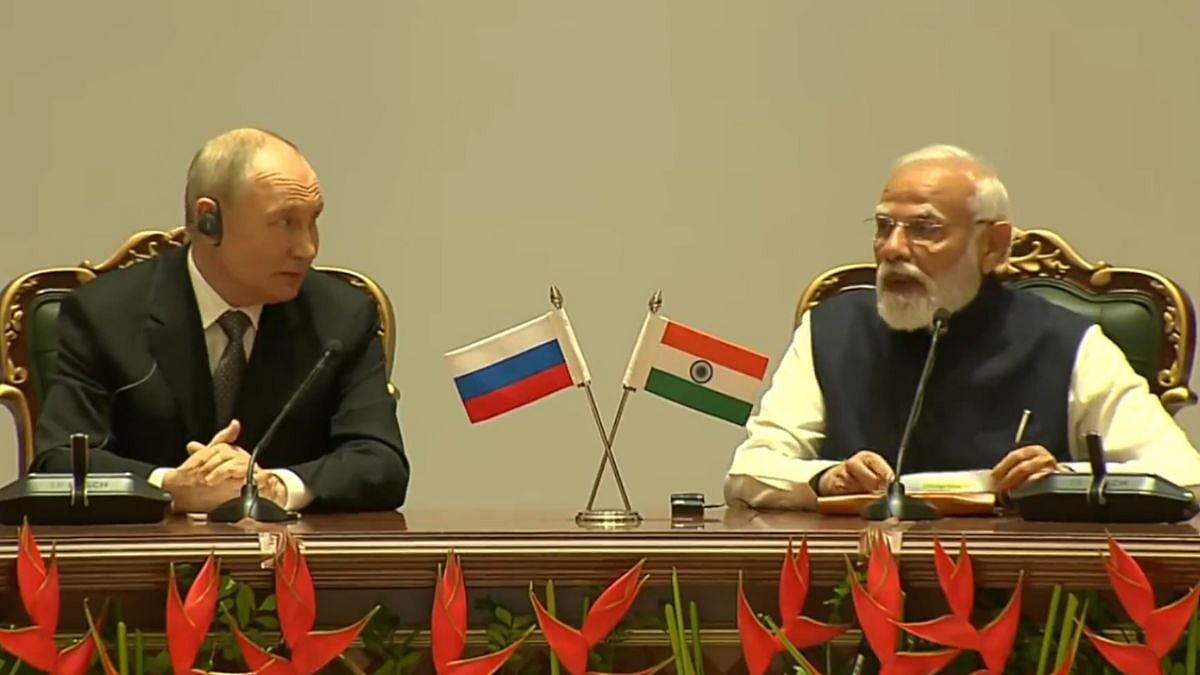
New Delhi: Economic cooperation was the highlight of Russian President Vladimir Putin’s visit to India for the annual India-Russia summit meeting. Putin, who arrived in New Delhi on Thursday night for the annual summit leaders meeting between India and Russia, met with his counterpart, Prime Minister Modi on Friday morning for talks.
The two sides focused on the special economic cooperation programme to reach $100 billion in bilateral trade by 2030. The other area of focus was on working towards an FTA between India and the Eurasian Economic Union (EAEU). Along with this, several agreements were signed by the two sides in various fields, such as migration and mobility, fertilizers, health and food safety, and maritime cooperation, amongst other areas. After the talks, both leaders held a joint press conference on the outcomes reached.

Speaking first, Prime Minister Modi stated that the two leaders had discussed all aspects of cooperation to strengthen this relationship. “Taking economic cooperation to new heights is our shared priority. To make this a reality, today we have agreed on an Economic Cooperation Program until 2030. This will make our trade and investment diversified, balanced, and sustainable, and will also add new dimensions to the areas of cooperation.”
He added that “both sides were striving for an early conclusion of an FTA with the Eurasian Economic Union (EAEU).” India has been keen to sign an FTA with the EAEU in since 2017. A Terms of Reference (ToR) for an FTA was signed during External Affairs Minister S Jaishankar’s visit to Moscow, and Russian media reports have suggested that negotiations could be wrapped up by 2026.Russia experts say that should this happen, this would broaden a relationship till now largely confined to oil and armaments.
Indian exporters could export pharmaceuticals, engineering goods, textiles, agriculture, and marine products to Russia and increase political and economic ties with Central Asian nations—a key foreign policy goal of India. Modi also said that India and Russia were looking at enhancing connectivity and moving forward on logistics for maritime sea routes such as the INSTC, the Northern Sea Route, and the ChennaiVladivostok Corridor.

On the geopolitical front, he stated that both sides had discussed regional and global issues, including the ongoing war in Ukraine and the efforts by the US to bring about peace. “India has always advocated for peace in Ukraine. We welcome all efforts to find a peaceful and lasting solution to this issue.” Speaking on the issue of terrorism, the prime minister said that “India and Russia have long cooperated shoulder to shoulder in the fight against terrorism. Whether it was the terrorist attack in Pahalgam or the cowardly attack on Crocus City Hall— the root of all these incidents is the same. India firmly believes that terrorism is a direct attack on the values of humanity, and global unity against it is our greatest strength.”
Speaking next, President Putin made it clear that Russia stood “ready to continue uninterrupted fuel shipments to India.” The agreement was made in the context of Russia providing nuclear energy to India for the Kudankulam power plant. Of the six nuclear reactors, two have already been developed, and four more will soon be on their way.
The Russian leader added trade would also be bolstered by the fact that the majority of payments was now taking place in national currencies. “96% of all our economic operations are being done in national currencies. Russians banks are expanding the use of Indian rupees in various contracts.”

The two leaders announced that a 30-day free evisa would be applicable to Indian and Russian nationals to visit each other’s countries. More significantly, Russian state channel RT would launch its India arm across the country. Russia watchers said this was an important signal, as it cemented India’s bid to be seen as not overly reliant on the West. Former foreign secretary Kanwal Sibal believes that such moves of cooperation may move India towards a “no-limits partnership” with Russia.
Pointing out that Kremlin spokesperson Dimitry Peskov had already stated that Russia was “ready for a no-limits partnership with India,” Sibal said that if such an initiative was enacted upon, it would certainly worry the West. “The no-limits partnership was used in Beijing some years ago, and this created huge concern in the West. If this idea of a no-limits partnership is taken up with India, then you have two no-limits partnerships—Russia-China and Russia-India.
This is going to worry the West far more than the bonhomie between the three leaders at Tianjin.” The Russian president was accorded a ceremonial welcome and a Guard of Honour at Rashtrapati Bhavan on Friday morning. He then visited Rajghat, where he laid a wreath.

