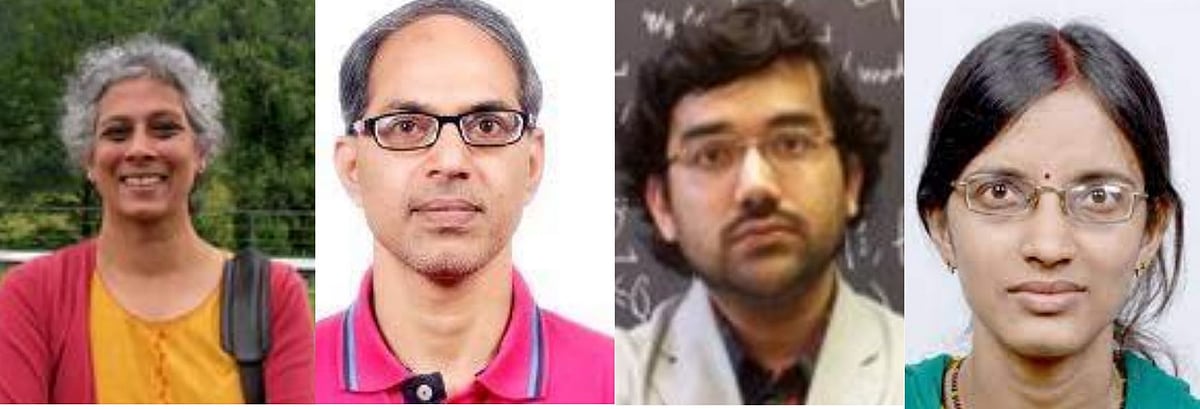
The Ramanujan Prize is bestowed internationally to mathematicians under the age of 45 years inorder to acknowledge their outstanding work in the field. It was established in 2004 and the first recipient was a Brazilian mathematician named Marcello Viana in 2005.
This year the award was bragged by an Indian Professor, Neena Gupta, making her the fourth national to get the Ramanujan Prize. She won the 2021 DST-ICTP-IMU Ramanujan Prize for her outstanding work in affine algebraic geometry and commutative algebra, in particular for her solution to the Zariski cancellation problem for affine spaces.
5 Things to know about Dr. Neena Gupta:
She is the fourth Indian and third woman to win the the Ramanujan Prize
She previously received the Shanti Swarup Bhatnagar Prize for Science and Technology in 2019
She had also won the Young Scientists Award of the Indian National Science Academy in 2014
Her solution, to the Zariski cancellation problem for affine spaces, which was a fundamental problem in Algebraic Geometry, has been described as one of the best works in the recent history of geometry anywhere in the world.
She had done her schooling from Khalsa High School in Dunlop, since then had developed a keen interest in mathematics

Earlier in history, the three Indian Mathematicians who made to this honor are Ramdorai Sujatha (2006), Amalendu Krishna(2015) and Ritabrata Munshi(2018).
Dr. Ramdorai Sujatha
She is the first Indian to win the prestigious ICTP Ramanujan Prize in 2006
She was also awarded the Shanti Swarup Bhatnagar Award, the highest honour in scientific fields by the Indian Government in 2004
She is best known for her non-commutative version of the main conjecture of Iwasawa theory
Dr. Amalendu Krishna
He was honoured with the precious award for his outstanding contributions in the area of algebraic K-theory, algebraic cycles and theory of motives
He was awarded the Shanti Swarup Bhatnagar Prize in the mathematical sciences category in the year 2016
He had dropped out of IIT and joined the Indian Statistical Institute in Kolkata, while completed his Ph.D. from TIFR
Dr. Ritabrata Munshi
The focus of his work was central to modern number theory, one that links arithmetic geometry, representation theory and complex analysis in many profound ways
He serves in the editorial board of The Journal of the Ramanujan Mathematical Society and the Hardy-Ramanujan journal
Munshi obtained PhD degree from Princeton University in 2006


