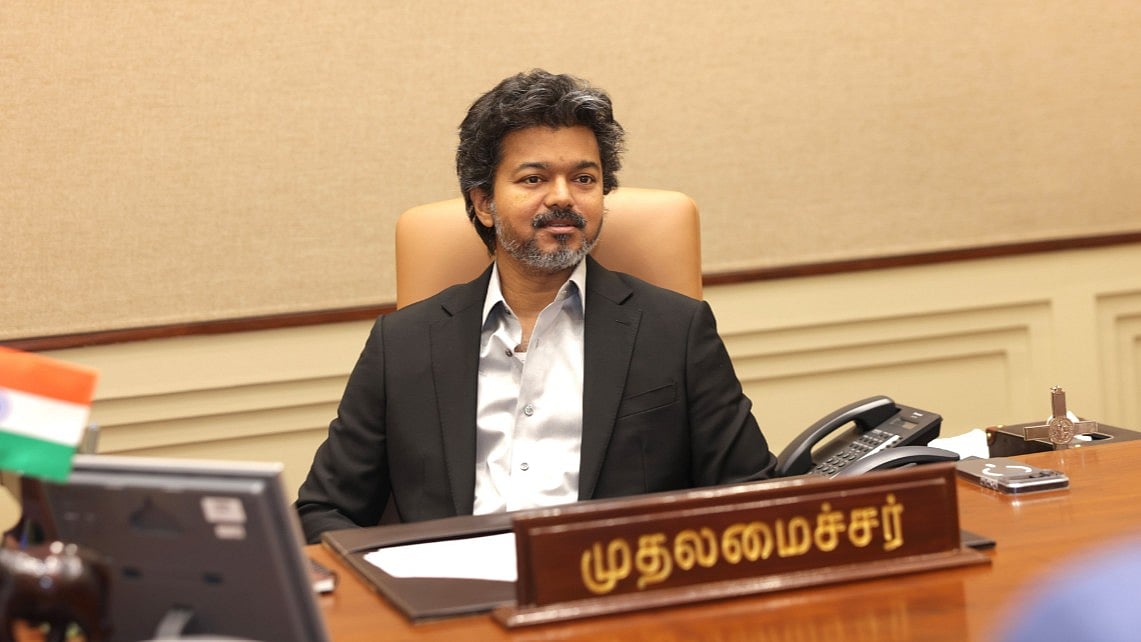
Chennai: Tamil Nadu Chief Minister C. Joseph Vijay on Thursday called for a stronger Southern regional framework on fiscal federalism, interstate water management, economic integration and parliamentary representation, urging the Union government to ensure that States which have successfully stabilised their populations are not penalised in the distribution of Lok Sabha seats.
Addressing the 31st meeting of the Southern Zonal Council at Mamallapuram near Chennai, Vijay pointed out the Southern States together contribute more than 30% of India’s GDP and described the region as a major engine of the national economy, particularly in manufacturing, exports, services and innovation.
He said the freeze on allocation of Lok Sabha seats based on the 1971 Census was approaching its end and that the Delimitation Bill, 2026 was being considered. The Southern States had a “genuine and shared concern” that population-based delimitation could reduce their collective voice in Parliament.
He argued that the South’s success in population stabilisation, human development and economic growth should not translate into diminished parliamentary representation. Vijay urged the Union government to provide a clear legislative assurance that no State would suffer a reduction in its percentage of representation in Parliament because of its success in population stabilisation.
Fiscal federalism was another major plank of the speech (copy circulated to media) in which he said the next Finance Commission’s approach to fiscal devolution should recognise both need and performance, arguing that States which had invested in development, fiscal discipline and demographic transition should not be placed at a disadvantage.
“The Southern States seek not preferential treatment, but a fair and equitable treatment,” he said, stressing fiscal autonomy and the need to reward performance alongside equity. He also pointed out that, after the introduction of GST, States had virtually no flexible revenue levers outside petroleum and alcohol. He called on all State governments to work together to reclaim flexibility in tax-rate determination under the GST framework.

On education, the Chief Minister reiterated Tamil Nadu’s opposition to NEET, maintaining that the examination places rural and socially and economically disadvantaged students at a disadvantage. He urged the Union government to allow Tamil Nadu to fill all State-quota seats in MBBS, BDS and AYUSH courses solely on the basis of Class XII marks.
On interstate water disputes, Vijay stressed adherence to Supreme Court judgments, tribunal awards and statutory mechanisms. Specifically referring to the Cauvery, he called for timely implementation of the Supreme Court judgment and decisions of the Cauvery Water Management Authority. On Mullai Periyar, he said safety should continue to be guided by judicial decisions concerning increasing the water level to 152 feet.

The Chief Minister also proposed common economic and logistics clusters across Southern States, including integrated manufacturing zones, multimodal logistics parks and freight and industrial corridors. He backed expediting the proposed Bengaluru Metro extension from Bommasandra to Hosur, describing it as a model for interstate infrastructure cooperation.
Calling for a coordinated regional response to drug abuse, Vijay sought tighter regulation of online sales of prescription medicines and stronger interstate intelligence-sharing and enforcement against narcotic and psychotropic substances.
He also urged the Southern Zonal Council to place the maritime economy at the centre of its agenda, covering ports, coastal shipping, fisheries, marine industries, maritime services and coastal tourism. He noted that Tamil Nadu has a 1,076-km coastline and said the State was ready to partner with other Southern States on a shared maritime vision.
Vijay concluded by asserting that “strong States make for a stronger India”, while calling for differences between the Union and States to be resolved through dialogue, mutual respect and the rule of law.

