In April this year, the Centre failed to get the Constitution amendment Bill linked to delimitation and the implementation of 33% women's reservation passed in the Lok Sabha. Seven months later, the government has convened a special sitting of Parliament, with the proposed legislation once again expected to be at the centre of proceedings.
The Bill seeks to facilitate the implementation of 33% reservation for women in the Lok Sabha and state legislative assemblies through an expansion of the legislatures and a delimitation exercise. However, the government's earlier attempt suffered a setback after it failed to secure the constitutionally mandated two-thirds majority.
With the DMK, NCP (Sharadchandra Pawar) and YSR Congress Party (YSRCP) indicating possible flexibility in their positions, the government appears to be exploring different combinations to secure the required votes. What has changed since April, and how does the NDA plan to overcome the numbers challenge this time?
How Many Votes Are Needed To Pass A Constitution Amendment Bill?
Unlike ordinary legislation, a Constitution amendment Bill must clear a special voting threshold under Article 368 of the Constitution.
It requires a majority of the total membership of each House of Parliament and a two-thirds majority of members present and voting. Both conditions must be satisfied.
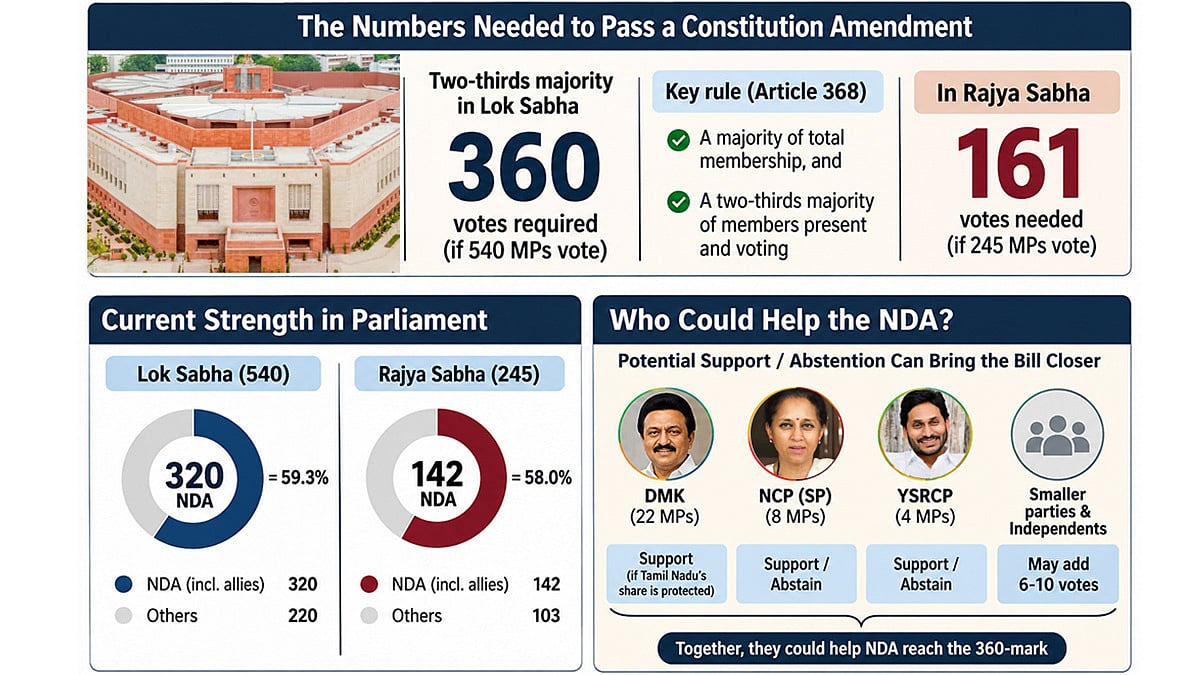
The Lok Sabha currently has an effective strength of 540 members, with three vacancies against its sanctioned strength of 543. If all 540 members participate in the voting, the government will need at least 360 votes in favour of the Bill.
Delimitation Bill: Decoding The Numbers Game Behind NDA's Fresh Push |
However, the required number can change depending on the number of MPs present and voting. Abstentions can therefore reduce the two-thirds threshold, although they do not count as votes in support of the legislation.
The Bill must independently clear this threshold in both the Lok Sabha and Rajya Sabha. Since it is a constitutional amendment, a joint sitting cannot be convened to overcome a deadlock between the two Houses.
What Is NDA's Current Strength In Lok Sabha And Rajya Sabha?
The BJP-led National Democratic Alliance (NDA) is estimated to have around 320 MPs in the Lok Sabha, including 241 BJP members and 79 MPs belonging to its allies.
Among the BJP's major allies are the National Citizens Party of India (NCPI) with 20 MPs, Telugu Desam Party (TDP) with 16, Shiv Sena with 13, Janata Dal (United) with 12 and Lok Janshakti Party (Ram Vilas) with five MPs.
Other allies include the Rashtriya Lok Dal, Janata Samajwadi Party and Janata Dal (Secular), along with smaller parties.
Even with approximately 320 MPs, the NDA remains around 40 votes short of the 360 required if all 540 Lok Sabha members vote.
The numbers are somewhat more favourable in the Rajya Sabha. The NDA has 142 MPs in the 245-member Upper House. It would need 161 votes if all members participate in the voting, leaving the ruling alliance short by 19 votes.
The government will, therefore, need support beyond its existing alliance in both Houses.
How Many Votes Did The Bill Receive In April?
The Constitution (131st Amendment) Bill was defeated in the Lok Sabha during the special sitting held between April 16 and 18.
Of the 528 MPs who participated in the voting, 298 voted in favour of the Bill, while 230 opposed it. The government needed 352 votes to achieve the required two-thirds majority but fell short by 54 votes. Eleven MPs were absent.
The NDA's tally of 298 votes was therefore insufficient to get the legislation through, despite the ruling alliance having a majority in the House.
This time, the government is attempting to bridge that gap by reaching out to regional parties and exploring the possibility of securing support or abstentions from Opposition members.
Which Opposition Parties Could Help The Government?
The DMK, NCP (Sharadchandra Pawar) and YSRCP have emerged as important players in the government's calculations.
The DMK, which has 22 Lok Sabha MPs, has indicated that it could consider supporting the legislation if Tamil Nadu's existing share of approximately 7.2% of Lok Sabha seats is protected.
The party has consistently opposed delimitation based solely on population figures, arguing that states which have successfully controlled population growth should not face a reduction in their political representation.
However, senior DMK leaders have suggested that the party may be open to increasing the overall number of seats, provided its state's proportionate representation remains protected.
The NCP (SP), with eight Lok Sabha MPs, has also indicated that it will examine the proposed legislation before taking a final position. Party MP Supriya Sule has said that the Bill could receive support if it serves the larger national interest.

The YSR Congress Party, which has four Lok Sabha MPs, is also expected to consider supporting the proposal if regional balance is maintained.
The government's possible combinations also include support from smaller regional parties, Independents and sections of other Opposition parties.
In the Rajya Sabha, the DMK has eight MPs, while the NCP (SP) has one. Their support could help the NDA bridge part of its shortfall in the Upper House as well.
Can Opposition Abstentions Help NDA Cross The Majority Mark?
Apart from securing additional votes, the government could benefit if some Opposition parties decide to abstain from voting.
Since the two-thirds requirement is calculated on the basis of members present and voting, abstentions reduce the denominator and consequently lower the number of votes needed to pass the Bill.
For instance, if all 37 Samajwadi Party MPs abstain, the number of members present and voting would fall from 540 to 503. The required two-thirds majority would then come down from 360 to 336.
In this situation, the NDA's estimated 320 votes would leave it short by just 16 votes. Support from the eight NCP (SP) MPs and four YSRCP MPs, along with four Independents or smaller-party members, could take the government's tally to the required 336.
Another possibility is that the DMK and YSRCP, together accounting for 26 MPs, abstain. The number of members present and voting would fall to 514, bringing the required threshold down to 343. The NDA would then need another 23 votes.
If the DMK, YSRCP and NCP (SP) abstain, the number of abstentions would rise to 34. The two-thirds requirement would fall to 338, leaving the NDA 18 votes short.
These calculations underline why the position of regional parties could prove decisive, even if they do not formally support the government.
Has The Government Changed The Bill That Failed In April?
One of the biggest questions ahead of the special Parliament sitting is whether the Centre has made changes to the legislation that failed to clear the Lok Sabha in April.
The final text of the proposed Bill has not yet been circulated to MPs, leaving uncertainty over the exact provisions the government intends to bring before Parliament.
However, speculation is growing that the Centre could revise the proposed formula for expanding the strength of the Lok Sabha and state legislative assemblies.
One possibility being discussed is a uniform increase of around 50% in the number of seats across states, which could help address concerns that southern states might lose their proportionate representation following delimitation based on population.
Such a formula could potentially provide greater political reassurance to states that have raised concerns over the exercise. However, it remains speculation, and there is no official confirmation that the government has decided to incorporate such a change.
The April proposal sought to expand the Lok Sabha and state assemblies while linking the implementation of women's reservation to a fresh delimitation exercise. The 2023 women's reservation law had already been passed by Parliament, but its implementation was linked to the publication of figures from the first Census conducted after the law came into force.
Whether the government has altered the proposed seat-expansion formula, the delimitation mechanism or other provisions will become clearer once the revised legislation is formally presented.
For now, the Centre's immediate challenge is to ensure that it has the numbers in both Houses. The positions taken by the DMK, NCP (SP), YSRCP and other regional parties could determine whether the government's second attempt succeeds where its April effort failed.
Level up your brain the fun way. Play daily games and quizzes on FPJ Smart!

