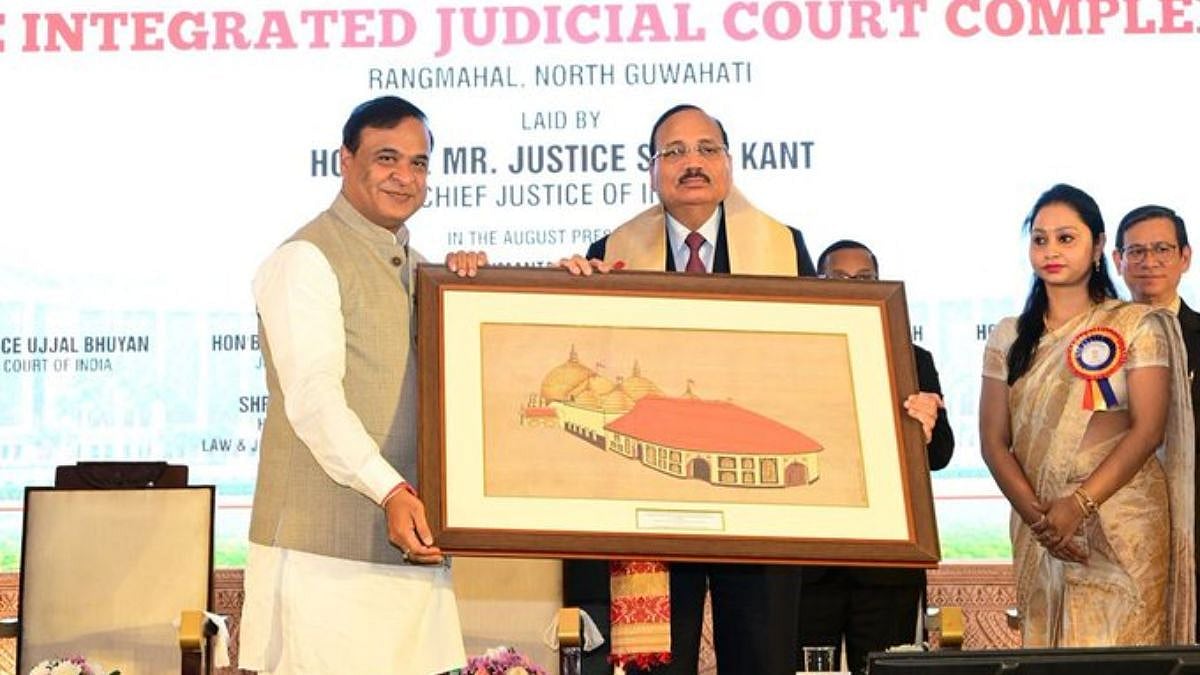
Guwahati, January 11: Chief Justice of India Justice Surya Kant on Sunday laid the foundation stone of the Integrated Judicial Court Complex at Rangmahal in North Guwahati, describing it as a transformative step towards making justice delivery more efficient, accessible and humane.
Justice and infrastructure
Speaking at the ceremony, the CJI said justice works best when courts, lawyers, litigants and support services function together rather than in isolation. He observed that the present system, with courts and offices scattered across locations, often turns access to justice into an exhausting exercise for ordinary citizens.
“Litigants should be thinking about their cases, not struggling with logistics,” Justice Kant said, adding that the proposed complex would allow people to focus on justice instead of navigating fragmented infrastructure.
The foundation stone was laid in the presence of Chief Minister Himanta Biswa Sarma, judges of the Supreme Court and the Gauhati High Court, senior members of the judiciary and representatives of the Bar.
Support for young lawyers
The Integrated Judicial Court Complex is designed to bring the Gauhati High Court, the district judiciary and essential allied services under one roof. Justice Kant noted that such integration is particularly important for young lawyers, who often face acute shortages of space and opportunity in existing court premises dominated by senior practitioners.

Emphasising the future of the legal profession, the CJI called for infrastructure planning that prioritises young and aspiring lawyers, including women advocates. He urged the creation of modern, inclusive facilities with basic amenities such as healthcare, better connectivity and work-friendly spaces.
Justice Kant also addressed the ongoing opposition to the project by the Gauhati High Court Bar Association, which has protested the proposed relocation, including through hunger strikes and a boycott of the event. While acknowledging differing views, he said personal or vested interests should not stand in the way of infrastructure development meant to serve future generations.
He pointed out that the Rangmahal site is strategically located, with improved connectivity and upcoming bridges over the Brahmaputra, and would provide modern facilities in a single, well-planned campus. “This complex is envisioned to meet the aspirations of the future judiciary, incoming lawyers and litigants alike,” he said, underlining that strengthening judicial infrastructure is essential to building public trust and ensuring that the law does not appear distant or inaccessible.
CM recalls legacy
Addressing the gathering, Chief Minister Himanta Biswa Sarma recalled the historic role of the Gauhati High Court in upholding justice and constitutional values since its inception. Sharing a personal note, Sarma said he began his professional life as an advocate at the Gauhati High Court and practised there for over a decade.
“The existing High Court building will not be able to reflect the aspirations of the people over the next 50 years,” Sarma said, noting that while institutions such as the State Legislative Assembly and the Secretariat have been modernised to represent a changing Assam, the High Court infrastructure has remained largely unchanged.

Tracing the origins of the project, Sarma said that in 2022, then Chief Justice of the Gauhati High Court Justice Sandeep Mehta had first flagged the need for a new location. After surveying multiple sites, the Rangmahal area was identified as suitable. During the tenure of Justice Vijay Bishnoi, the design and layout of the complex were finalised, following which 148 bighas of land were acquired.
Acknowledging locals
The Chief Minister expressed gratitude to the people of Rangmahal for making the land available out of respect for the judiciary. He said the project design incorporated suggestions from Supreme Court Justice Ujjal Bhuyan and all judges of the Gauhati High Court, and that tenders were floated only after approval by the High Court’s full court.
Sarma informed that the new High Court building will initially house 31 courtrooms, with seating arrangements that allow advocates and litigants to observe proceedings comfortably. The complex will include 300 advocates’ chambers, seating for 2,000 lawyers, and a six-storeyed administrative building, with provision for 15 additional courtrooms in the future.
Envisioned as a modern judicial hub, the Integrated Judicial Court Complex will be built over 148 bighas at an estimated cost of Rs 1,700 crore. It will house the High Court, advocates’ buildings, High Court offices, courts of Kamrup and Kamrup Metropolitan districts, parking facilities and allied infrastructure.
Facilities for lawyers
The complex will also accommodate 65 courts, including District and Sessions Courts, Motor Accident Claims Tribunals and Industrial Tribunals, along with seating for another 2,000 advocates. Additional facilities will include a 1,000-seat auditorium, examination halls for High Court exams, a well-equipped hospital, cafeteria, canteen and landscaped green spaces.
The programme was attended virtually by former Chief Justice of India Ranjan Gogoi. Supreme Court judges Justices Ujjal Bhuyan, Sandeep Mehta, N. Kotiswar Singh and Vijay Bishnoi, former judges and Chief Justices of the Gauhati High Court, current Chief Justice Justice Ashutosh Kumar, Chief Justices of the High Courts of Tripura, Manipur and Meghalaya, and several other dignitaries were present.
Union Minister of State (Independent Charge) for Law and Justice Arjun Ram Meghwal, Assam ministers Ranjeet Kumar Dass and Chandra Mohan Patowary, senior government officials, Advocate Generals of Assam, Nagaland and Arunachal Pradesh, representatives of the Bar Council, and a large number of advocates and members of the judicial fraternity also attended the landmark event.

