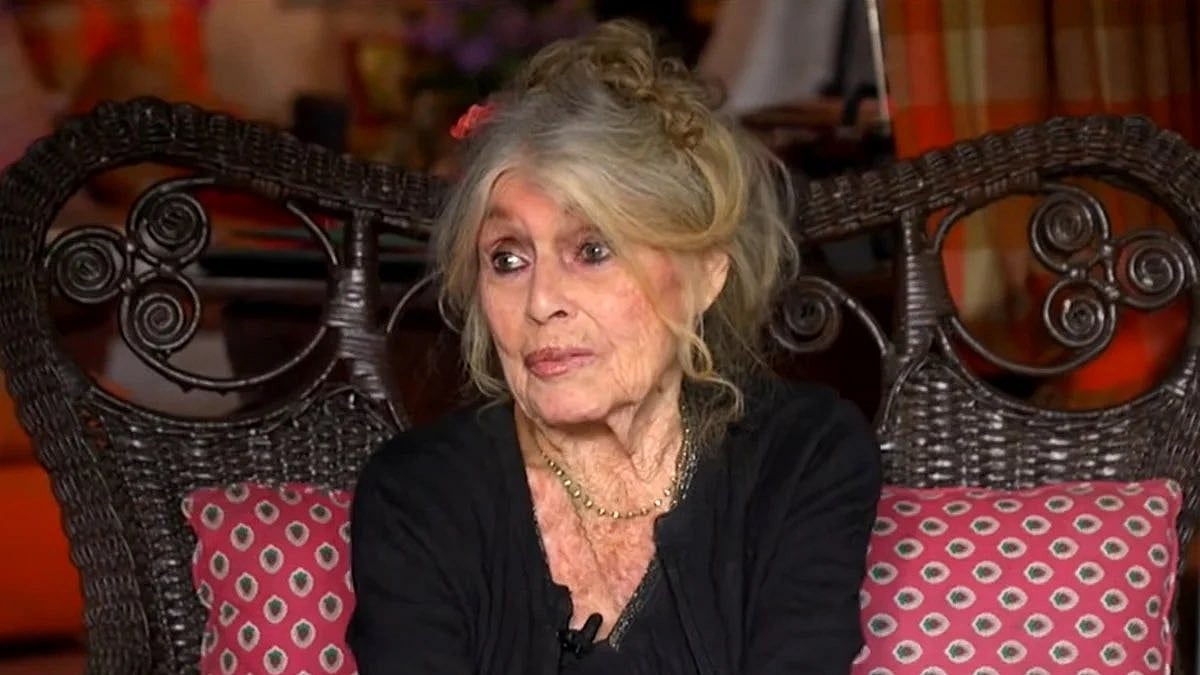
Mumbai: Brigitte Bardot, who redefined desire on screen and then renounced it all for animals, died on Sunday, aged 91. It was confirmed by a spokesman for the Foundation Brigitte Bardot, the nimal welfare organisation she founded. The cause of death wasn’t immediately known. Often referred to simply as “BB” in France, Bardot was more than a film star. She was a rupture.
When she danced barefoot to the mambo in "And God Created Woman" (1956), her tousled hair and unapologetic sensuality shattered the era’s carefully constructed image of feminine modesty. At just 21, she scandalised censors, captivated audiences and became an international phenomenon. A global icon was born, even as the film itself flopped in France before conquering the US. Born in Paris on September 28, 1934, into an upper-middle-class family, Bardot described herself as a shy, awkward child who “wore spectacles and had lank hair.”
By 15, she was on the cover of Elle, launching a modelling career that soon led to cinema. Her breakthrough role, directed by her then husband Roger Vadim, embodied a liberated femininity that would come to symbolise 1950s and 60s France. Her influence reached far beyond film. Bob Dylan reportedly wrote his first song about her, the never-released Song for Brigitte. Andy Warhol painted her portrait. Simone de Beauvoir, in a 1959 Esquire essay, praised her “dazzling virtue — genuineness,” writing, “BB does not try to scandalise. She follows her inclinations.”
Bardot’s unapologetic appetite and refusal to conform made her a touchstone for shifting social attitudes, even as Beauvoir later called her feminist challenge a “noble failure.” At the peak of her fame, nearly every aspect of Bardot’s look and style was widely imitated, from her intentionally tousled hair and dramatic eye makeup to her wardrobe of snug knit tops, slim trousers, gingham fabrics and ruffled skirts that highlighted her bare, sunkissed legs. What set Bardot apart from other screen sirens of her era was not just her lush youthfulness, but also the bold, unashamed sensuality that defined her on-screen persona.

Yet fame, Bardot often said, was a prison. “Nobody can imagine how horrific it was,” she reflected decades later. “I couldn’t go on living like that.” Her life was marked by four marriages, high-profile affairs and deep unhappiness. She survived multiple suicide attempts and spoke openly about depression. “I have been very happy, very rich, very beautiful… and very unhappy,” she told Paris Match. Alongside acting, Bardot enjoyed a successful music career, including provocative collaborations with Serge Gainsbourg such as Je t’aime… moi non plus. She worked with directors like Jean-Luc Godard, Louis Malle and Henri-Georges Clouzot, later saying La Vérité (1960) was the only good film she ever made.
In 1973, after 42 films, she quit cinema at 39, calling the industry “rotten.” Her last movie appearance was a supporting role in The Edifying and Joyous Story of Colinot, a 1973 comedy about a young man’s numerous romantic encounters. She withdrew to Saint-Tropez, a town she had inadvertently turned into a glamorous resort, and devoted herself to animals. “This is my only battle,” she said. In 1986, she founded the Brigitte Bardot Foundation, auctioning her jewellery to fund campaigns against whaling, bullfighting, vivisection and animal cruelty. “I gave my beauty and my youth to men,” she declared.
“I am going to give my wisdom and experience to animals.” Her later years, however, were marred by controversy. Bardot’s outspoken views on immigration, Islam and homosexuality led to multiple convictions for inciting racial hatred and aligned her with France’s far right. She dismissed feminism, denounced #MeToo and remained defiantly unrepentant. “With me, life is made up only of the best and the worst,” she once said. “Everything that happened to me was excessive.”
