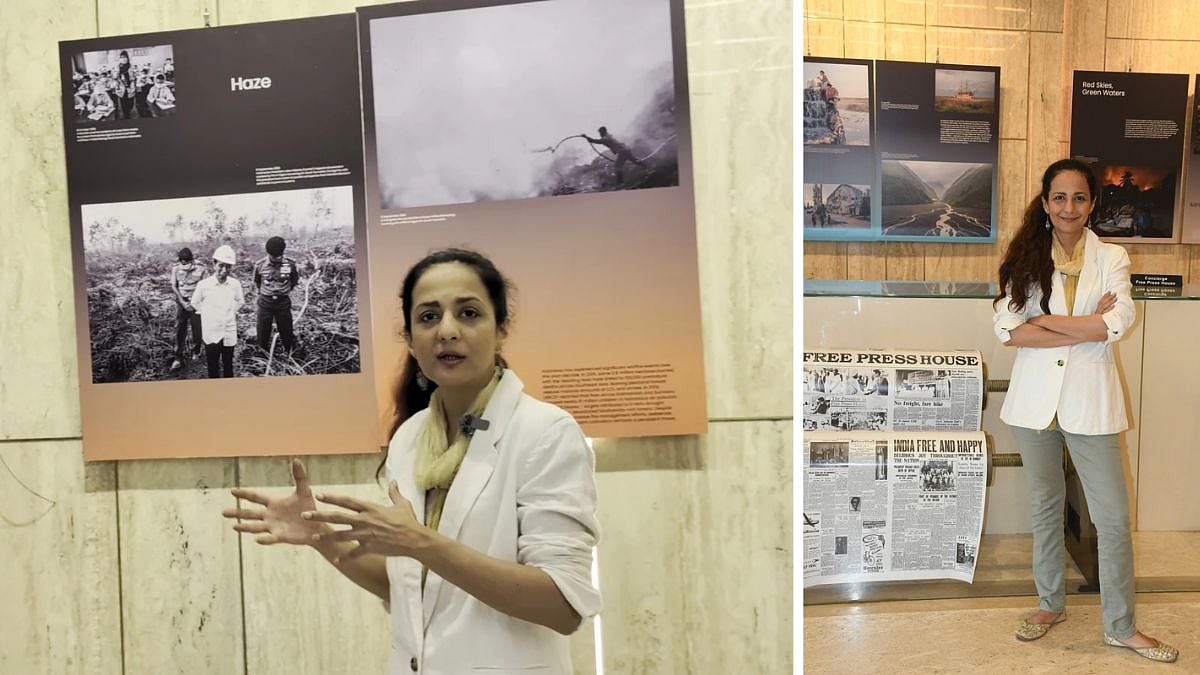
Actress Pooja Ruparel, best known for playing Chutki in the iconic Bollywood film Dilwale Dulhania Le Jayenge (DDLJ), visited the World Press Photo Exhibition at The Free Press House for a special walkthrough of its latest showcase, ‘Down to Earth: Climate Change, Climate Futures’.
Presented by World Press Photo in partnership with the Consulate General of the Kingdom of the Netherlands and Mumbai Press Club along with FPJ, the exhibition features 21 award-winning photographic projects documenting the devastating impact of climate change, environmental destruction and the collective efforts towards building a sustainable future.
During her visit, Pooja explored the photographs documenting environmental crises across different parts of the world, including the Philippines, Australia and Germany, among several other regions. She closely observed the stories behind the frames and reflected on how climate change has emerged as a global crisis that transcends geographical boundaries.
Speaking about her experience, the actress highlighted how the photographs serve as powerful visual narratives of the people and communities witnessing the consequences of environmental destruction. Sharing her thoughts on the exhibition, Pooja said, “It’s wonderful to see that in this world where every morning we wake up and we feel like nobody understands and why don’t they care? How do we make them care? There are these brave hearts all over the world that do care. And their work speaks volumes about how much they care. And through each picture here, I mean, we’re on Instagram all day long, so we know the value of a good picture. And oh my God, these are like an essay. It’s really a photo essay. And it’s been a very fulfilling experience to watch all the photos.”
The actress added, “We discussed at many points how we felt that so many of these photos could have been India. You know, like if you just hit the name, like they all felt like India. And so I think this issue or rather this crisis of the climate and of global warming that we have caused has brought the entire globe together because for the first time, irrespective of everything else, everyone needs to save their home, their health, their lives and their loved ones. So it does feel like war time. But the war is from the elements and the aggression is the disrespect that we are showing the five elements that we are all made out of. So we’re only made out of five elements and we have to keep them clean. There’s absolutely no getting away from that. And the sooner we make our peace with it, the sooner we don’t have to see such tragic visuals. But that was an entire section for solutions. And I feel that people need to go out of their ways to promote the work of ingenious people who are constantly asking themselves the question, how can I make it better? Because we all can make it better in our own way.”
Emphasising that climate action does not necessarily require celebrity influence or large-scale movements, Pooja stressed that individuals can bring about meaningful change through small, everyday decisions. She urged people to use their influence within their own communities and encourage sustainable practices. She said, “So right now, we are all influencers in our spheres. The people around you may not know me, but they know you. So, to bring about change, even simple steps like segregating and composting waste or avoiding harmful chemicals and plastics can make a difference. Each one of these actions supports local economies, artisans and traditional crafts, while also benefiting our health. We are not powerless; we all have the ability to influence change. Sometimes, all it takes is for one person to take the first step and inspire others to follow.”
Level up your brain the fun way. Play daily games and quizzes on FPJ Smart!

