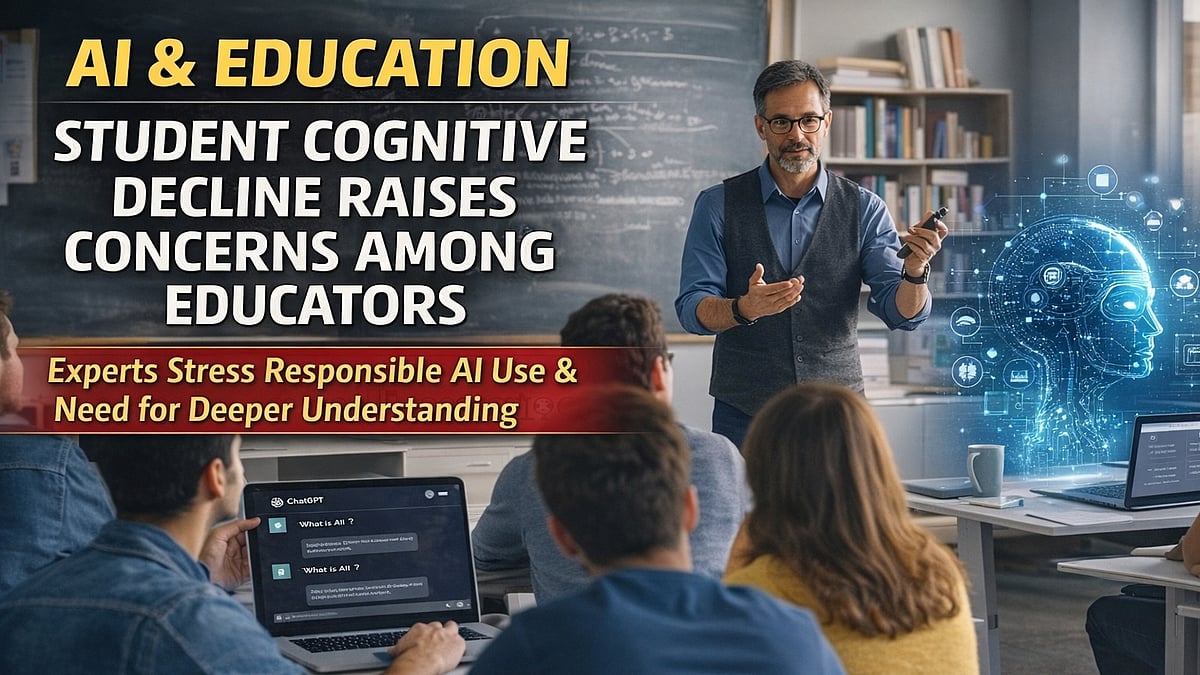
One of the biggest challenges before educators in current times is the decline of cognitive ability among students with the rise of AI. But the biggest difficulty is the deceptive nature of the problem; answers are all correct, assignments have improved in content, and the presentations are much more elegant than ever before. But the moment we as educators interact with the students and try to assess depth of their understanding, there appears to be problems and they falter. The deeper we go, more we find their lack of understanding. And that tells the whole story of decline of cognitive ability.
Problem Statement:
Not that the problem did not exist earlier. It did in the earlier era of newly invented world of internet and Google search as well. The only difference during that time and the current world of AI is in the “nature” and “scope” of availability of easy solutions. In Google search era, the primary information search was limited to “what” of content. The world of AI has created readymade solutions of “how” and “why” aspects as well. And if a technology platform can answer to all three aspects of cognitive traits namely, “what”, “how” and “why”, very little remains to be done at the said space. Then AI can answer all questions, and a student can, through AI, get easy answers and solutions for all issues / problem points, possibly at all learning levels of Bloom’s Taxonomy. This development has, in recent times, created the biggest worry for educators.

While in this democratic world the students cannot be denied the right to use AI, how to ensure that cognitive ability is kept intact, and students learn the concepts and applications thereof so that they become “employable” as well as “good thinking individuals” is the big challenge before the educators.
Coping Strategies:
The challenges created by advent of AI are difficult in nature and there are no easy solutions. The instructors must learn how to navigate through the AI world, be a part of it, allow the students to be with it but still be the facilitators of “real learning”. This indeed is a tough task.
Some of the coping strategies that are being experimented by the faculty include the following:

Devise an Acceptable AI Policy:
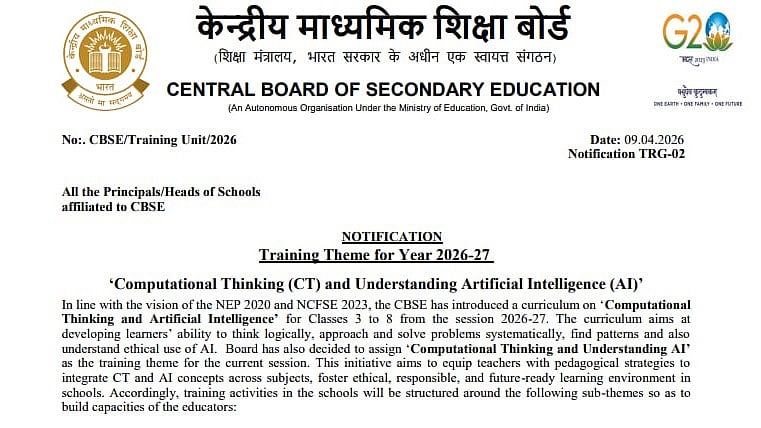
The institute may have its own AI Policy. Otherwise, one approach could be to devise an AI policy democratically in consultation with the students themselves at the beginning of the term. This may include the allowable scope and nature of AI (green, orange and red zones) for the purpose of assignments/project reports, etc. The important point that should be highlighted in the policy is that the students can use AI tools as a “supporting guide” but not “copy and paste” in toto therefrom. The policy should also say that the content provided by AI must be tested for its validity and that the students must understand fully the submitted assignment/report. Acceptance and abiding the AI policy is possibly the best way at least for college students.
Teaching the Students Where AI Can Fail:
It is always prudent that the students should know where AI can falter and therefore know the risks of using it blindly. Therefore, it is always suggested that maybe at the beginning of the term, the teacher can take / arrange session on the possible misrepresentation / misinterpretation of facts / data by AI.
Spend More Time on Discussions:
The pedagogic approach needs to undergo a change fundamentally. The more we as instructors discuss with the students an issue / theory: the pros & cons thereof, its history, rationale, context, fallouts, applications, etc., the more we can make the learning interesting and involve students in the thinking process. Immersive interactions & debates are one way of stimulating the cognitive abilities of students. Flipped classrooms are best suited for such type of environment. To start with, it might appear difficult as students may not be ready for these types of pedagogical approach; however, over a period, it may be found to be useful. Project based learning (PBL) or experiential based learning (EBL) can also suit the scenario.
Use AI to Tackle AI:
Using AI to solve the problems of AI is one popular approach. One of the methods experimented today in some places is that different modes of prompt are given to generate different answers to the same problem. And then these different solutions / answers become the topic for discussion to find the “real truth” or the “theoretical framework”. In some cases, the instructors are generating the reports / cases by deliberately giving “wrong prompts” and bringing these cases for discussion to find out whether the students can identify the errors. These are some indicative means; what it implies is that we as teachers should learn to take the “help of AI” to “beat the AI”.

Alternative Ways of Assessment:
The end-term summative assessments may not be impacted by AI. What the educators should be looking at carefully as to how to assess the assignments / project reports submitted by the students. Analytical / in-depth interviews and “layered questions” can bring out immediately whether the students have understood the concepts or not. And therefore, more marks should be given to “oral interviews” based on assignments rather than the “quality of presentation” which can be AI generated.
Moving Forward:
Whatever one may do as instructor, we should remember that the world of AI has come to stay. The challenge is how we as teachers integrate the same in our process of learning so that students use AI judiciously as well as learn the concepts / applications. We must ensure that students do not give away their “thinking ability” to AI and become “blind users”. The AI arena has just arrived; all of us are in the learning phase. We will become wiser as we go along.

