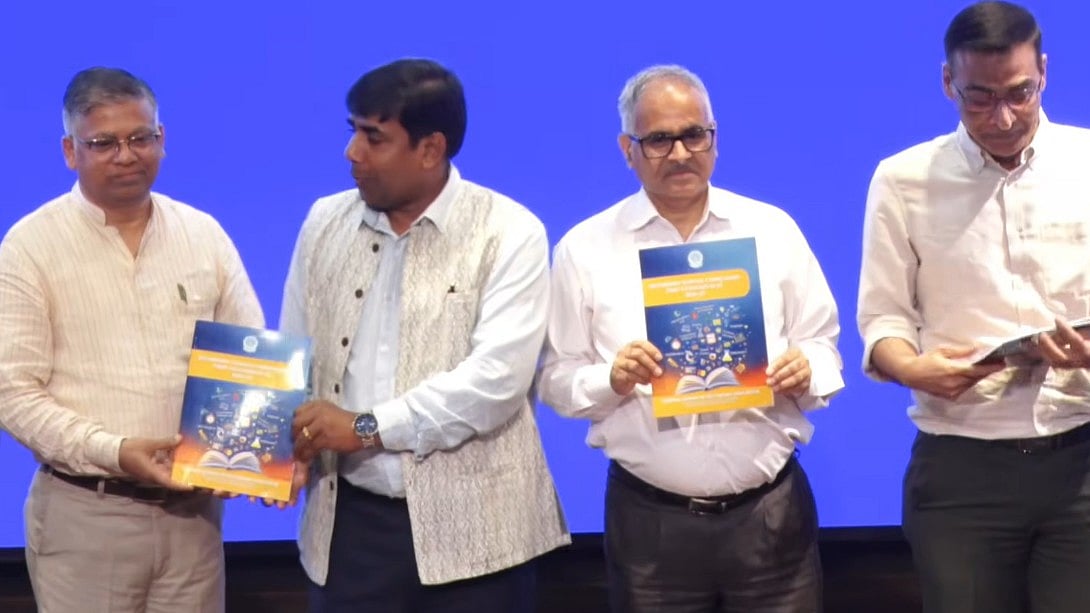
New Delhi: The Central Board of Secondary Education (CBSE) has introduced a revised syllabus for Class 9 and Class 10 for the academic session 2026-27, which is based on the National Education Policy (NEP) 2020 and National Curriculum Framework for School Education (NCFSE) 2023. The board shared details of the changes during a recent webinar attended by CBSE Chairman Rahul Singh and NCERT Director Prof. Dinesh Saklani.
Addressing concerns around textbooks, Prof. Saklani said that most Class 9 books are currently in the printing stage and are expected to be available between April 10 and April 15. He added that while a few titles may see slight delays, efforts are being made to ensure timely supply to schools.
He also highlighted a shift in the way textbooks are being developed. "Earlier, a single author would prepare a book. Now, nearly 4,000 experts are involved in the process, which naturally takes more time but ensures broader perspectives,” he said. According to him, some of the newly designed language textbooks draw inspiration from music, linking learning with culture.
The Director of NCERT also spoke about the importance of the concept of multilingual learning. He said, "Under the NEP 2020, the students will study three languages, out of which at least two will be mother tongues or regional languages." He also said that there was a need to change the mindset while introducing the new curriculum. He said, "The curriculum has to reflect the needs of today and the knowledge traditions of India."
Secondary Curriculum: Part - 1 (Class IX)
Secondary Curriculum: Part - 1 (Class X)
Secondary Curriculum: Part - 2 (XI-XII)
Key Highlights of CBSE New Syllabus 2026-27
• New syllabus introduced for Classes 9 and 10
• Aligned with the National Education Policy 2020 and National Curriculum Framework 2023
• Textbooks for Class 9 likely to be ready between April 10-15
• Developed with the contribution of around 4,000 contributors
• Emphasis laid on the importance of multilingual education with two local languages included
• Incorporation of culture-related learning with music-based books for language education included
• Emphasis laid on the importance of conceptual understanding with holistic education included
The new syllabus will enable the students to move beyond the realm of rote learning and adopt a more flexible approach towards education. The board advised the schools to be aware of the changes in the syllabus well in time before the beginning of the new academic session.

