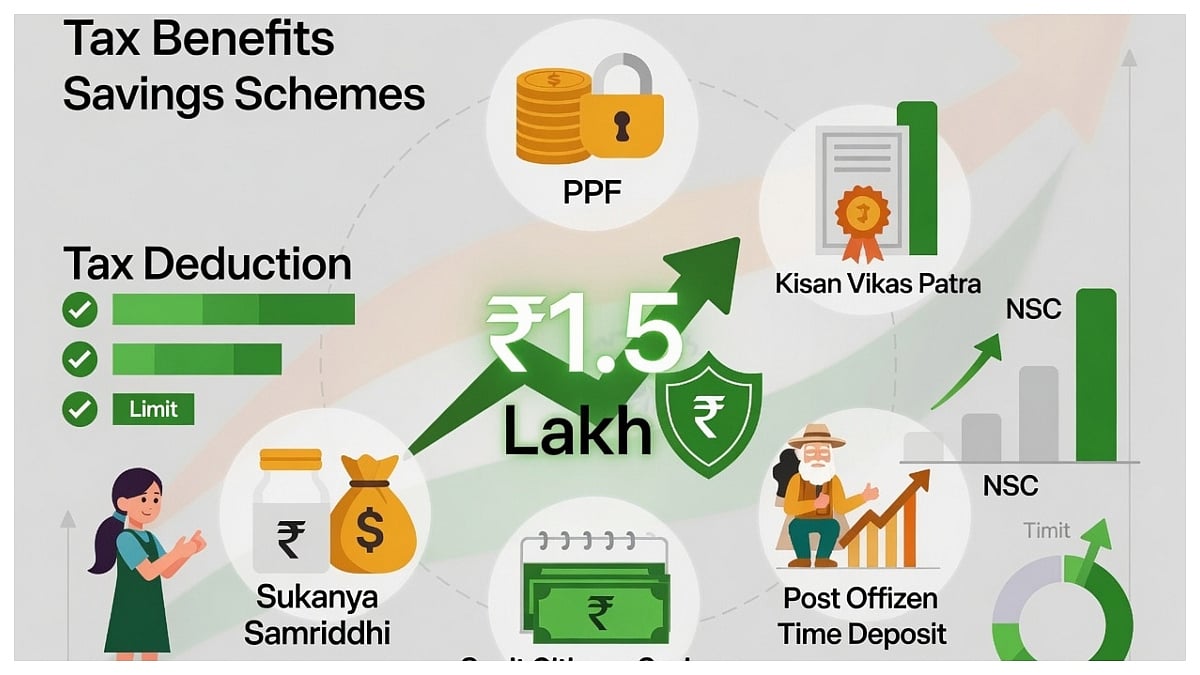
New Delhi: Government-backed small savings schemes remain a popular investment option for many Indians because they offer safe returns, fixed interest and sovereign guarantee.
These schemes are considered low-risk and are widely used for long-term savings. However, not every small savings scheme offers tax benefits under the Income Tax Act.
Before investing, it is important to understand which schemes qualify for tax deduction and which do not.
Schemes Eligible for Tax Benefits
Investments in the following schemes qualify for tax deduction under Section 80C of the Income Tax Act:
- Public Provident Fund (PPF)
- Sukanya Samriddhi Yojana (SSY)
- National Savings Certificate (NSC)
- Senior Citizens Savings Scheme (SCSS)
- 5-Year Post Office Fixed Deposit
Investors can include these investments while calculating tax deductions.
Schemes Without Tax Benefits
The following small savings schemes do not qualify for tax deduction under Section 80C:
- Kisan Vikas Patra (KVP)
- Post Office Monthly Income Scheme (MIS)
- 1-Year, 2-Year and 3-Year Post Office Fixed Deposits
Post Office Recurring Deposit (RD)
These schemes still offer attractive interest rates and government-backed safety, but the invested amount cannot be claimed for tax deduction.
Section 80C Limit
Under Section 80C, taxpayers can claim a deduction of up to Rs 1.5 lakh from their taxable income.
This deduction reduces taxable income, not the final tax amount directly.
Experts note that this tax benefit is available only under the old tax regime. Taxpayers choosing the new tax regime cannot claim this deduction.

Current Interest Rates
Some of the key interest rates on small savings schemes are:
SSY: 8.2 percent
PPF: 7.1 percent
NSC: 7.7 percent
KVP: 7.5 percent
SCSS: 8.2 percent
Post Office MIS: 7.4 percent
Savings Account: 4.0 percent
1-Year FD: 6.9 percent
2-Year FD: 7.0 percent
3-Year FD: 7.1 percent
5-Year FD: 7.5 percent
5-Year RD: 6.7 percent
Investors should compare tax benefits, lock-in period and returns before choosing the right scheme.

