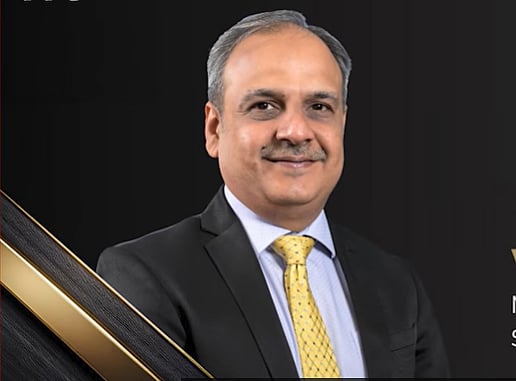
In an exclusive conversation with Sheryll D’Souza, Business Editor–Consulting at The Free Press Journal, Vikas Satija, Managing Director and Chief Executive Officer of Shriram Wealth Ltd, explains how market-linked debentures can help investors balance wealth maximisation with capital protection. He also discusses the importance of disciplined asset allocation, regular portfolio rebalancing and long-term investing amid market volatility, while highlighting key investment risks and the growing relevance of professionally managed family offices in India. Edited excerpts follow.
Shriram Wealth entered the market about a year ago. What distinguishes it from established wealth managers?
India’s wealth management industry is expanding rapidly and could grow at a compounded annual rate of 20–22% over the next two decades. Shriram Wealth brings together Shriram Group’s 51-year legacy and Sanlam’s 107-year history.
Our objective is to offer solutions instead of pushing products. We follow an open-architecture model covering five pillars: wealth creation, lending, protection, global investments and legacy planning. Few players bring all these services together under one umbrella.
What exactly is a market-linked debenture?
A market-linked debenture, or MLD, is a debt instrument whose return is linked to an underlying market asset rather than a predetermined interest rate. The underlying asset could be an equity index, an individual stocks, gold, commodity or any other asset class.
Index-linked, stock-linked and gold-linked structures are among the most common. If an investor chooses an MLD linked to the Nifty 50, the return will depend on the index’s performance and the terms specified in the structure.
Can an MLD protect an investor’s capital while offering market participation?
Capital-protected structures are widely available, although not every MLD provides such protection. Consider a simplified example involving an investment of ₹100. Around ₹80 may be placed in a debt instrument designed to grow to ₹100 by maturity, while the remaining ₹20 may be used to gain exposure to the underlying derivatives.
This structure can protect the principal at maturity while providing market upside. However, such participation may be capped.
How should investors respond to geopolitical uncertainty and sharp market fluctuations?
The starting point must be asset allocation. Investors should determine what proportion of their investable surpluses must be allocated in equities, debt, gold, real estate and other asset classes according to their risk profile.
Short-term developments can produce volatility, but investors with long term horizon should avoid reacting impulsively. India’s long-term growth story remains strong. Investors need patience, appropriate diversification and periodic portfolio rebalancing.

Is asset allocation different for every investor?
Absolutely. It depends on risk appetite, investment horizon and financial goals. Money required for retirement cannot be managed in the same manner as funds earmarked for a short-term need or a child’s education.
Markets move through cycles. Investors lost money during the early 2000s, then again in 2008 financial crisis and then in the Covid-19 shock, but strong rallies followed. Trying to time every rise and fall can be counterproductive. A disciplined, long-term approach is more dependable.
How frequently should portfolios be rebalanced?
The core allocation should remain aligned with the investor’s risk profile and goals. Tactical changes can be made as market conditions evolve, but these may generally involve adjustments of about 10-15% rather than a complete portfolio overhaul.

For example, an investor who went overweight on gold in recent times may reduce exposure, while someone underweight on large-cap equities may increase it. Rebalancing prevents one asset class from dominating the portfolio after a sharp rally or fall in the markets.
Can MLDs help investors worried about missing a market rally?
They can be useful for moderate or growth-oriented investors who want market exposure but also seek to limit downside. An investor bullish on mid-cap equities, but concerned about volatility, could consider a capital-protected MLD linked to a mid-cap index.
The investor may not receive the market’s entire upside, but the structure can provide participation while protecting capital at maturity, subject to its terms and the issuer’s ability to repay.
What must investors examine before buying an MLD?
Three factors are essential. First, examine the issuer, its credit rating and financial strength because the investor carries the issuer’s credit risk. Second, understand why the money is being raised and how it will be used by the issuer.
Third, match the product’s tenure with the investment horizon. MLDs may have limited liquidity, and exiting before maturity could produce an unfavourable return. Investors should therefore understand the payoff formula, caps, conditions and risks before committing funds.
Are MLDs suitable only for wealthy investors?
The minimum investment threshold has been reduced from ₹10 lakh to ₹1 lakh, making these products accessible to a broader group. However, greater accessibility does not make them simple products.
Changes in taxation have removed their earlier tax advantage, but taxation alone should not determine an investment decision. Depending on the structure, an MLD can occupy the space between conventional fixed-income instruments and equity exposure.
Why are family offices becoming more prominent in India?
Considerable wealth has been created in India over the past two decades. Large business families increasingly require professional management, succession planning and governance.
Some establish their own family offices and appoint wealth managers as advisers. Others ask an institution to create and manage the entire structure. The objective is not merely to generate returns, but to preserve wealth, understand family goals and transfer the legacy efficiently across generations.

