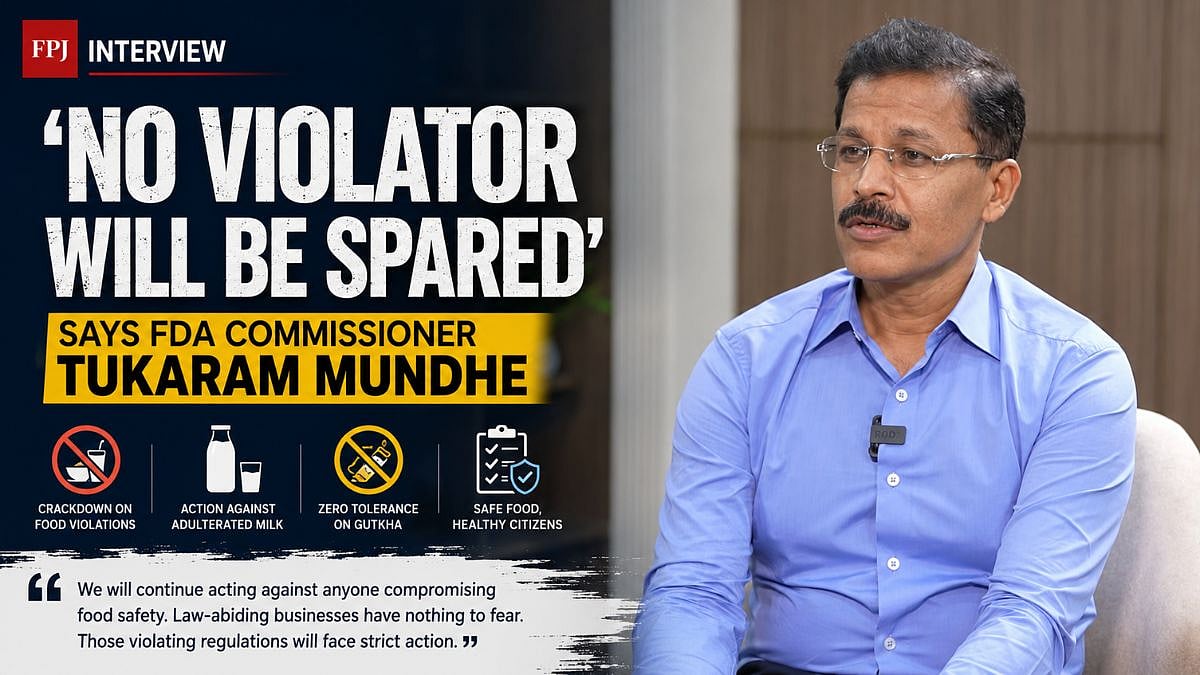
Mumbai, July 30, 2026: Tukaram Mundhe (51), one of the most dynamic IAS officers in Maharashtra, has triggered a major crackdown on food safety violations since taking charge as the Commissioner of the state Food and Drug Administration (FDA) two months ago.
The entire food industry is in fear of raids by FDA officials. Prominent restaurants, bakeries, dairies, etc. have had their food licences suspended. The raids have exposed alarming levels of hygiene in many of the targeted premises.
On Thursday, Tukaram Mundhe spoke exclusively to S. Balakrishnan, Executive Editor, and Amit Srivastava, Senior Correspondent of The Free Press Journal, in his modest office at the FDA building in Bandra (East). Excerpts:
Q: You have earned a reputation for taking on powerful vested interests wherever you are posted. What inspires you to take such tough decisions?
A: I don't think lawful action requires inspiration or courage. As a public servant, I am expected to act in accordance with the law and in the public interest. We represent the authority of the State, and our duty is to uphold that authority fairly and ethically.
Courage comes from within. It is about consistently doing the right thing, both personally and professionally. My guiding principle is to ensure justice for people, empower citizens and remain ethical in every decision. If that requires tough action, I take it without hesitation.
Q: Critics allege that your department suspends licences of restaurants, etc. without issuing show-cause notices and without giving them enough time to rectify deficiencies. Please comment.
A: That criticism is unfounded. The Food Safety and Standards Authority of India (FSSAI) Act clearly distinguishes between unsafe, adulterated, substandard and misbranded food. When food is found to be unsafe, the law empowers us to immediately suspend the licence because consuming such food could endanger public health. In less serious cases, we issue improvement notices. It is not that in every case we suspend licences immediately. Of the over 600 hotels and restaurants inspected so far in the state, the licences of only about 60 have been suspended, while 150 have been served with improvement notices. The majority were found to be compliant. Action is always proportionate to the nature and severity of the violation.
Q: In the last two months, you have cracked down on adulterated milk, gutkha and food establishments. What impact have these actions had?
A: Maharashtra has over 12 lakh licensed or registered food business operators. We prioritised high-risk sectors such as hotels, eateries, milk and dairy products because they directly affect public health. Our enforcement has had a strong deterrent effect. Inspections have increased compliance across sectors. The availability of synthetic and substandard milk has reduced, though the problem has not been completely eliminated. We will continue acting against anyone compromising food safety. Law-abiding businesses have nothing to fear. Those violating regulations will face strict action.
Q: Why is dismantling the gutkha racket so challenging?
A: Gutkha was banned in Maharashtra in 2012 and its manufacture in the state is limited, but it is illegally produced outside the state and smuggled in. The supply chain has become more sophisticated. Earlier, consignments arrived in trucks; now they are transported through cars, jeeps and even buses, with stock often stored in residential premises. We are invoking the Maharashtra Control of Organised Crime Act (MCOCA) against organised networks and targeting everyone involved—from manufacturers to distributors and retailers. Our objective is to eliminate the trade in gutkha.
Q: Why has the government restricted the sale of HFSS (high fat, sugar and salt) foods only around schools instead of imposing a complete ban?
A: India is a democracy, and adults are free to make their own dietary choices. The restrictions are aimed at protecting children, who may not fully understand the health risks associated with HFSS foods. The ban within school premises and a 50-metre radius is intended to create a healthier environment for children. Implementation requires cooperation from schools and parents.
Q: The FDA has often cited a shortage of Food Safety Officers. How are you managing?
A: Our approach is to make the best possible use of existing manpower. At the same time, we are preparing proposals to strengthen staffing because the number of licences has increased significantly. The government is supportive, and we expect additional manpower in due course.
Q: Consumers complain that many restaurants, especially reputed fast-food chains, repeatedly reuse cooking oil. What is being done about that?
A: Reusing cooking oil beyond the prescribed Total Polar Compounds (TPC) limit is prohibited. Oil with a TPC value above 25 cannot be reused and must be disposed of through authorised recyclers for conversion into biofuel. We have already taken action against establishments violating these norms, including licence suspensions. A focused enforcement drive on used cooking oil compliance will be launched soon. The rules apply equally to roadside eateries and five-star hotels.
Q: Ever since you took charge, the FDA has focussed more on food-related issues. How about acting against fake medicines, misleading advertisements and illegal online drug sales?
A: We are paying attention to drugs as well. We have taken action against misbranded medicines, misleading advertisements, pharmacies, hospitals violating regulations, blood centres, medical devices and AYUSH products. We are also aggressively recalling Not of Standard Quality (NSQ) drugs from the market and regularly publishing details about recalled medicines. These actions may receive less media attention than food enforcement, but they continue with equal seriousness.
Q: Street food vendors and food outlets at railway stations often operate under poor hygienic conditions. Will the FDA target them too?
A: No food business operator violating the law will be spared. However, we have to prioritise inspections because of manpower constraints. We have introduced the online grievance portal complaints.mahafda.in where citizens can file complaints and track action in real time. Around 1,600 complaints have already been received through the portal. Citizen participation is essential for improving food safety.
Also Watch:
Q: You are often called the 'Singham of Maharashtra.' How do you react to that?
A: I don't consider myself a 'Singham'. I am simply the FDA Commissioner entrusted with a responsibility under the law.
Our work has only begun. Protecting public health is a long-term mission that requires not only enforcement but also public awareness and participation. Citizens must become more conscious about what they eat, read food labels carefully and make informed choices. While the FDA will continue enforcing the law, food safety is ultimately a shared responsibility.
To get details on exclusive and budget-friendly property deals in Mumbai & surrounding regions, do visit: https://budgetproperties.in/

