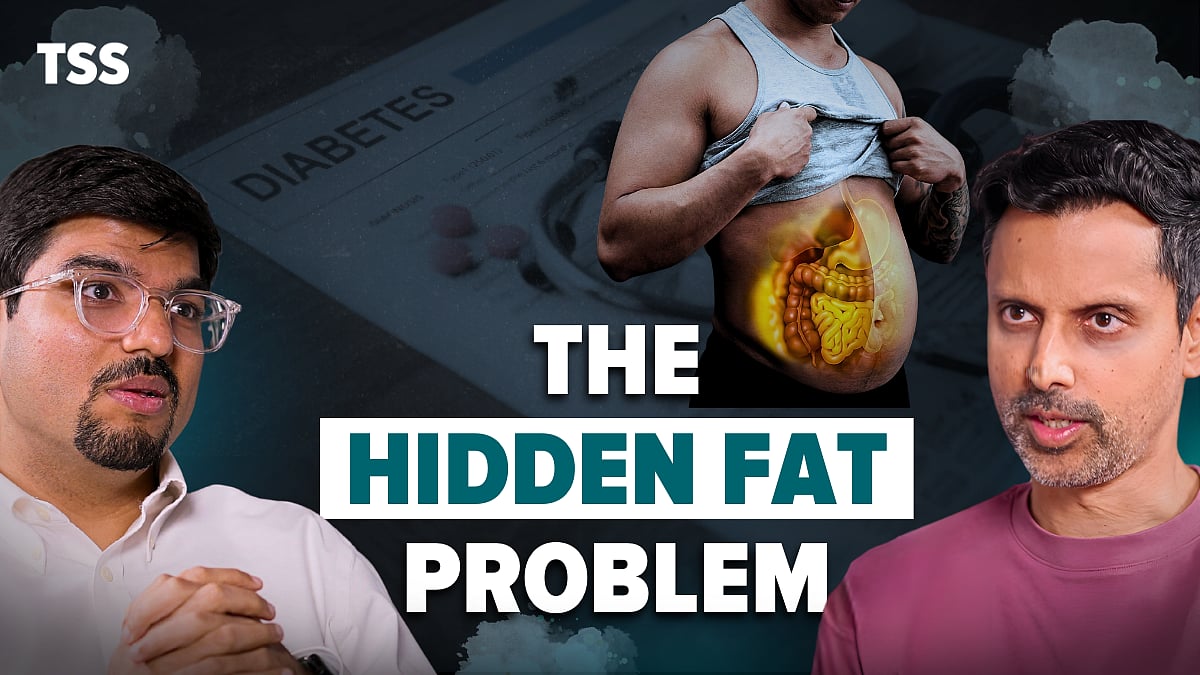
In cities across India, office workers who look “fit enough”, walk 8,000 steps, and pass their annual health check on paper believe they are safe. Yet India now carries one of the heaviest diabetes burdens in the world, with an estimated 77 million people living with diabetes in 2019, projected to rise to over 134 million by 2045 if current trends continue. (PMC)
A growing body of national data suggests that the crisis is no longer about visibly overweight bodies alone. It is about metabolic risk hiding under normal-weight frames, especially in urban, stressed, sleep-deprived professionals. On The Secret Sauce Podcast hosted by Oscar- nominated filmmaker Mukul Deora, leading diabetologist Dr. Rushin Mehta breaks down the core problem: “You may look fit and exercise regularly, but you have no idea about your visceral fat percentage. That’s what is making people pre-diabetic and diabetic.”
The ‘Thin-Fat’ Indian Phenotype
For decades, the body mass index (BMI) has been treated as the parameter for health. In the conversation, the doctor recalls how a study comparing runners with desk-bound professionals disrupted this assumption. Despite having similar BMIs, Asian participants carried a “huge excess of visceral fat index” compared to their Western counterparts. The term “thin-fat Asian” and in popular clinic talk, the “thin-fat Indian” emerged from that paradox.
Visceral fat is packed around organs like the liver and pancreas. It does not sit visibly under the skin, but it drives insulin resistance, cholesterol problems and cardiovascular risk. Dr. Rushin now urges every patient to look past weight and BMI and check their visceral fat percentage and ask: where is my visceral fat accumulated internally?
The recent ICMR-INDIAB-23 study, a nationally representative survey, reported that 43.3% of Indian adults are “metabolically obese, non-obese” (MONO); people who may not look
overweight but show metabolic abnormalities. An IJMR research states that only 26.6% of adults fall into the “metabolically healthy, non-obese” category as stated by the.In other words, more than seven in ten Indian adults are metabolically unhealthy in some way, even if many of them look slim. This is the structural reality to the “thin-fat Indian” that doctors now meet every day in their consulting rooms.
When Lifestyle Outruns Metabolism
The conversation links this hidden fat to everyday urban behaviour. It is not only what Indians eat, but how and when they eat, sleep and work.
One strand is speed. Dr. Rushin Mehta describes how eating very quickly “dumping” a large quantity of food into the stomach in a few minutes forces insulin to work far harder than it was designed to. Satiety signals do not get time to trigger, so people overshoot their needs. Over time, the hormone is overused and the body begins to resist it.
Sleep and work hours form the second strand. When people stay awake late into the night, the body’s repair window shrinks. Organs that should be resting continue to demand energy. Fat stores dissolve to supply sugar, but as the doctor explains through a banking metaphor the “loan” has to be repaid with interest later, in the form of excess fat returning to the liver, setting the stage for fatty liver and steadily rising insulin resistance.
Recent ICMR-INDIAB data shows that abdominal obesity affects nearly 40% of Indian adults, even in regions where overall obesity is far lower. Research consistently identifies central fat and not BMI as one of the strongest predictors of type 2 diabetes in Indian populations. The outcome is a troubling convergence: fast eating, late nights, chronic stress and unmeasured central fat. Many Indians who consider themselves “reasonably active” and “not very overweight” are quietly drifting into prediabetes.
The New Markers of Risk
The podcast emphasises further on that early diabetes is not silent if people know what to look for. The first signals are small and easy to normalise.
One early warning is post-meal cravings for something sweet, not just as a small mental reward but as an uncomfortable urgency: a feeling that if one does not eat sugar immediately, the body will feel unwell. This often comes with a post-lunch slump, a strong desire to nap, and the need for repeated “pick-me-ups” in the form of coffee with sugar, sweets, or desserts. A second visual clue is dark, velvety patches around the neck or under the eyes, often dismissed as tanning or general “dark circles”. Medically, this is Acanthosis Igricans, and in the doctor’s words it is a visible sign that the body is becoming insulin resistant, “the main crux of the pre- diabetic phase.”
Crucially, these signs can appear in people who do not eat obvious junk food every day. Many patients insist they eat “only home food”. What is often missing is an understanding of proportion: very high carbohydrate plates with minimal protein, repeated across the day, can trigger the same insulin spikes as obvious sweets. In India, in a ten year follow up study that was conducted by the dept. of endocrinology in PGI found that one in five initially non-diabetic adults developed diabetes over 10 years, with central obesity emerging as the strongest modifiable risk factor. A rise of just 1.6 cm in waist circumference tripled diabetes risk.
Rethinking Prevention for Urban India
Prevention, in this framing, is not about a single number such as fasting blood sugar or BMI. It is about re-designing your lifestyle so that insulin does not have to “overwork” for years.
In this conversation, Dr. Mehta prioritised four anchors. First, reducing chronic stress to avoid constant cortisol spikes that push the insulin-liver system into an emergency mode. Second, sleeping at the right time in sync with the body’s circadian rhythm, rather than simply counting hours. Third, being mindful around food, eating more slowly, without screens, and shifting the plate towards more protein and fewer refined carbohydrates. And fourth, adding at least a regular, brisk walk several times a week, so that muscles can use the glucose that insulin is trying to deliver. These are modest interventions, but they aim at the weakness of the “thin-fat” pattern: a life that looks normal from the outside, yet keeps the body in a permanent state of metabolic overdrive.
Studies have now confirmed that only about a quarter of Indian adults are both normal-weight and metabolically healthy. The rest occupy various combinations of visible and invisible obesity, often without realising it. The message is direct and clear: Looking slim, having a normal BMI or a decent lipid profile is no longer enough. India’s next health standard will have to move beyond appearance. It will require citizens, employers and healthcare systems to treat visceral fat, sleep, stress and eating speed as seriously as they once treated the weighing scale.

