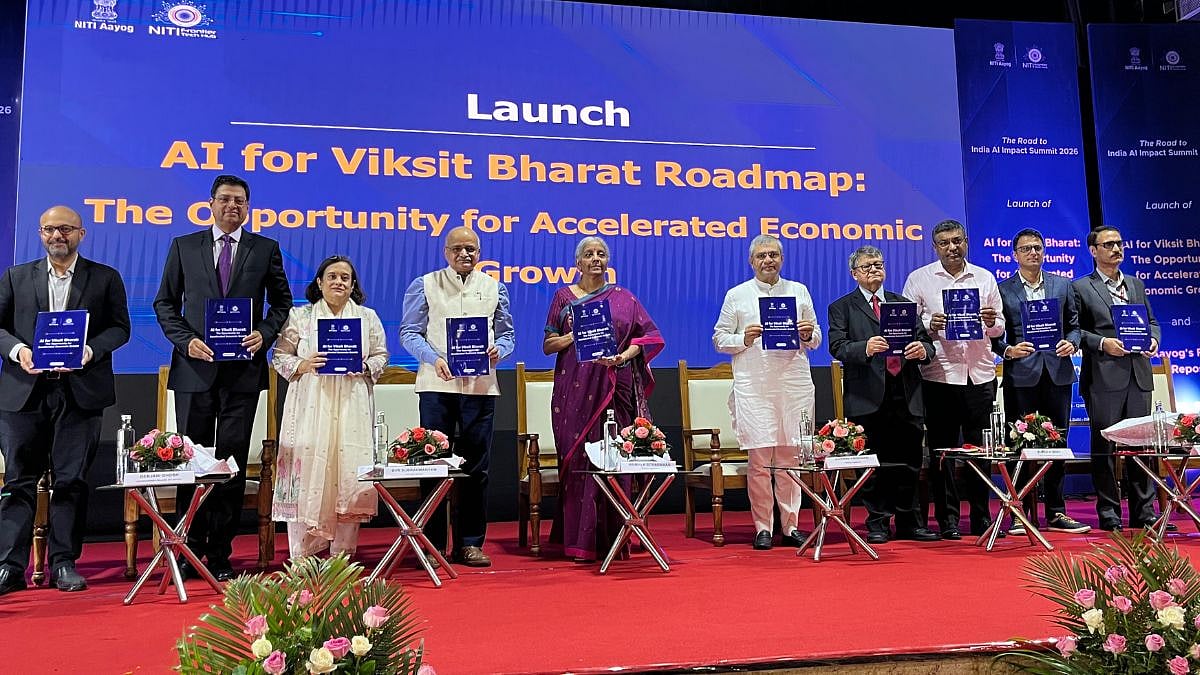
New Delhi, Sep 15: Accelerated adoption of Artificial Intelligence (AI) across industries can contribute USD 500-600 billion to India’s GDP by 2035 on the back of increased productivity and efficiency in the workforce, a NITI Aayog report said on Monday.
Global AI Impact Estimated at USD 17-26 Trillion
The report titled 'AI for Viksit Bharat: The Opportunity for Accelerated Economic Growth' further said that over the next decade, the adoption of AI across sectors is expected to add USD 17-26 trillion to the global economy.
India Positioned to Capture 10-15% of Global AI Value
"India’s combination of a large STEM workforce, expanding R&D ecosystem, and growing digital and technology capabilities position the country to participate in this transformation, with the potential to capture 10-15 per cent of global AI value," it said.
Job Creation and Displacement Expected
According to the Aayog, projections show that while AI will create many new roles, it will also displace many existing jobs, particularly in clerical, routine, and low-skill segments.
"Accelerated adoption of AI across industries can contribute USD 500 billion -USD 600 billion over and above India’s current GDP growth by 2035, driven by increased productivity and efficiency in the workforce," the report said.
Financial Services and Manufacturing to Gain the Most
It said the analysis shows that financial services and manufacturing can be most impacted and might have up to 20-25 per cent of their sectoral GDP attributed to AI by 2035.
USD 50-55 Billion Boost in Financial Services
AI-led productivity and efficiency improvement could unlock USD 50-55 billion in financial services, over and above the current estimated growth for the sector by 2035.
AI to Strengthen Compliance and Risk Management
"AI could power automated compliance, fraud detection, and risk management through advanced anomaly detection techniques and privacy-preserving analytics such as secure multi-party computation and federated learning," the report said.
AI to Reshape Lending and Credit Decisioning
According to the report, AI-enabled systems can reshape credit decisioning, collections, and portfolio management. By leveraging alternative data sources, banks can make more accurate, dynamic, and inclusive lending decisions
30-35% Gap Can Be Bridged Through AI Adoption
The report noted that potential AI opportunities for India presently include accelerating AI adoption across industries to improve productivity and efficiency, potentially bridging 30-35 per cent of the gap. "These effects are expected to materialize across both domestic consumption and export markets," it said.
Innovation in Tech Services to Enhance Competitiveness
The report also observed that innovation in technology services, strengthening India’s reputation as a technology services leader, contributing another 15-20 per cent to the step up could drive the development of higher-value solutions and new business models, enhancing India’s competitiveness in the global market.
In manufacturing, the report said USD 85-100 billion could be driven by AI-led productivity and efficiency improvement over and above India’s current growth by 2035.
GDP Could Reach USD 8.3 Trillion by 2035
At its current growth rate of 5.7 per cent, India’s GDP is projected to reach USD 6.6 trillion by 2035.
However, the report said under the aspirational 8 per cent growth trajectory outlined in the government’s vision for the nation known as Viksit Bharat, India’s GDP could increase to USD 8.3 trillion, representing an incremental USD 1.7 trillion compared with the current growth path.
Sitharaman Calls for Balanced AI Regulation
Releasing the report, Finance Minister Nirmala Sitharaman emphasised the need for regulations that foster technology innovations for the common good, particularly in artificial intelligence (AI), but not stifle them
"We do not want regulations that literally wipe out technology itself. We want regulations because we want a responsible application," she said after releasing the report prepared by Niti Aayog here.
Sandboxes provide a testing ground for regulatory mechanisms, enabling a balanced approach that fosters innovation while ensuring necessary oversight, she said, adding that this helps prevent over-regulation that could kill the technology itself.
"India is a country which can understand the implication of a good which comes in our way, although a good is never unmitigated, a good is never without riders, a good is never on its own good; it is for us all to use it in such a way that it is for the common good.
"I think AI is something which we should know how to keep well under our reins and serve for the common good," she said. Observing that Artificial Intelligence (AI) is not static, the finance minister said it is rapidly progressing, real-time and dynamic.
AI as a Decisive Lever for Viksit Bharat
NITI Aayog CEO BVR Subrahmanyam in his foreword said, "If India is to accelerate its growth to the 8 per cent annual rate required for the realization of Viksit Bharat, we have no option but to significantly raise productivity across the economy and unlock new growth through innovation. Artificial Intelligence can be the decisive lever."
AI in Banking and Manufacturing to Drive Transformation
Subrahmanyam said with a focused and sector-specific approach, industries such as banking and manufacturing can deploy Al today to improve efficiency, service quality, and competitiveness creating momentum for deeper transformation.
Also Watch:

Nurturing Frontier AI Innovation Key to Growth
"At the same time, India must nurture frontier innovation, from Al-enabled drug discovery to software-defined vehicles, building the next engines of growth. The path to 8 per cent growth runs through decisive AI adoption and innovation, he added.
(Disclaimer: Except for the headline, this article has not been edited by FPJ's editorial team and is auto-generated from an agency feed.)

