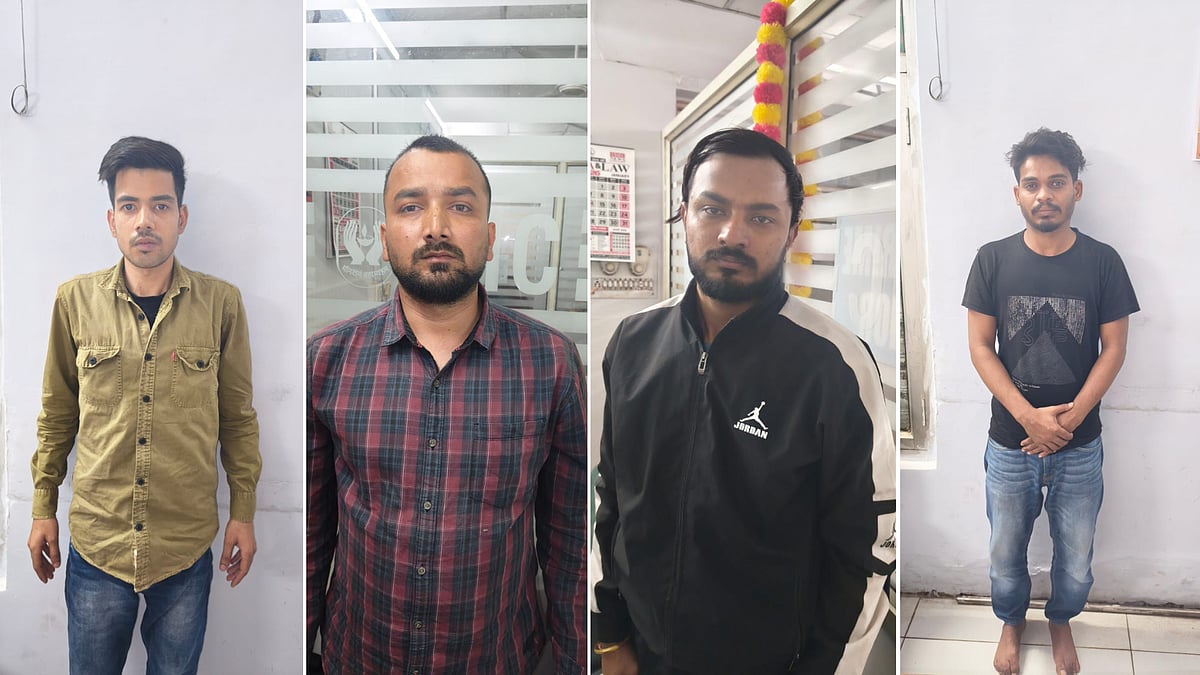
Gwalior (Madhya Pradesh): The Crime Branch of Gwalior Police has arrested four people from Delhi in connection with a cyber fraud case involving ₹2.52 crore.
The victim is a retired radiologist from the Indian Air Force who was allegedly duped by scammers posing as CBI officers.
According to police, the accused kept the retired doctor under so-called “digital arrest” for 27 days.
He was continuously monitored over video calls and was instructed not to contact anyone. During this period, the fraudsters convinced him to transfer ₹2.52 crore.
Money routed through multiple accounts
Investigations revealed that the amount was first transferred to five different bank accounts located in Delhi, Noida, Varanasi and Guntur (Andhra Pradesh).
Around ₹1.5 crore was transferred to two accounts in Andhra Pradesh.
Nearly ₹1 crore went to three accounts in Delhi and Uttar Pradesh.
After the first layer of transfers, the money was further distributed to more than 300 bank accounts across 15 states, including Delhi, Uttar Pradesh, Andhra Pradesh, Rajasthan, Chhattisgarh, Odisha, Jharkhand, Bihar, Assam and Karnataka.
Fake firm used for transactions
During scrutiny of the accounts, police found large transactions in a current account registered under a Delhi-based firm named “Jingga Crunch and Snacks.”
The Crime Branch team traced the firm and detained two men, Mohit Mishra and Shahil Khan, from their shops in Delhi. During questioning, they said the firm had been opened on the instructions of Rahul Prajapati and Harish Yadav.
Police said the firm was created only to open a current account for transactions. The account remained active for about a month after bank verification and was later closed. The two men allegedly received ₹2.5 lakh as commission for allowing the use of their firm.
Mule account agents arrested
Based on the information, police also arrested Rahul Prajapati and Harish Yadav, who are believed to be agents involved in opening mule accounts for cyber fraud operations.
Crime Branch officials said all four accused have been brought to Gwalior and are being questioned further.
Police described the case as a major breakthrough in a “digital arrest” scam, where fraudsters impersonate central agencies to extort money through fear and intimidation. Further investigation is underway to trace other members of the network.


