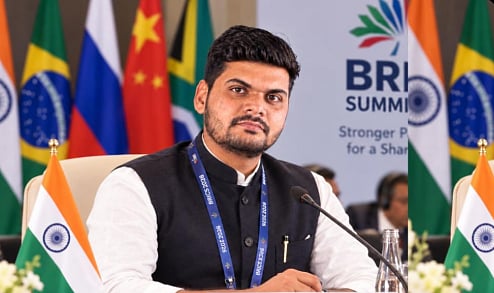
Abhishek Panwar from Madhya Pradesh was invited as a special Guest Speaker at the IDD ORG International COP31 Summit’26, organised virtually by IDD ORG recently. The two-day international summit brought together young people from around the world to discuss issues shaping the future of global climate action.
Conducted entirely in English through Zoom, the summit featured discussions on a wide range of climate and sustainability themes, including the transition to clean energy, climate finance, the circular economy, zero waste, and sustainable agriculture and food systems. Panwar delivered a one-hour special session on the topic “Action for Climate Empowerment: Bridging COP31 Commitments with Grassroots Climate Action”, with more than 300 participants and youth delegates taking part.
Panwar presented his perspectives through a detailed PowerPoint presentation and emphasised that addressing climate change cannot be limited to technology, finance and government policies alone. He highlighted the importance of strengthening climate education, public awareness, training, public participation, access to information and international cooperation. He stressed the need to take global climate commitments beyond international forums and connect them with schools, universities, cities, villages and local communities. Referring to the development of Action for Climate Empowerment (ACE) in the context of Article 6 of the UNFCCC and Article 12 of the Paris Agreement, he explained that global climate decisions can become meaningful only when citizens, young people and local communities are empowered to participate actively in their implementation.
In his presentation, Panwar elaborated on the six key elements of ACE Climate Change Education, Public Awareness, Training, Public Participation, Public Access to Information and International Co-operation. Drawing on global and grassroots perspectives, he explained that young people should not be viewed merely as recipients of climate awareness, but as active contributors with opportunities for leadership, skills development and meaningful participation in decision-making processes. He presented COP31 as an opportunity to move from “Commitments to Empowerment and then to Implementation”, and discussed practical approaches such as youth-led local Climate Action Teams, community-based initiatives and locally driven climate solutions. His presentation particularly emphasised the importance of connecting international climate diplomacy with the realities and needs of communities on the ground.
The session was followed by an interactive Question and Answer session, during which participants from different parts of the world raised questions on climate change, youth participation, international climate conferences and the translation of global climate policies into grassroots action. Responding to the participants, Panwar underlined that young people can play an important role as a bridge between climate policy and grassroots implementation, rather than remaining only participants in international conferences.
Panwar has been actively engaged for more than a decade in the fields of the Sustainable Development Goals (SDGs), climate action, youth leadership and sustainable development. He represented India at COY18 in Dubai in 2023 and COY19 in Azerbaijan in 2024, and has also represented youth and civil society at the Second UN World Summit for Social Development. His central message at COP31 Summit’26 was that while climate decisions are made at the global level, meaningful climate action ultimately takes shape within communities and at the grassroots level.