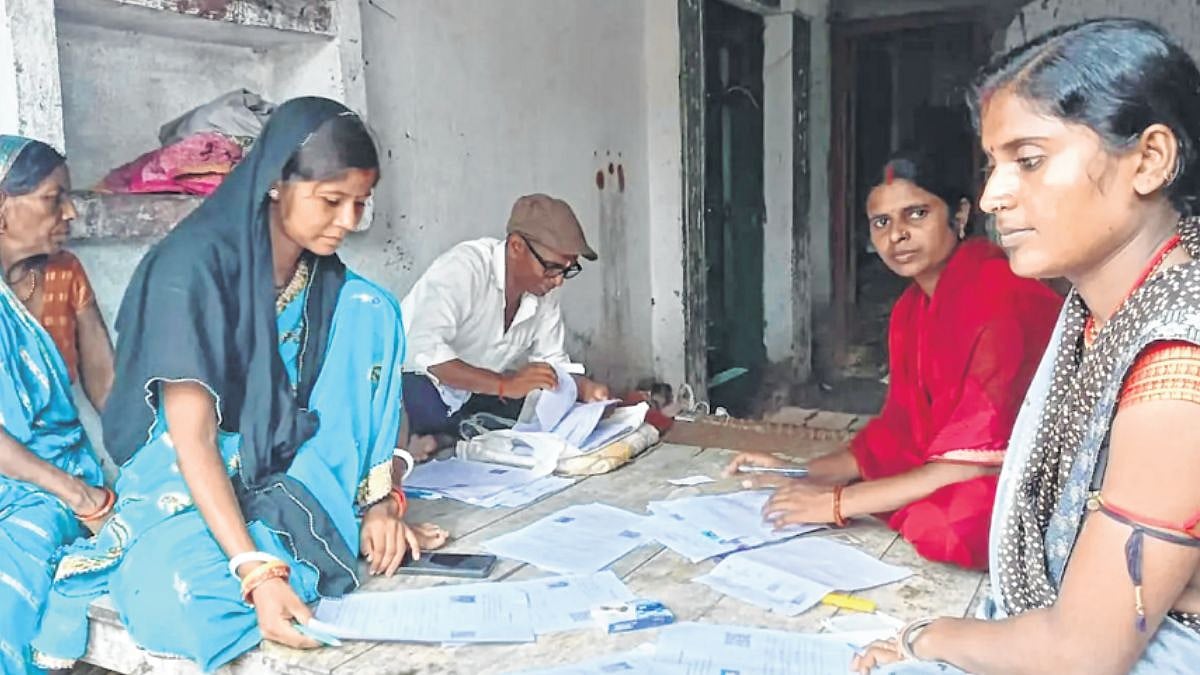
It begins before sunrise, in houses where alarm clocks ring not for ambition but for duty. A government schoolteacher ties her hair, an anganwadi worker folds yesterday’s saree, a clerk swallows a blood-pressure pill. By 7 am, they are no longer teachers, caregivers or clerks. They are Booth Level Officers — BLOs — the invisible spine of India’s electoral machinery.
They step out carrying files thicker than school textbooks and phones heavier with fear than apps. Before the first door is knocked, the pressure has already arrived through WhatsApp groups buzzing with reminders, warnings and deadlines. “Target pending.” “Upload today.” “Explain delay.”
By evening, some of them will collapse. By night, a few will not return.
So far, at least 33 BLOs across six states have died — from heart attacks, suicides, collapses on duty and accidents while rushing to meet impossible targets. The Special Intensive Revision (SIR) of electoral rolls, designed on paper to “purify” democracy, has on the ground begun to erase the very people tasked with implementing it.
The Election Commission’s language is sterile. Its handbook is not.
On page 56 of the 161-page manual titled Handbook for Booth Level Officers, a BLO is told how to process claims and objections — Form 6, Form 7, signatures, countersignatures and eligibility checks. The text is dense, legalistic and unforgiving. It assumes time, training, literacy, digital access and physical stamina. It assumes, above all, that the person reading it is not human enough to break.
This manual is just one among a mound of literature the BLO is expected not only to read but to imbibe daily — alongside WhatsApp instructions, video tutorials, app updates and oral orders that carry the weight of suspension, FIRs and career ruin.
For this, the BLO is paid roughly ₹12,000 a year. Incentives are added like afterthoughts. Phone bills, travel costs and internet data are often paid out of pocket. The math is cruel: democracy at ₹32 a day.
A day in the life of a BLO during SIR is a study in sanctioned exhaustion.
Morning is door-to-door verification — locked houses, hostile questions, suspicion sharpened by rumours of NRC-like deletions. “Why are you asking again?” “Why do I need documents?” “Are you removing my name?” BLOs return to the same house eight, nine, ten times. Lunch is skipped. Water is rationed.
Afternoons stretch into kilometres walked under winter sun or fog, carrying forms that must be filled precisely or rejected digitally later. Evenings are not rest; they are punishment. Forms must be digitised. Servers crash. Internet fails. Apps freeze. Work already done must be redone. Supervisors call hourly. Family life dissolves into background noise.
By midnight, BLOs are still uploading data, eyes burning, hearts racing, fingers trembling. Sleep comes in fragments — if at all.
And then morning comes again.
This cycle has begun to kill.
In Gujarat, a teacher named Arvind left behind a note that stripped democracy of its slogans: “I can’t do this SIR work anymore.” He died by suicide. In Vadodara, Ushaben collapsed and died on duty, despite her family warning officials about her health.
In West Bengal, Shantimoni Ekka was found hanging in her courtyard. Rinku Tarafdar, a para-teacher, followed. Five deaths in one state in days.
In Uttar Pradesh, Vipin Yadav consumed poison before breakfast and died by afternoon. In Fatehpur, 25-year-old Sudhir Kumar Kori killed himself a day before his wedding after being suspended for seeking leave to marry. In Tamil Nadu, Jahitha Begum died by suicide after failing to upload targets due to poor connectivity. Chitra, 59, survived a suicide attempt after being threatened with suspension.
In Moradabad, Sarvesh Kumar recorded a final video, weeping, apologising to his mother, asking his sister to raise his four daughters. “I want to live,” he said. “But the pressure is too much.”
This is no longer coincidence. It is a pattern.
A detailed complaint filed before the National Human Rights Commission has described the SIR as imposing “inhuman workload and coercive pressure” on BLOs, resulting in deaths and collapses across states. It warns of a “moment of deep constitutional danger” — not just because workers are dying, but because voter deletions are happening alongside their deaths, unchecked, unaudited and unexamined.
The irony is brutal. The people tasked with protecting the vote are themselves dispensable.
BLOs are not full-time election staff. They are teachers, anganwadi workers and clerks — pulled from already strained systems and told to carry democracy on their backs without support.
The pressure does not stop at work. It leaks into homes. BLOs report threats of suspension, salary cuts and FIRs for “dereliction of duty”. Some face political pressure. Others face public anger. Many work in their own villages, vulnerable to backlash without security or institutional cover. The fear travels both ways.
Citizens panic when names vanish from rolls. In West Bengal, a 63-year-old rickshaw puller threw himself onto railway tracks after failing to find his name in old voter lists, losing a limb. The terror BLOs carry on clipboards becomes terror in homes. Bureaucratic rigidity breeds human collapse on both sides of the door.
At the heart of the crisis is speed. What was once a months-long exercise has been compressed into weeks. The so-called “Bihar model” of SIR has been imposed across diverse states without regard for language barriers, digital gaps, terrain or manpower. The system assumes infinite resilience from workers who are anything but.
Opposition leaders have called it “imposed oppression”. Unions call it “institutional murder”. Families call it abandonment.
The Election Commission insists the process is necessary. Necessary for whom? Necessary at what cost?
Democracy does not survive on forms alone. It survives on trust, dignity and human labour. When the state turns deadlines into weapons and manuals into shackles, the process may continue — but legitimacy bleeds out quietly, one BLO at a time.
Thirty-three dead so far is not a statistic. It is an indictment.
Every night, somewhere in India, a BLO stares at a phone screen that refuses to upload, a form that refuses to validate, a deadline that refuses to move. Somewhere, a child waits for a parent who is still “on duty”. Somewhere, a manual lies open at page 56, dense and indifferent.
And somewhere, democracy is being updated — by people it is slowly killing. If elections are the festival of democracy, then these are its unlit pyres.
The author is News Editor, The Free Press Journal.

