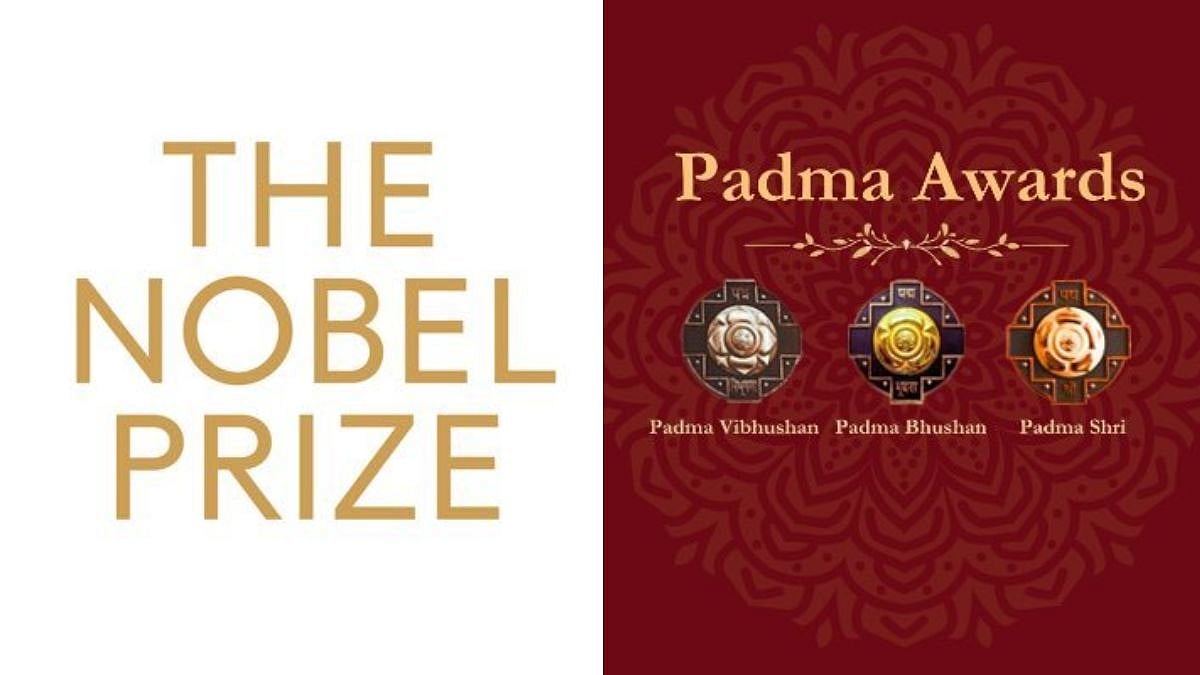
Irving Wallace, in his vastly infotaining novel, The Prize, points to, in passing at places, how the Nobel Prize, since its inception by Alfred Nobel, has created heartburn and resentment. The winners, or their families in the case of a posthumous award, resent that the recognition ought to have come during the lifetime of the one decorated now, and, in the case of a live award, it should have come much earlier. The Nobel awarded to single achievements also causes heartburn among scientists, who rightly aver that such awards give a short shrift to the continuing work done by other scientists in the field in the past. In science, it is always work-in-progress till one fine morning the one who consummates research to perfection often rushes to the patent office to be recognised as the original inventor. And in case of joint winners, each views the other as an impostor and usurper. Be that as it may.
In the Indian context, both the Bharat Ratna and the Republic Day eve Padma Awards have been controversial, with the critics condemning the politicisation of the awards. Pandit Nehru and his daughter, Indira Gandhi, have been accused of awarding Bharat Ratna to themselves, as it were. In this context, it would be useful to recall the self-abnegation by prominent independence movement leader and India's first minister of education, Maulana Abul Kalam Azad, who declined the Padma honour, arguing that those who were on selection committees for national honours should not themselves receive them. That, at the end of the day, he received a posthumous Bharat Ratna in 1992 is another matter. By the way, posthumous awards smack of doubletake. While the government did make amends by giving the Bharat Ratna to agriculture scientist Late MS Swaminathan, credited with ushering in the green revolution, it is yet to acknowledge the immense contribution made by the doodhwala to the nation, Verghese Kurien, who founded India’s only international brand, AMUL. It is ironical that the Father of the Nation, Mahatma Gandhi, is yet to get the Bharat Ratna, though the omission could be rationalised by saying the appellation ‘Father’ is the supreme honour, surpassing the Bharat Ratna.
If posthumous awards are condemned for their tardiness, the live awards are condemned for their blatant and unabashed favouritism in a manner of self-glorification. That the lion’s share of the Bharat Ratna and Padma awards go to politicians is another sore point with the cognoscenti. Going a step further, detractors condemn such awards as undermining the stellar role of the unsung heroes. After all, in a country of 145 crores, handpicking a few for the honours does indeed grave injustice to the quiet, low proletariat, and self-effacing achievers, especially given the proclivity of politicians to politicise the awards. To wit, the bulk of the Padma Awards go to persons belonging to the election-going states under both the Congress and the BJP regimes. It cannot be gainsaid that the awards are often accused of being used to cultivate vote banks or reward political figures, rather than focusing solely on national service. Critics often highlight that awards are skewed towards specific regions or politically important states, particularly around election times, as pointed out earlier. Lack of transparency in the selection process lends credence and adds fuel to the fire. Numerous recipients in the past have returned their awards, arguing that the honours are used by the government to create a sycophantic, pro-establishment culture and sometimes to placate political rivals in the manner of playing good cop, bad cop.
The awards have faced legal challenges, with opponents arguing they violate Article 18 of the Indian Constitution, which prohibits the state from conferring titles (though the Supreme Court ruled they are not "titles" but honours). This interpretation of the apex court appears to many as quibbling or legal hairsplitting.
Be that as it may, against the backdrop of negativity and cynicism, often there is a clamour for ending the awards themselves, which many label as amounting to throwing the baby out with the bathwater. What perhaps can be done is to invite nominations for the honours, emulating the Nobel Prize dispensation. For the annual Nobel awards given on December 10th, nominations have to be made by Ivy League institutes, among others, by February 10th so that the various committees get plenty of time to ponder. Of course, in a country marked by caste, linguistics, and regional divides, the solution may seem to be worse than the disease, but then there is no harm in giving it a try, provided the government comes out with the explanation for awarding or declining to award the nominees. The overarching criteria should be strictly "excellence plus". Publishing clearer guidelines on what constitutes "exceptional work" in different fields could help nominators craft better and more focused submissions. The nomination approach may not appeal to the ruling political class, as it may clip its wings, especially when it comes to posthumous awards and electionisation, as it were, of the awards.
It is acknowledged on all hands that Artificial Intelligence (AI) has been a boon to both questioning minds and charlatans. By and large, answers supplied by AI have been crisper, pointed, and well-researched in a jiffy. AI can be employed to vet the nominations. The AI output has to be fact-checked; otherwise, one may have to face the embarrassment of a lawyer in the USA, whose citation in his pleadings was found to be the figment of AI’s imagination.
At the end of the day, one must remember that while most of the Nobel and Padma awardees are deserving ones, the angst is that the more deserving ones, the unsung, low-profile, and self-effacing heroes, should not be left out. That is why canvassing or lobbying through nominations comes out smelling more of roses than decisions made by the government behind the ornate doors. Cacophony is better than the silence of the graveyard. Canvassing for projects and prizes goes beyond electoral democracy; it is the beginning of direct democracy.
S Murlidharan is a freelance columnist and writes on economics, business, legal and taxation issues.

