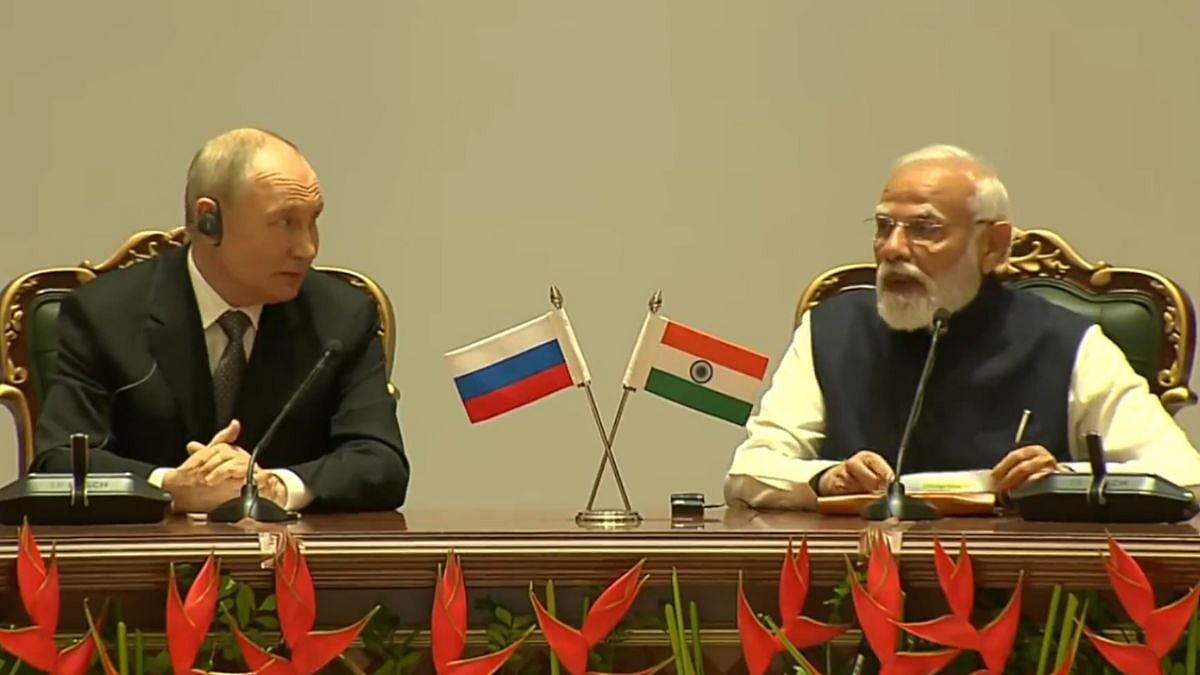
As if a long-trusted comrade had returned at the height of a storm, Vladimir Putin’s arrival in New Delhi — while the Ukraine conflict rages on and Donald Trump intensifies his push for a cease-fire pact — has unfolded as a moment layered with history and deep geopolitical messaging. The visit evoked echoes of the 1971 Indo-Soviet pact that stood as India’s armour in an unpredictable world, yet the aftermath of this summit has carried the relationship beyond sentiment and firmly into the realm of strategic futurism.
With today’s culmination of negotiations, a bouquet of landmark agreements has not only underlined New Delhi’s unwavering commitment to nurture its most time-tested partnership but has also demonstrated Moscow’s willingness to turbocharge India’s Atmanirbhar drive across defence, nuclear power, outer space and high-technology. The sterling combat performance of the S-400 during Operation Sindoor has decisively influenced the strategic thinking on both sides, strengthening belief that the Indo-Russia axis is now primed to deliver tangible power advantages rather than merely honour its legacy — a transition from an emotional alliance to an era of self-confident, capability-driven collaboration.
India-Russia friendship has remained steadfast like a pole star, and the 23rd Annual Summit in New Delhi reaffirmed that the light from this partnership is not dimming, but intensifying with a fresh economic cooperation roadmap till 2030. In a world where strategic loyalties shift like desert sands, the images from Palam Airport told a different story — Prime Minister Narendra Modi breaking protocol to embrace President Vladimir Putin, sharing a car ride to the PM’s residence, and presenting him with a copy of the Bhagwad Gita. Symbolism evolved into substance as the two leaders unveiled a long-term programme to turbocharge bilateral trade, diversify investments and rewrite the grammar of global power equations.
The Economic Drive That Redraws Trade Geography
The centrepiece of the summit was the launch of an Economic Cooperation Programme designed to expand and stabilise bilateral trade until 2030. The two sides backed it with concrete agreements across energy, logistics, food safety, health, mobility, maritime operations and industrial production. Russia assured uninterrupted fuel shipments to meet India’s growing energy needs, while Indian companies finalised a flagship agreement with URALCHEM to build a urea plant in Russia — a deal that will secure fertiliser supply and reduce price volatility. Cooperation between India’s food safety authority and Russia’s consumer protection body, new migration and mobility protocols, maritime logistics collaboration and medical science partnerships add breadth to what is no longer a single-sector engagement. The goal is clear: build a trade architecture resilient to sanctions, political coercion and global turbulence. With both nations pushing for early completion of the Free Trade Agreement with the Eurasian Economic Union and increasing settlements in national currencies, New Delhi and Moscow are quietly constructing an alternative system of commercial exchange beyond the traditional Western-centric grid.
Energy Security and Strategic Depth: The Heart of the Partnership
Defence and energy remain the spine of the relationship. Modi emphasised that decades-long civil nuclear collaboration now aligns with critical mineral supply chains essential for clean energy, semiconductors and high-technology industries. Russia, for its part, signalled readiness to work with India on small modular nuclear reactors and floating nuclear power plants, potentially marking the next frontier of energy cooperation. Both leaders underscored India’s expanded role in Arctic operations, where training of Indian seafarers for polar waters will not only boost employment but also strengthen India’s presence in a region crucial to future maritime trade routes. The push to scale bilateral trade to $100 billion and explore sovereign currency mechanisms reflects not just ambition but strategic insulation.
A Message to Washington: Strategic Autonomy Has Muscle
The summit delivered an unmistakable message to the United States: India will not be intimidated into reducing engagement with Russia. At a time when Washington’s tariff pressures, sanctions warnings and strategic signalling under Donald Trump have sharpened, New Delhi has reinforced that its foreign policy is not designed in the shadow of American domestic politics. India’s ties with both major powers are strong enough to withstand turbulence, yet the balancing act has evolved — not managing two partnerships but managing risks to each. The Delhi summit projects strategic autonomy as an operational doctrine. India will maintain defence, energy and technology links with Russia even as it expands maritime and supply-chain collaboration with the United States. New Delhi’s message is not confrontational but undeniable: partnerships will be chosen, not imposed.
How Trump May View the New Delhi Summit
Washington’s reaction will focus on three questions — whether India institutionalised long-term oil import arrangements with Russia; whether joint work on air-defence systems and advanced sensors weakens CAATSA-based leverage; and whether the summit gives diplomatic visibility to Russia during wartime. Even though India-U.S. strategic convergence will not derail, the trust gap widens as India refuses to play a subsidiary role in U.S. grand strategy. For New Delhi, national interest is supreme, not alignment theatrics.
The Global Ripple: Multipolarity Becomes Reality, Not Rhetoric
The Putin–Modi engagement accelerates structural global change. It strengthens collective resistance to coercive economic tools, legitimises alternative energy-settlement systems, and revives the Russia-India axis within the expanding Eurasian forum of BRICS+ and the SCO. Most importantly, it signals that the Global South will negotiate its own future — not inherit blocs from established powers. In a world shaped by sanctions, tariffs and wars, rising nations are building strategic autonomy as a shield.
China and Pakistan Face Strategic Recalibration
Beijing and Islamabad will read the summit with unease. China views a stronger India-Russia alignment as a dilution of Moscow’s dependence on Beijing, while Pakistan recognises that deeper energy and defence cooperation between India and Russia limits China’s ability to leverage the Russia-Pakistan vector. India’s strengthening Arctic role, nuclear partnership and security autonomy signal that New Delhi is not ceding strategic space to the Sino-Pak axis.
Benefits to India
New Delhi consolidates five major gains: long-term fuel security insulated from geopolitical disruption; assured fertiliser supplies via the urea manufacturing plant; deeper defence and nuclear cooperation including next-generation technologies; access to diversified logistics routes and the Arctic corridor; and leverage in global affairs by reinforcing multipolar diplomacy rather than bloc-based dependence.
Benefits to Russia
Moscow secures critical advantages during a period of global isolation: a massive and stable energy market; a reliable technology and defence partner that reduces vulnerability to sanctions; investment inflows and industrial collaborations that soften war-time economic strain; logistical and supply-chain routes independent of Europe; and geopolitical legitimacy beyond China’s orbit. India provides Russia a strategic breathing space at a moment of historic pressure.
The New Strategic Grammar of Indian Foreign Policy
The Delhi summit was not romantic nostalgia for Soviet-era solidarity. It was a calibrated projection of power by a nation unwilling to mortgage its global choices. For Russia, India remains one of the last great bridges to the world. For India, Russia remains indispensable to defence depth, energy affordability and strategic diversification. And for the global order, the summit will be remembered less for hugs and protocol-breaking warmth and more for a strategic signal that echoes beyond New Delhi — India bends to no axis. The pole star still shines, but it now illuminates a multipolar world where rising powers chart their own destiny.
(Writer is a strategic affairs columnist and senior political analyst based in Shimla.)

